
An ADU grant program is a source of financial assistance that helps California homeowners cover the early, out-of-pocket costs of building an accessory dwelling unit (ADU) — a self-contained secondary home on a residential lot, sometimes called a granny flat or backyard home. For example, the state-backed CalHFA program has reimbursed qualifying homeowners up to $40,000 for design, permitting, and other pre-construction expenses. However, funding availability shifts frequently from year to year, so understanding exactly how these programs work — and what’s changing heading into 2026 — is essential before you start planning your project.
Quick Answer: An ADU grant program reimburses eligible homeowners for pre-development costs — like design, engineering, and permitting — when building a granny flat or backyard home. Most programs do not fund full construction, so grants are typically layered with a loan, home equity line, or personal savings to complete the build.
What Is the ADU Grant Program?
The ADU grant program refers to a category of state and local funding initiatives designed to lower the financial barrier of adding a secondary unit to a residential property. Specifically, California’s most well-known version, administered through CalHFA (the California Housing Finance Agency), has reimbursed homeowners for costs such as architectural drawings, impact fees, and soil testing. In addition, several local jurisdictions, housing trust funds, and nonprofit housing organizations offer smaller, region-specific ADU grants with similar goals.
Because these programs rely on limited public funds, enrollment periods open and close based on budget cycles. As a result, homeowners who wait too long to check availability sometimes miss the application window entirely — which is exactly why this guide covers not just what the grant is, but when and how to move quickly once funding opens.

Reviewing eligibility documents is one of the first steps in the ADU grant program application process.
How the ADU Grant Program Works in California for 2026
Most ADU grant programs function as reimbursement mechanisms rather than upfront cash payments. In other words, homeowners typically pay for pre-development work first, then submit receipts to a participating lender for repayment once the funds are approved. Consequently, applicants need enough initial capital or a bridge loan to cover early costs while waiting for reimbursement and learn about financing an ADU.
Furthermore, these grants are usually layered on top of other financing tools. For instance, a homeowner might combine grant reimbursement with a home equity line of credit or a dedicated construction loan to cover the full project. According to the CalHFA ADU program page, funding has been distributed on a first-come, first-served basis whenever the program is active, which underscores the importance of early preparation and monitoring.
Who Qualifies for ADU Grant Funding?
Eligibility generally hinges on household income limits set relative to the area median income (AMI), along with proof that the property is an owner-occupied primary residence. Similarly, some programs require that the ADU be used for long-term housing rather than short-term rentals. Above all, applicants must be prepared to document income, ownership, and intended use of the unit before funds are released.
- Household income at or below the program’s published AMI threshold
- Ownership and occupancy of the primary residence where the ADU will be built
- Intent to use the unit for long-term housing, not vacation or short-term rental
- Ability to front pre-development costs and submit itemized invoices for reimbursement
- Use of licensed professionals for design, engineering, and permitting work
2026 ADU Grant Program Updates: What’s New This Year
Heading into 2026, homeowners should expect the same core structure — reimbursement-based funding tied to state budget cycles — but with renewed attention from state lawmakers on expanding accessory dwelling unit production statewide. In particular, California’s continued housing shortage has kept ADU policy a legislative priority, and the California HCD website remains the authoritative source for tracking whether new funding rounds have opened.
Consequently, homeowners planning a 2026 build should not assume the CalHFA ADU grant program is permanently closed or permanently open. Instead, treat availability as a moving target that requires periodic checking, ideally every few weeks during the planning phase. In contrast to years when funding sat untouched for months, recent cycles have shown grants can be claimed within weeks of reopening, so speed matters once a window appears.
ADU Grant Programs by County: Orange, Los Angeles & Riverside
Beyond the statewide CalHFA option, several Southern California counties and cities maintain their own accessory dwelling unit incentives. Specifically, availability, amounts, and eligibility rules vary significantly by jurisdiction, so it pays to check both state and local sources.
| Region | Typical Focus | Administering Body | 2026 Status |
|---|---|---|---|
| Statewide (CalHFA) | Pre-development reimbursement, up to $40,000 | CalHFA | Cycles open/close with budget allocations |
| Orange County | Local fee waivers and expedited permitting incentives | City housing departments | Varies by city; check municipal planning office |
| Los Angeles County | Affordable ADU incentive programs, some rent-restricted units | LA County Development Authority / local nonprofits | Rolling applications, budget-dependent |
| Riverside County | Pre-approved ADU plan discounts, permitting support | County planning department | Check county housing division for current openings |
Because local programs change even more frequently than the statewide grant, working with a contractor who tracks these updates across all three counties saves homeowners from missing smaller, stackable incentives.
Step-by-Step: How to Apply for an ADU Grant Program
Applying for accessory dwelling unit grants involves a fairly consistent sequence of steps, regardless of which agency administers the funding. The following process outlines what most homeowners can expect from start to reimbursement; see how to finish application for lender submission and documentation.
- Research current availability. Check official housing agency websites to confirm whether the ADU grant program is currently open, since funding rounds pause once budgets are exhausted.
- Confirm eligibility. Review income limits, residency status, and property requirements carefully before investing time in an application.
- Gather documentation. Collect income verification, ownership records, and itemized invoices for design and permitting costs.
- Submit through an approved lender. Most programs require applications to route through a participating financial institution rather than a direct state portal, so be prepared to finish your application with a lender's guidance.
- Complete pre-development work and request reimbursement. Finish design and permitting tasks, then submit receipts for repayment under the program’s terms.
For a deeper walkthrough of this process, our guide on how to find and apply for free ADU funding breaks down each step with additional detail specific to Southern California homeowners.
ADU Grant vs. ADU Loan: Which Funding Path Fits Your Project?
Understanding the difference between an ADU grant program and a loan is essential before you budget your project. In short, a grant does not need to be repaid but is limited in scope, while a loan finances the full build but comes with interest and monthly payments.
| Feature | ADU Grant | ADU Loan |
|---|---|---|
| Repayment required? | No | Yes, with interest |
| Typical coverage | Design, permitting, soil testing (up to ~$40,000) | Full construction ($150,000–$400,000+) |
| Disbursement style | Reimbursement after expenses are paid | Draws released during construction phases |
| Availability | Limited, budget-dependent | Widely available through lenders |
Therefore, most successful ADU projects blend both tools: grant funds absorb early-stage costs, while a loan finances the actual build. For more on how a home equity line of credit fits into this picture, the Consumer Financial Protection Bureau’s HELOC overview explains how draw periods and repayment terms typically work.
Alternative Ways to Fund Your ADU Beyond Grants
Because grant funding rarely covers full construction, most homeowners rely on additional financing sources. In particular, home equity loans, cash-out refinances, and dedicated construction loans remain the most common options. If you are weighing your choices, prequalify for ADU financing to identify lender limits and speed approvals.
Likewise, local homeowners in the Yorba Linda area can review our breakdown of ADU loan options in Yorba Linda for region-specific lender recommendations. In contrast to grants, loans provide full construction funding but require repayment with interest, so many households use a blended strategy. If you’d rather explore financing built specifically around long-term real estate strategy, our piece on easy ADU financing for real estate success outlines how investors approach the same decision.
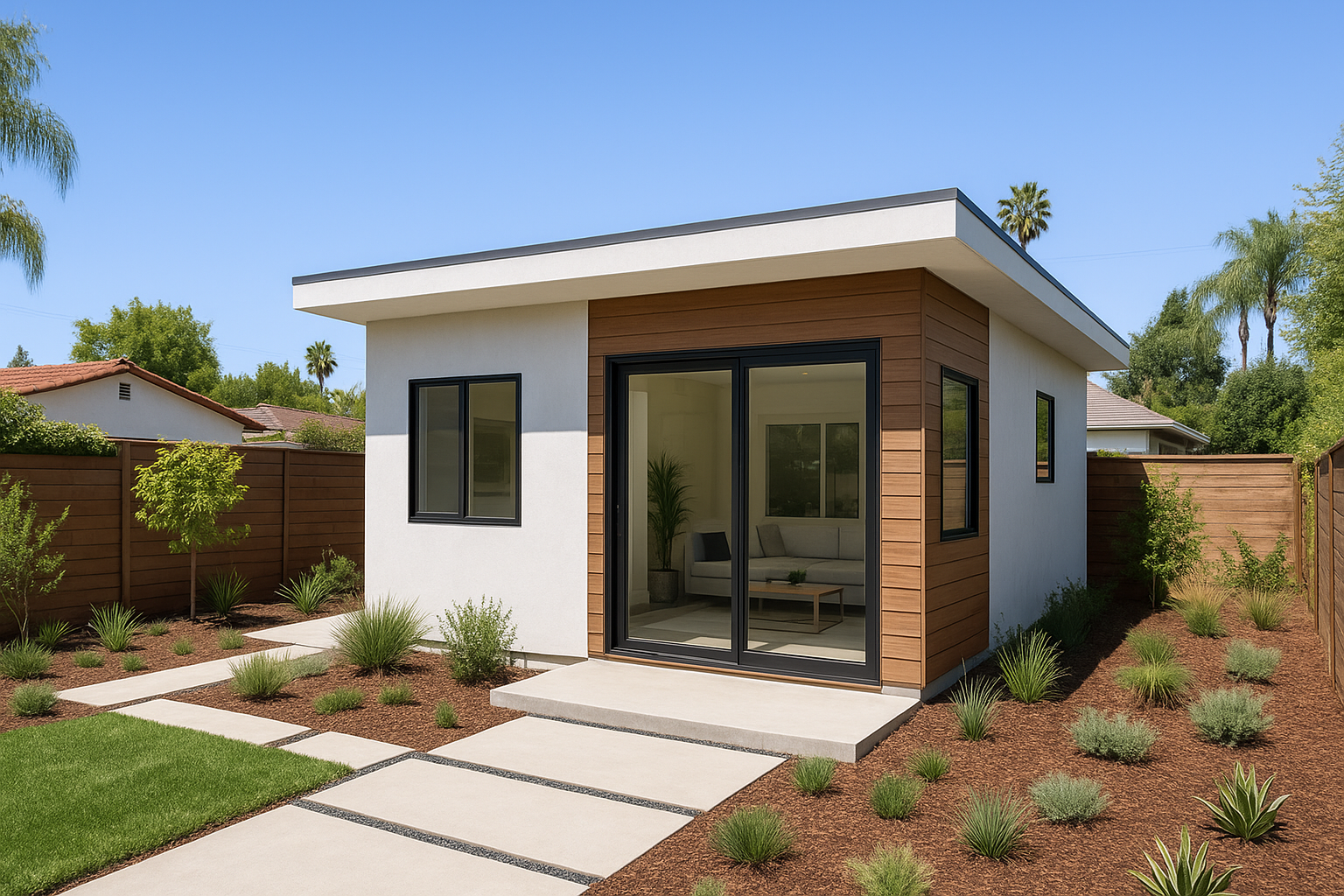
A completed backyard ADU funded partly through grant reimbursement and a construction loan.
Costs and Statistics: What ADU Grants Typically Cover
Data from CalHFA’s original rollout shows the program reimbursed up to $40,000 per household for pre-development costs, a figure that helped thousands of California homeowners move projects from concept to permit-ready status. Specifically, common covered expenses include architectural design fees, engineering reports, and local permitting or impact fees. Meanwhile, actual construction, which can range from $150,000 to $400,000 depending on size and finishes, generally falls outside grant coverage.
Therefore, homeowners should treat grant funding as a helpful offset rather than a complete solution. For more background on available programs, our article covering accessory dwelling unit grants and free funding sources lists additional state and regional options worth exploring. For a broader definition of what qualifies as an ADU under state law, the Wikipedia overview of accessory dwelling units offers useful background.
Common Mistakes When Applying for ADU Grants
Many applicants lose time by submitting paperwork before confirming that a program is actively accepting new applicants. Similarly, incomplete income documentation is a frequent cause of rejection or delay. As a result, working with a knowledgeable contractor or housing counselor early in the process can prevent costly missteps.
In addition, some homeowners mistakenly assume grant funds can be used toward construction labor or materials. Since most programs restrict funds to pre-development costs, clarifying allowable expenses upfront avoids confusion later. Our page on whether there are grants available for building an ADU addresses several of these misconceptions directly.
- Applying before confirming the program is currently funded
- Submitting incomplete or outdated income documentation
- Assuming the grant covers labor, materials, or full construction
- Skipping licensed professionals for design or permitting tasks
- Failing to track deadlines for reimbursement submission
Working With The ADU Pro for Your Accessory Dwelling Unit Project
As a contractor serving homeowners across Orange County, Los Angeles County, and Riverside County, theadupro.com guides clients through design, permitting, and construction while helping them identify available funding sources, including any active ADU grant program. Because regulations and funding change often, working with a local team that tracks these updates can save both time and money. You can learn more about our end-to-end ADU development process by visiting theadupro.com.

A licensed contractor helps homeowners navigate grant and loan options for their ADU build.
Frequently Asked Questions About the ADU Grant Program
What is the ADU grant program?
The ADU grant program is a state-backed funding initiative that reimburses eligible California homeowners for pre-development costs, such as design, permitting, and soil testing, when building an accessory dwelling unit. It does not typically cover full construction costs, so many homeowners often prequalify for ADU financing early to secure complementary funding.
How much money can you get from an ADU grant program?
Historically, the CalHFA ADU grant program offered up to $40,000 per household to reimburse pre-construction expenses. Funding amounts and availability change frequently, so verify current caps before applying.
How do I apply for an ADU grant program?
You generally apply through a participating lender or local housing authority rather than directly with the state. The process involves confirming eligibility, gathering documentation, and submitting proof of pre-development expenses.
Who is eligible for ADU grant funding?
Eligibility usually depends on household income limits, property ownership status, and whether the home is a primary residence. Some programs prioritize low- and moderate-income homeowners.
Is the CalHFA ADU grant program still accepting applications in 2026?
Availability shifts based on state budget allocations, and the program has paused enrollment in the past once funds were exhausted. Check the official CalHFA website for current 2026 status before applying.
How long does it take to receive ADU grant funding?
Processing times vary, but reimbursement typically takes several weeks to a few months after documentation is approved. Delays often occur when paperwork is incomplete or income verification is pending.
What is the difference between an ADU grant and an ADU loan?
A grant does not need to be repaid and usually covers only pre-development costs, while a loan finances full construction and must be repaid with interest. Most homeowners use a combination of both.
What can ADU grant funds be used for?
Grant funds are typically restricted to pre-construction costs such as architectural design, engineering, permit fees, and impact fees. They are rarely applied toward building materials or labor.
What common mistakes do homeowners make when applying for ADU grant programs?
Common mistakes include applying before confirming current funding availability, submitting incomplete income documentation, and assuming the grant covers full construction. Working with an experienced contractor helps avoid these missteps.
Are there other funding options besides an ADU grant program?
Yes, homeowners often combine grants with home equity loans, cash-out refinancing, construction loans, or personal savings. Exploring multiple financing paths increases the likelihood of fully funding your project.
Do I need to hire a licensed contractor to qualify for ADU grant funding?
Most programs require licensed professionals for design and construction documentation to be eligible for reimbursement. Working with a licensed ADU contractor also reduces permitting delays.
How does income affect eligibility for the ADU grant program?
Many ADU grant programs set income ceilings based on area median income, favoring low- to moderate-income households. Homes exceeding these limits may still qualify for other financing but not the grant itself.
What documents are required to apply for an ADU grant program?
Applicants typically need proof of income, property ownership records, itemized pre-development invoices, and a signed lender agreement. Requirements vary by administering agency, so confirm the exact checklist in advance.
Can I combine an ADU grant with a construction loan?
Yes, combining a grant with a construction loan is common and often recommended, since the grant covers early costs while the loan funds actual building. This layered approach reduces out-of-pocket expenses.
Will there be new ADU grant funding available in 2026?
Because ADU policy remains a state legislative priority, additional funding rounds are possible, but they depend entirely on budget approval. Monitoring HCD and CalHFA announcements is the most reliable way to catch a 2026 reopening.
Where can I find updated information about ADU grant programs?
The most reliable sources are official state housing agency websites and licensed ADU contractors who track funding changes closely. Checking regularly helps you apply as soon as a program reopens.
Final Thoughts on the ADU Grant Program
In summary, an ADU grant program can meaningfully reduce the upfront costs of designing and permitting an accessory dwelling unit, though it rarely funds construction in full. Therefore, homeowners should pair grant research with a realistic financing plan that may include loans or personal savings, and should track county-level programs alongside the statewide CalHFA option heading into 2026. Above all, staying informed through official sources and experienced local contractors, such as our team at theadupro.com, gives you the best chance of successfully leveraging an ADU grant program while building a functional, code-compliant home addition. For further reading, the Wikipedia overview of accessory dwelling units and the California HCD website offer additional context on state housing policy.