The Complete Guide to Accessory Dwelling Units in Orange County (2025)
Accessory dwelling units are secondary housing units built on the same lot as a primary residence — and they are one of the most effective ways Orange County homeowners can generate rental income, increase property value, and create flexible living space. An ADUs in Orange County is a self-contained residential unit — complete with its own kitchen, bathroom, and sleeping area — that shares a single-family lot with a main home. Whether you are planning a detached backyard cottage, a garage conversion, or an in-law suite, this guide covers everything you need to know: zoning rules, permits, design, costs, financing, and construction timelines — all tailored specifically to Orange County.
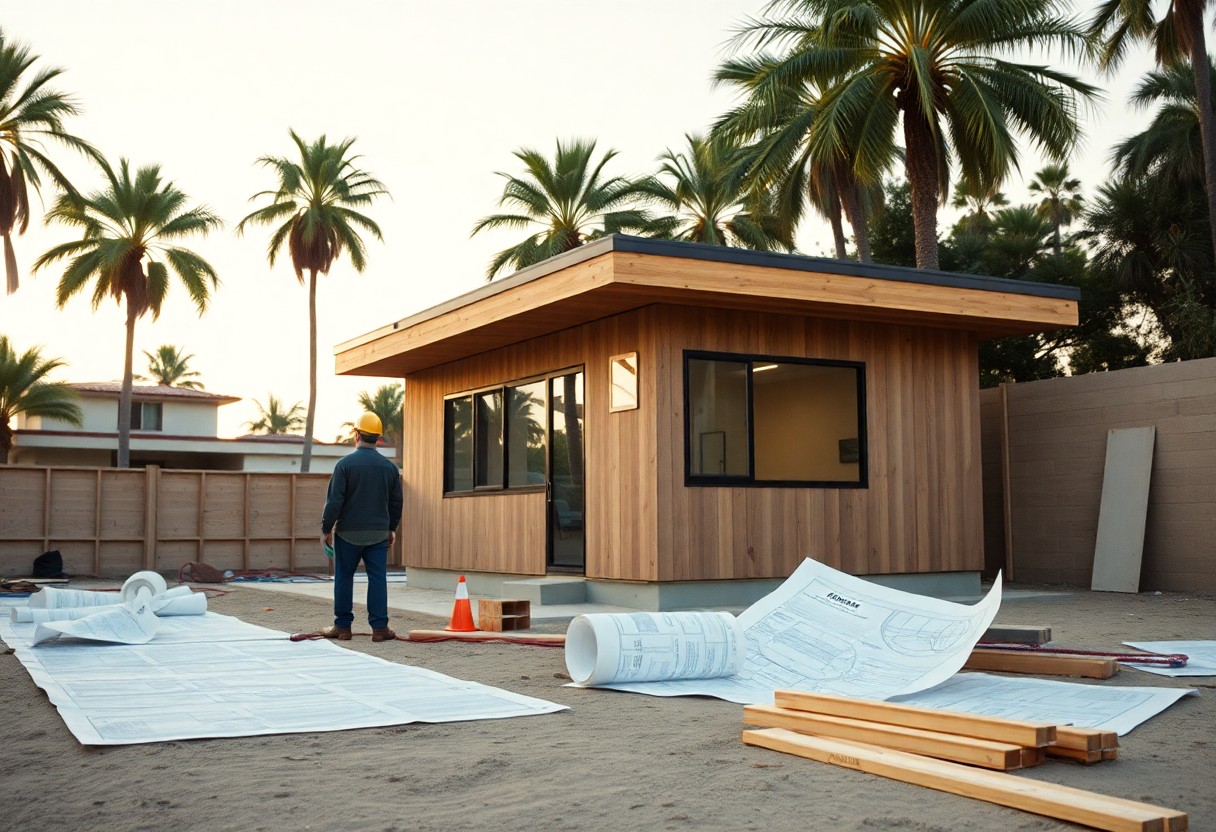
A completed detached accessory dwelling unit in an Orange County residential neighborhood.
What Are Accessory Dwelling Units?
An accessory dwelling unit is a legal, secondary residential unit located on a lot zoned for a single-family or multi-family home. In California, ADUs are defined and governed by state law — specifically California Government Code Sections 65852.2 and 65852.22 — but local jurisdictions like Orange County layer additional rules on top. Specifically, an ADU must include its own living space, sleeping area, kitchen, and bathroom to qualify as a full unit.
ADUs go by many names: granny flats, in-law suites, backyard cottages, carriage houses, and secondary suites. However, regardless of what you call them, the definition remains the same. Furthermore, California’s housing laws have significantly expanded ADU rights since 2020, making it easier than ever for Orange County homeowners to build one.
In addition to full ADUs, California recognizes a smaller category called a Junior Accessory Dwelling Unit (JADU). A JADU is up to 500 square feet and is created within the existing walls of a primary residence — often converting a bedroom or portion of a garage. JADUs have their own, slightly different set of rules, which we cover below.
Types of Accessory Dwelling Units Available in Orange County
Before diving into regulations and costs, it helps to understand which type of ADU best fits your property and goals. Orange County permits several distinct ADU configurations, and each carries different cost, design, and permitting implications.
Detached ADUs
A detached ADU is a completely separate, freestanding structure built on the same lot as the primary home. This is the most popular choice for Orange County homeowners because it offers maximum privacy for both the main-home occupants and the ADU tenant. Detached ADUs can be built in backyards, on side yards, or above garages. They are typically the most expensive type due to the full foundation, framing, and utility connections required.
Attached ADUs
An attached ADU shares at least one wall with the primary residence. In many cases, this means adding a new room or suite to the side or rear of the house. Because it shares structural elements with the main home, an attached ADU is often less expensive to build than a detached unit. However, soundproofing and separate entrances become important design considerations.
Garage Conversion ADUs
Converting an existing attached or detached garage into a livable ADU is one of the most cost-effective paths in Orange County. The structure already exists, which means foundation and framing costs are minimal. Additionally, California state law prohibits local governments from requiring replacement parking spaces when a garage is converted to an ADU — a major regulatory win for homeowners.
Junior ADUs (JADUs)
A Junior ADU is created entirely within the existing footprint of a single-family home and is capped at 500 square feet. JADUs require an owner-occupancy covenant — meaning the property owner must live in either the main home or the JADU. They are the most affordable ADU option, as they typically require only interior conversion work. Consequently, they are a strong choice for homeowners who want to generate income with minimal disruption.
ADU Types at a Glance
| Type | Max Size (CA State Law) | Owner Occupancy Required? | Best For |
|---|---|---|---|
| Detached ADU | 1,200 sq ft | No (until 2025 law) | Maximum privacy, rental income |
| Attached ADU | 50% of primary unit or 1,200 sq ft | No | Adding space to existing structure |
| Garage Conversion | Existing structure size | No | Lower cost, existing footprint |
| Junior ADU (JADU) | 500 sq ft | Yes | Budget-conscious, interior conversion |
Benefits of Building an Accessory Dwelling Unit
The reasons Orange County homeowners choose to build accessory dwelling units have grown considerably in recent years. Therefore, it is worth examining each benefit in detail — because understanding your motivations shapes every decision that follows, from ADU type to design to financing.
Rental Income Generation
In Orange County, where median rents consistently rank among the highest in California, well-designed ADUs in the OC can generate $1,500 to $3,000+ per month in rental income depending on size, location, and amenities. For many homeowners, this income stream covers a significant portion of their mortgage payment. Furthermore, ADU rental income can be used to qualify for certain financing products, effectively using the future income to pay for construction.
Increased Property Value
Adding an accessory dwelling unit typically increases a property’s market value by more than the cost of construction — particularly in high-demand markets like Irvine, Anaheim, Santa Ana, and Huntington Beach. Appraisers increasingly recognize ADU income potential when valuing properties. As a result, many homeowners see a strong return on their ADU investment even before collecting a single month’s rent.
Multi-Generational Living
ADUs are ideally suited for multi-generational households. Specifically, they allow aging parents to live nearby while maintaining independence, or enable adult children to live at a reduced cost while saving for their own home. This arrangement is increasingly popular in Orange County’s diverse communities, where multi-generational living is both culturally valued and financially practical.
Housing Flexibility and Future-Proofing
An ADU gives your property long-term flexibility. Today it might serve as a home office or guest suite; in five years it could be a rental unit; later it may house a family caregiver. Consequently, building an ADU is one of the most future-proof investments a homeowner can make — one structure that adapts to changing life circumstances without requiring a move.
Orange County ADU Regulations and Zoning Laws
Understanding the regulatory framework is the most critical early step in any accessory dwelling unit project. Orange County encompasses 34 cities — each with its own municipal code — plus unincorporated county areas governed directly by the County of Orange. Therefore, the specific rules that apply to your project depend on your precise address.
That said, California state law sets a baseline floor of ADU rights that no local jurisdiction can undercut. Local governments may add restrictions on top, but they cannot be more restrictive than state minimums. Here is what state law guarantees:
- Ministerial approval — ADUs that meet objective standards must be approved administratively, without discretionary review or public hearings.
- 60-day approval deadline — Local agencies must act on complete ADU applications within 60 days.
- No parking replacement — When a garage is converted to an ADU, replacement parking cannot be required.
- Maximum size of 1,200 sq ft for detached ADUs on most lots.
- 4-foot rear and side setbacks for new detached ADUs (though existing structures may have different rules).
- Reduced utility connection fees for ADUs under 750 square feet.
Key Local Zoning Considerations in Orange County
While state law provides strong protections, local ordinances still govern important details. Specifically, you need to verify the following for your property:
- Zoning designation: ADUs are generally permitted on lots zoned for single-family or multi-family residential use. Confirm your parcel’s zoning designation through your city or county planning department.
- Lot coverage limits: Most jurisdictions cap the percentage of your lot that can be covered by structures. Adding an ADU counts toward this total.
- Height restrictions: Detached ADUs are generally limited to 16 feet in height for one-story structures, or up to 25 feet in some jurisdictions that allow two-story ADUs.
- HOA rules: Homeowners Associations cannot outright prohibit ADUs under California law. However, they may impose design standards that affect materials, colors, and aesthetics.
- Fire safety: Sprinklers may be required in some jurisdictions for new ADU construction, particularly for larger detached units. For a deeper walkthrough, see our ADU Construction La Habra.
- Historic districts: Properties in designated historic areas may face additional design review requirements.
⚠ Important: Because regulations vary by city — and because state ADU law has changed significantly in 2020, 2022, and 2023 — always confirm current requirements directly with your local planning department before finalizing any plans. What applied two years ago may not apply today.
ADU Construction Permitting in Orange County: Step by Step
The permitting process is where many Orange County ADU projects stall — not because permits are impossible to get, but because applicants submit incomplete packages or underestimate the number of separate permits required. Consequently, understanding each step before you begin can save weeks or even months of delay. For detailed contractor and permitting guidance, see our ADU builder Orange County resource.
Step 1: Pre-Application Research
Before drafting plans, contact your local planning department for a pre-application meeting and get help with ADU permits. Many Orange County cities offer this service free of charge. During this meeting, you can confirm your zoning designation, learn about any specific local requirements, and identify potential design constraints before investing in architectural plans.
Step 2: Design and Plan Preparation
Work with a licensed architect or ADU designer to prepare a complete set of construction documents. A complete plan set typically includes site plans, floor plans, elevations, structural drawings, and MEP (mechanical, electrical, plumbing) plans. In addition, many jurisdictions also require a soils or geotechnical report for new detached structures. See our ADU builder guide for planning and documentation examples.
Step 3: Submit Your Permit Application
Submit your complete application package — including all drawings and supporting documents — to the local building department. Most Orange County jurisdictions now accept electronic plan submittals, which speeds up the process significantly. Under state law, the agency must respond with corrections or approval within 60 days of receiving a complete application. ADU permits Orange County
Step 4: Plan Check and Corrections
The building department reviews your plans for compliance with the California Building Code, local amendments, and applicable energy codes (Title 24). It is common to receive a corrections list — a document outlining items that need to be revised or clarified. Respond to corrections quickly and thoroughly. Slow responses are the single biggest cause of extended permit timelines.
Step 5: Permit Issuance and Inspections
Once plans are approved, you pay permit fees and receive your building permit. Construction may then begin. Throughout construction, you will need to schedule and pass a series of inspections at key milestones — typically including foundation, framing, rough plumbing, rough electrical, insulation, and final inspection. Each inspection must be passed before moving to the next phase.
Step 6: Certificate of Occupancy
After passing the final inspection, the building department issues a Certificate of Occupancy (CO). This document certifies that your ADU is safe and legally habitable. Without a CO, you cannot legally rent your ADU. Furthermore, an unpermitted ADU can create significant liability and complications if you ever sell or refinance your home.
Permits Typically Required for an Orange County ADU
- Building permit (structural)
- Electrical permit
- Plumbing permit
- Mechanical permit (HVAC)
- Grading permit (if significant earthwork is required)
- Encroachment permit (if work affects the public right-of-way)
Designing Your ADU: Space Planning, Style, and Compliance
Great ADU design accomplishes three things simultaneously: it maximizes livability within the available square footage, it complies with all applicable codes, and it complements the aesthetic character of your property and neighborhood. Therefore, design is not simply a matter of style — it is a strategic exercise with legal and financial implications.
Space Planning Principles for ADUs
Because ADUs are typically smaller than full homes, efficient space planning is essential. Specifically, consider these proven strategies:
- Open floor plans: Combining the kitchen, dining, and living areas into a single open space makes small ADUs feel significantly larger.
- Multi-functional furniture: Murphy beds, fold-out dining tables, and built-in storage all maximize usable space without sacrificing comfort.
- High ceilings and clerestory windows: Vertical volume and natural light create a sense of spaciousness that square footage alone cannot achieve.
- Outdoor living integration: A small patio, deck, or covered outdoor area effectively extends the livable space of an ADU at relatively low cost.
- Built-in storage throughout: Under-stair storage, built-in shelving, and recessed niches reduce clutter and keep the space feeling organized.
Neighborhood Compatibility and Aesthetic Design
Orange County neighborhoods range from Spanish Colonial Revival homes in older Anaheim tracts to contemporary coastal designs in Newport Beach and Laguna Beach. Your ADU should draw from the architectural vocabulary of its surroundings. In particular, pay attention to:
- Roofline: Match the pitch and style of your primary home’s roof whenever possible.
- Exterior materials: Use siding, stucco, wood, or fiber cement that echoes the primary residence.
- Window proportions: Maintain similar window styles and proportions to the main home for visual cohesion.
- Color palette: Choose exterior colors that harmonize with both the primary home and the broader streetscape.
- Landscaping: Screen the ADU with appropriate landscaping to maintain privacy and reduce visual impact on neighbors.
Energy Efficiency and Title 24 Compliance
All new ADU construction in California must comply with Title 24 energy efficiency standards. Specifically, this means you will need to meet requirements for insulation, window performance, HVAC efficiency, and in most cases, solar-ready or solar-equipped design. As a result, working with designers who are current on Title 24 requirements from the outset saves costly redesigns during plan check.
ADU Construction Costs in Orange County: A Detailed Breakdown
Cost is consistently the biggest concern homeowners have about accessory dwelling units. The honest answer is that ADU costs in Orange County vary widely — but having realistic numbers from the start prevents budget surprises that derail projects mid-construction. ADU construction costs
Typical Cost Ranges by ADU Type
What Drives ADU Costs Higher in Orange County
Several factors can push your ADU cost toward the higher end of these ranges. Specifically, watch out for:
- Difficult site conditions: Slopes, expansive soils, or poor drainage require additional foundation or grading work.
- Utility upgrades: If the existing main panel or sewer lateral cannot support a new unit, upgrades may be required.
- High-end finishes: Premium appliances, tile, cabinetry, and fixtures significantly increase per-square-foot costs.
- Design complexity: Custom architectural details cost more than standard designs.
- Permit fees: Orange County permit fees vary by jurisdiction but can range from $5,000 to $20,000+ depending on project scope.
Budgeting Best Practices
Regardless of your ADU type, a solid budget always includes a 10-15% contingency reserve for unforeseen costs. For example, uncovering old plumbing or a soil problem can add costs rapidly. Additionally, factor in soft costs — architectural fees, engineering fees, permit fees, and utility connection fees — because these add up quickly and are often overlooked in initial estimates. See estimated ADU costs & permits to compare typical price ranges.
Financing Your Accessory Dwelling Unit
Financing is a significant barrier for many homeowners who want to build accessory dwelling units but are unsure how to pay for them. Fortunately, there are more options available in 2025 than ever before. The right choice depends on your current equity position, credit profile, and how quickly you need funds. Learn lender options and financing strategies on our ADU financing and builder options page.
Home Equity Loan or HELOC
A Home Equity Loan provides a lump sum at a fixed interest rate, while a Home Equity Line of Credit (HELOC) gives you a revolving line you can draw from as needed. Both use your home as collateral and typically offer lower rates than unsecured loans. These are among the most popular ADU financing methods for homeowners with substantial equity — a common position in high-value Orange County neighborhoods.
Cash-Out Refinance
A cash-out refinance replaces your existing mortgage with a new, larger loan — and gives you the difference in cash. This approach can make sense if current rates are near your existing rate, or if you need a larger amount than a HELOC provides. However, it extends your loan term and resets your amortization, so evaluate the long-term cost carefully.
ADU-Specific Construction Loans
Several lenders now offer ADU-specific loan products that use the projected rental income of the finished unit to help you qualify. These products — offered by lenders like RenoFi, Acorn Finance, and various California credit unions — can be particularly valuable for homeowners who have limited existing equity but strong income. Furthermore, some allow the future appraised value of your property with the ADU to be used for underwriting.
CalHFA ADU Grant Program
The California Housing Finance Agency (CalHFA) has offered grant funding specifically for pre-development ADU costs — including architectural drawings, permits, and site prep — up to $40,000. While program availability and funding levels change annually, this is a particularly valuable resource for income-qualified homeowners. Check CalHFA ADU grant program directly, as these grants have been oversubscribed in past years.
Fannie Mae and Freddie Mac ADU Financing
Both Fannie Mae and Freddie Mac have updated their guidelines to allow lenders to count ADU rental income when underwriting purchase and refinance loans. Specifically, Fannie Mae’s HomeStyle Renovation loan and Freddie Mac’s CHOICERenovation loan both allow ADU construction costs to be wrapped into a single mortgage. These are powerful tools for homeowners who are simultaneously purchasing and planning an ADU.
Hiring the Right Professionals for Your ADU Project
The quality of your ADU outcome is directly linked to the quality of the professionals you hire. Orange County has a robust ecosystem of ADU specialists — but also many general contractors who overestimate their familiarity with local ADU regulations. Consequently, vetting your team carefully upfront saves significant time and money. best ADU contractor
Architects and ADU Designers
A licensed architect handles design, structural documentation, and ensures your plans meet all applicable codes. However, for simpler ADU projects — particularly garage conversions or standard detached units — a licensed building designer or ADU design firm may offer faster timelines and lower fees than a full architectural firm. In either case, look for professionals who have completed recent ADU projects specifically in your city, as local plan-check familiarity reduces correction cycles.
General Contractors
Your general contractor coordinates all subcontractors — framing, electrical, plumbing, HVAC, drywall, and finishes — and is responsible for overall project quality and schedule. When evaluating contractors for your ADU project:
- Verify their California Contractor’s License (CSLB) is current and in good standing.
- Ask for references from at least three completed ADU projects — and call them.
- Review their subcontractor relationships — a strong network of reliable subs is as important as the GC themselves.
- Get at least three detailed bids, and compare them line by line — not just the total.
- Confirm they carry general liability insurance and workers’ compensation coverage.
Full-Service ADU Companies
A growing number of companies in Orange County now offer turnkey ADU services — handling design, permits, construction, and project management under one roof. These companies simplify the homeowner experience considerably. However, they often charge a premium for that convenience. Specifically, compare their all-in pricing against building your own team before committing. Some homeowners find full-service firms worth every dollar; others prefer direct oversight of each professional. See our shortlist of best ADU companies to compare providers.
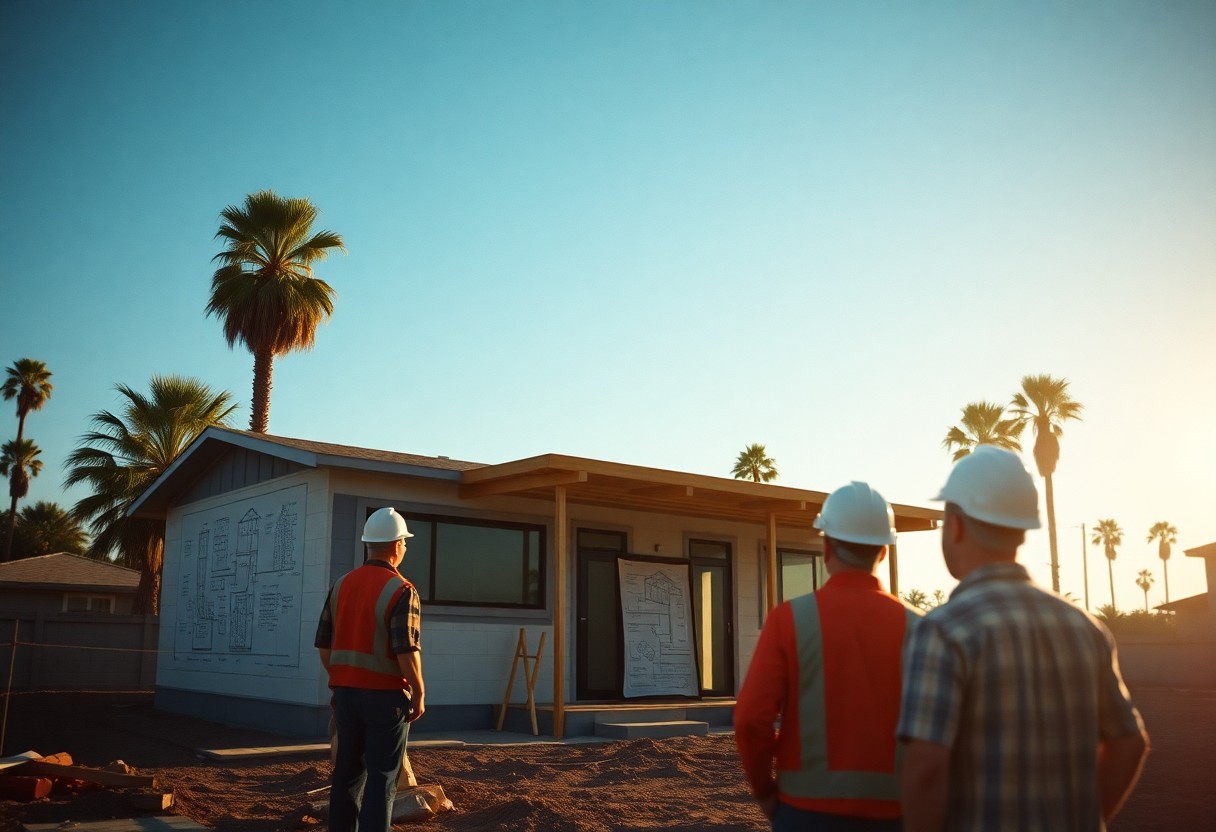
Professional coordination between architects, contractors, and project managers is critical to a smooth ADU build.
ADU Construction Timeline: What to Expect
One of the most common questions Orange County homeowners ask is: how long will this take? The honest answer is that timelines vary — but understanding what drives delays puts you in control. A well-managed, straightforward detached ADU project in Orange County typically takes 9 to 18 months from initial design to certificate of occupancy. Complex projects or those with permitting complications can run longer.
Phase 1: Design and Pre-Permitting (1–3 Months)
This phase includes the initial design consultation, schematic design, development of construction documents, and preparation of the permit application package. The duration depends on the complexity of your design and the responsiveness of your design team. Therefore, staying engaged and making decisions quickly during this phase compresses the overall timeline.
Phase 2: Permit Review and Approval (1–4 Months)
While state law mandates a 60-day response window, this clock only starts once the agency considers your application complete. Plan check corrections add time. As a result, ADU guide Orange County and over-the-counter ADU programs — offered by several Orange County cities — can dramatically shorten this phase by allowing same-day or pre-approved plan approvals for standard designs.
Phase 3: Site Preparation and Foundation (1–2 Months)
Once permits are in hand, site prep begins: clearing, grading, utility staking, and foundation work. The foundation inspection is one of the most critical milestones — it must pass before any framing begins. Specifically, concrete cure time alone adds 7-10 days to this phase regardless of how efficiently the contractor works.
Phase 4: Framing, Mechanical, Electrical, and Plumbing (2–4 Months)
This is the most visually dramatic phase — your ADU takes shape. Framing is followed by rough plumbing, electrical, and HVAC rough-in. Each trade requires a separate inspection before walls are closed. In addition, coordination between subcontractors is essential here — scheduling conflicts between trades are a primary cause of delay.
Phase 5: Insulation, Drywall, and Finishes (2–4 Months)
After all rough inspections pass, insulation is installed and inspected, drywall goes up, and finish work begins: flooring, cabinetry, tile, fixtures, appliances, and exterior finishes. This phase is where quality of workmanship becomes most visible. Consequently, close communication with your contractor during finishes prevents costly rework.
Phase 6: Final Inspection and Certificate of Occupancy (2–4 Weeks)
The final inspection covers all trades simultaneously. Once passed, the Certificate of Occupancy is issued — typically within a week. You can then legally occupy or rent your new ADU. Overall, from first design meeting to move-in, expect 9–18 months for a well-managed Orange County project.
Post-Construction: Renting Your ADU and Ongoing Compliance
Once your ADU is complete and the Certificate of Occupancy is issued, the work is not quite done. Several important steps and ongoing obligations apply to Orange County ADU owners who plan to rent their unit.
Setting Up for Rental
Before renting, confirm whether your city requires a business license or rental registration for ADU landlords. Additionally, some Orange County cities have adopted rent stabilization ordinances that may apply to your unit depending on its construction date and the city’s specific rules. Consulting a local real estate attorney before signing your first lease is a worthwhile investment.
Property Tax Implications
Building an ADU triggers a reassessment — but importantly, only the ADU itself is reassessed at current market value. Your existing primary home’s assessed value is not affected under California Proposition 13. Therefore, the property tax increase is proportional to the new ADU construction value, not your entire property. Expect an annual property tax increase of approximately 1-1.2% of your ADU’s construction cost.
Short-Term vs. Long-Term Rental Considerations
California state law prohibits local governments from requiring ADU owner-occupancy (except for JADUs). However, many Orange County cities restrict or regulate short-term rentals (STRs) — platforms like Airbnb and VRBO — separately from long-term rentals. Specifically, some cities require STR permits, limit the number of rental nights per year, or restrict STRs entirely in certain zones. Verify your city’s STR rules before committing to a short-term rental strategy.
Frequently Asked Questions About Accessory Dwelling Units
What is an accessory dwelling unit and how does it differ from a regular rental?
An accessory dwelling unit is a complete, self-contained residential unit located on the same lot as a primary residence. Unlike a room rental or a shared-home arrangement, an ADU has its own fully separate kitchen, bathroom, living area, and entrance. It functions as a complete independent home — just on a shared lot. Furthermore, it is permitted, inspected, and receives its own Certificate of Occupancy, making it a legal and distinct housing unit.
How large can an ADU be in Orange County?
California state law allows detached ADUs up to 1,200 square feet in most cases. Attached ADUs can be up to 50% of the primary dwelling’s size, or 1,200 sq ft — whichever is less. Junior ADUs are capped at 500 sq ft. Specific Orange County cities may have additional size restrictions within these state-law maximums. Always confirm with your local planning department for your specific parcel.
How long does it take to get an ADU permit in Orange County?
The permitting phase typically takes 1 to 4 months in Orange County, though it can be shorter for simple projects in cities with over-the-counter ADU approval programs. State law requires local agencies to act on complete applications within 60 days. Incomplete submissions, plan check corrections, and back-and-forth with the building department are the most common causes of delay — all of which can be minimized with thorough upfront preparation.
Can I build an ADU if I have an HOA?
Yes. California law prohibits HOAs from outright banning ADU construction. However, HOAs can enforce objective design standards — such as roofing materials, exterior colors, and screening requirements — as long as those standards do not effectively prohibit an ADU or increase costs unreasonably. Review your CC&Rs and submit to your HOA’s architectural review committee early in the design process to avoid conflicts.
Do I need owner-occupancy for an ADU in Orange County?
As of 2020, California state law removed the owner-occupancy requirement for standard ADUs. You do not need to live on the property to rent your ADU. However, Junior ADUs (JADUs) are still subject to an owner-occupancy covenant — meaning the property owner must reside in either the main home or the JADU. Note that future legislation could change these rules, so check current state law before making long-term plans.
How much rental income can an ADU generate in Orange County?
Rental income from an Orange County ADU varies significantly by location, size, and amenities. As a general guide, studio and one-bedroom ADUs in most Orange County cities rent for $1,500 to $2,500 per month. Two-bedroom or larger detached ADUs in desirable areas like Newport Beach, Irvine, or Laguna Beach can command $2,500 to $4,000+ per month. These figures make ADUs one of the highest-yielding residential investments available to individual homeowners.
What is the difference between an ADU and a JADU?
A Junior Accessory Dwelling Unit (JADU) is a smaller, lower-cost ADU type created within the existing footprint of a single-family home. JADUs are capped at 500 square feet, require owner-occupancy, and must have a separate entrance. They may share bathroom facilities with the main home, unlike a full ADU which must have its own complete bathroom. As a result, JADUs are significantly cheaper and faster to create — but they are limited in size and require the owner to live on-site.
Conclusion: Your Path to a Successful Accessory Dwelling Unit in Orange County
Building an accessory dwelling unit in Orange County is one of the most financially rewarding and practically versatile investments a homeowner can make. From generating $1,500 to $4,000+ in monthly rental income to increasing your property’s long-term value, the benefits are substantial — provided you approach the process with realistic expectations, thorough planning, and the right professional team.
In summary, a successful ADU project begins with understanding your local zoning rules, choosing the right ADU type for your property and goals, working with experienced architects and contractors, securing appropriate financing, and managing the construction timeline proactively. Specifically, the homeowners who succeed are those who engage deeply with the process rather than delegating it entirely and hoping for the best.
Above all, remember that California’s accessory dwelling unit regulations have never been more favorable to homeowners than they are today. The regulatory environment continues to evolve in your favor. Therefore, the best time to start planning your Orange County ADU is right now — before competing homeowners in your neighborhood get there first.