
Most advice about property expansion overlooks how critical a seasoned ADU contractor is when navigating California’s dense housing codes. For Southern California homeowners aiming to add one of the sought-after british-style granny flats or turn underused space into rental income, this role is more than just project management. With demand for ADUs rising by over 40 percent throughout Los Angeles and Orange County, choosing the right contractor means unlocking real value and avoiding costly mistakes.
Table of Contents
- Defining The Role Of ADU Contractors
- Types Of ADU Projects And Solutions
- Construction Process From Design To Completion
- Navigating Local Laws And Building Codes
- Risks, Costs, And Contractor Selection Tips
Key Takeaways
| Point | Details |
|---|---|
| Role of ADU Contractors | ADU contractors act as project managers, ensuring compliance with building regulations and enhancing property potential through expert guidance. |
| Types of ADU Projects | Detached, attached, and interior conversion units each offer unique benefits for homeowners aiming to expand their living spaces efficiently. |
| Construction Process | The ADU construction process involves careful planning and adherence to local regulations, typically ranging from 6 to 12 months for completion. |
| Financial Considerations | Homeowners must assess potential risks and costs, ensuring thorough contractor vetting and clear contracts to safeguard their investments. |
Defining the Role of ADU Contractors
ADU contractors in California serve as comprehensive project managers responsible for transforming residential properties through strategic accessory dwelling unit development. These specialised professionals bridge the complex gap between homeowners’ vision and regulatory compliance, offering expertise that extends far beyond traditional construction services. Their role encompasses intricate navigation of local building regulations, ensuring every ADU project meets stringent California housing standards.
Specifically, ADU contractors manage multiple critical dimensions of residential expansion projects. They coordinate architectural design, secure necessary permits, handle complex zoning requirements, and execute precise construction techniques tailored to Southern California’s unique urban landscape. The California Contractors State License Board mandates that these professionals possess a General Building Contractor licence, signalling their comprehensive understanding of multi-trade construction processes and legal compliance frameworks.
Beyond technical execution, ADU contractors act as strategic advisors who help homeowners maximise property potential. They assess structural feasibility, recommend optimal unit configurations, estimate potential rental income, and provide insights into property value enhancement. Their expertise spans detached units, garage conversions, second-storey additions, and junior ADUs, each requiring nuanced understanding of local building codes and design aesthetics.
Pro Tip – Contractor Selection: Always verify a potential ADU contractor’s California State Licence Board credentials and request comprehensive portfolios demonstrating experience with similar neighbourhood projects before committing to any residential expansion initiative.
Types of ADU Projects and Solutions
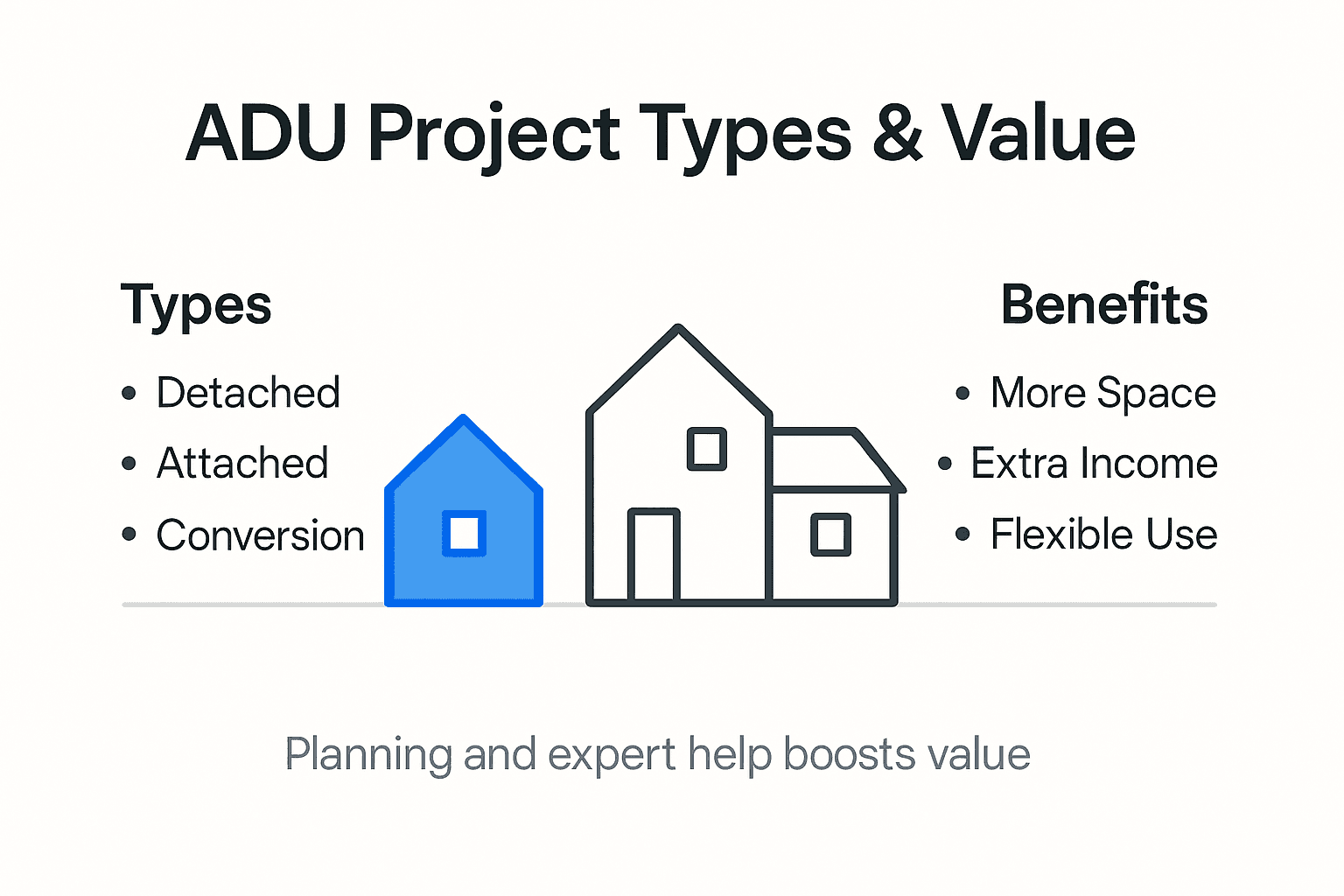
Accessory Dwelling Units (ADUs) in California represent a diverse range of residential expansion solutions, offering homeowners multiple strategies for maximising property potential. California’s housing regulations officially recognise three primary ADU configurations: detached units, attached units, and interior conversions, each presenting unique opportunities for property enhancement and additional living spaces.
Detached ADUs provide the most flexible approach, allowing homeowners to construct completely independent structures within their property boundaries. These standalone units can range from compact studio apartments to two-bedroom cottages, offering maximum design autonomy and potential rental income. Attached ADUs, alternatively, connect directly to the primary residence, creating seamless integration while expanding functional living space. Interior conversions transform existing underutilised spaces like garages, basements, or attic areas into fully functional secondary dwelling units, presenting a cost-effective solution for property expansion.
Modern ADU development has evolved beyond traditional construction methods, incorporating innovative design solutions that address Southern California’s unique housing challenges. Prefabricated units, modular construction techniques, and streamlined permitting processes have significantly reduced development complexity and cost. Homeowners can now choose from pre-approved designs, access financial assistance programmes, and leverage advanced construction technologies that dramatically reduce project timelines and administrative burden.
Here is a comparison of the main types of ADU projects and their unique benefits:
| ADU Type | Space Utilisation | Project Complexity | Potential Rental Income |
|---|---|---|---|
| Detached Unit | Maximises unused outdoor space | Higher due to new build | Highest for standalone |
| Attached Unit | Expands living space seamlessly | Moderate, requires integration | Moderate to high |
| Interior Conversion | Utilises existing structure | Lowest, adapts current space | Lower, limited by size |
Pro Tip – Project Scoping: Carefully assess your property’s specific characteristics, local zoning regulations, and long-term objectives before selecting an ADU configuration to ensure optimal alignment with your residential enhancement strategy.
Construction Process from Design to Completion
The ADU construction journey in Southern California represents a meticulously structured process that transforms architectural vision into functional living spaces. Comprehensive ADU construction guidelines outline a systematic approach that typically spans 6-12 months, encompassing multiple intricate stages of planning, design, permitting, and execution. Homeowners must navigate a complex landscape of regulatory requirements, technical specifications, and creative design considerations to successfully deliver their residential expansion project.
The initial design phase demands careful collaboration between homeowners and ADU contractors to conceptualise a unit that maximises both functional utility and aesthetic appeal. This stage involves comprehensive property assessment, understanding local zoning restrictions, and developing architectural plans that comply with California’s stringent building codes. Professional contractors leverage advanced design technologies and three-dimensional modelling to create precise representations of proposed ADU configurations, enabling homeowners to visualise potential outcomes before committing to construction.

Subsequent stages involve rigorous permitting processes, where contractors submit detailed documentation to local municipal authorities for comprehensive review. Alameda County’s ADU resource centre highlights the critical importance of obtaining all necessary approvals, which may include building permits, electrical and plumbing certifications, and compliance documentation. The actual construction phase then unfolds through sequential steps: site preparation, foundational work, structural framing, mechanical and electrical installations, interior finishing, and final inspections. Each stage requires meticulous attention to detail and adherence to California’s exacting construction standards.
Pro Tip – Documentation Management: Maintain a comprehensive digital and physical file of all project documentation, including permits, design plans, contractor agreements, and inspection reports, to streamline communication and protect your investment throughout the ADU construction process.
Navigating Local Laws and Building Codes
Navigating the intricate landscape of ADU construction regulations represents a critical challenge for Southern California homeowners. California’s housing regulations create a complex framework that demands meticulous understanding of state, county, and municipal requirements. Each jurisdiction maintains unique zoning ordinances, building codes, and permitting processes that significantly impact ADU development strategies, making professional guidance essential for successful project implementation.
Local building codes encompass multiple critical dimensions, including setback requirements, maximum unit dimensions, parking specifications, and architectural design standards. Municipalities across Southern California frequently update their ADU regulations, introducing nuanced restrictions that can dramatically influence project feasibility. Professional ADU contractors play a pivotal role in interpreting these intricate legal frameworks, ensuring homeowners can effectively navigate potential regulatory constraints while maximising their property’s development potential.
The permitting process represents a particularly challenging aspect of ADU development, requiring comprehensive documentation and precise compliance with established municipal best practices. Homeowners must prepare detailed architectural plans, environmental impact assessments, and structural engineering reports that demonstrate complete alignment with local building standards. Successful navigation of these regulatory requirements demands a sophisticated understanding of technical specifications, zoning classifications, and potential legal limitations that could impact residential expansion projects.
Pro Tip – Regulatory Research: Conduct comprehensive preliminary research with your local planning department and consult experienced ADU contractors who maintain up-to-date knowledge of current municipal regulations before initiating your residential expansion project.
Risks, Costs, and Contractor Selection Tips
Navigating the financial landscape of ADU construction requires a strategic approach that balances potential investment returns with comprehensive risk management. California’s contractor regulations provide critical guidance for homeowners seeking to minimise financial vulnerabilities during residential expansion projects. Understanding the intricate cost structures and potential pitfalls becomes paramount in ensuring a successful ADU development that enhances property value without compromising financial stability.
The financial risks associated with ADU construction extend beyond initial project costs, encompassing complex variables such as potential permit delays, unexpected structural challenges, and potential regulatory compliance expenses. Homeowners must carefully evaluate contractors based on multiple criteria, including demonstrated expertise in local building codes, transparent pricing structures, and proven track records of successful ADU implementations. Professional contractors should provide comprehensive, itemised estimates that clearly delineate potential additional costs, enabling homeowners to develop robust financial contingency strategies.
The table below summarises key factors affecting the total cost and risk of an ADU project:
| Cost/Risk Factor | Impact on Project | Typical Mitigation Strategy |
|---|---|---|
| Permit Delays | Can increase total timeframe | Early, thorough application review |
| Structural Challenges | Unexpected expenses possible | Detailed pre-build assessment |
| Regulatory Changes | May require plan adjustments | Regular updates with local council |
| Contractor Experience | Influences build quality | Verify credentials and portfolio |
Effective contractor selection demands meticulous due diligence and a systematic evaluation process. Alameda County’s ADU resource centre recommends soliciting multiple detailed bids, thoroughly verifying professional licences, and conducting comprehensive reference checks. Critical selection factors include the contractor’s specialisation in ADU projects, demonstrated understanding of local zoning regulations, proven project management capabilities, and transparent communication practices. Homeowners should request comprehensive portfolios showcasing previous ADU projects, paying particular attention to units similar in scope and complexity to their proposed development.
Pro Tip – Financial Safeguarding: Request a detailed written contract that explicitly outlines project scope, payment schedules, potential additional costs, and comprehensive warranty provisions to protect your investment and establish clear expectations with your chosen ADU contractor.
Unlock Your Property’s True Potential with Expert ADU Contractors
Adding an Accessory Dwelling Unit is a proven way to maximise your home value while creating versatile living spaces that suit your lifestyle. The article highlights common challenges such as navigating complex local building codes, managing permit approvals, and selecting qualified contractors who understand California’s unique zoning laws. At The ADU Pro, we specialise in turning these challenges into opportunities with custom ADU solutions tailored for Orange County, LA County, and Riverside County homeowners.
Whether you are considering a detached unit, an interior conversion, or a second-storey addition, our dedicated team guides you through every phase from initial design to completion. We focus on efficient permitting, comprehensive compliance, and innovative, eco-friendly construction methods designed specifically for Southern California’s housing market. With transparent pricing, detailed project reports, and financing options, getting started on your ADU has never been easier.
Ready to enhance your property value and enjoy additional rental income or multigenerational living spaces?
Discover how expert project management transforms your vision into a reality.
Explore our services at The ADU Pro and take the first step toward a stylish, functional ADU that meets all local regulations and maximises your investment. Start your journey today and experience the confidence that comes from working with California’s leading ADU contractor.
Frequently Asked Questions
What does an ADU contractor do?
ADU contractors act as comprehensive project managers who oversee the development of accessory dwelling units by managing design, permits, zoning requirements, and construction processes to ensure regulatory compliance and homeowners’ visions are realised.
How can an ADU increase my home’s value?
Adding an ADU can significantly enhance your property value by providing additional living space or rental income potential, which is appealing in the current housing market, making your home more attractive to buyers.
What are the main types of ADUs I can build?
The primary types of ADUs include detached units, attached units, and interior conversions. Each type offers unique advantages in terms of space utilisation and construction complexity, catering to different homeowner needs.
How long does the ADU construction process typically take?
The ADU construction process usually spans 6 to 12 months, including design, permitting, and actual construction. Timelines can vary based on project complexity and local regulatory factors.
Recommended
- ADU Builders in Orange County: Best Practices & Advice – The ADU Pro®
- Why California ADUs Are the Hottest Housing Trend on the West Coast in 2024 – The ADU Pro®
- Top 6 Reasons to Build an Accessory Dwelling Unit (ADU) in California – The ADU Pro®
- The Ultimate Guide for ADU Builders in California: Step-by-Step – The ADU Pro®