ADU Kitchen Design: The Complete Guide to Layouts, Features & Costs
By Daniel Messina, Licensed General Building Contractor (CSLB #1128679) | The ADU Pro | Updated 2025 | 12-Minute Read
Quick Answer
ADU kitchen design is the process of planning a fully functional, code-compliant kitchen inside an Accessory Dwelling Unit (ADU) — a secondary living space on a residential property. A well-executed ADU kitchen design maximizes a compact footprint with smart layouts, right-sized appliances, and built-in storage, typically costing between $10,000 and $30,000 depending on size and finish level. See our broad ADU guide for policy and planning context.
Getting ADU kitchen design right is one of the most important decisions you will make when building or renovating an Accessory Dwelling Unit. The kitchen directly affects livability, rental appeal, resale value, and code compliance — all at once. At The ADU Pro, we have spent over 30 years designing compact kitchens that feel spacious, work efficiently, and meet every California requirement. In this guide, we cover everything: layouts, appliances, storage, materials, costs, permits, trends, and financing. Furthermore, we answer every question homeowners typically have before breaking ground. Learn examples of Southern California ADU designs that inspire kitchen layouts.
Whether you are building a new detached ADU, converting a garage, or upgrading an existing in-law suite, the principles of great ADU kitchen design are the same. Specifically, the goal is to create a kitchen that feels complete — not like a compromise.
Why ADU Kitchen Design Is a Critical Investment
A kitchen is not simply one room among many in an ADU — in most units it anchors the entire living experience. Consequently, decisions made early in the design process ripple across every other aspect of the build. For a deeper walkthrough, see our Can I Build an ADU in an HOA? A Comprehensive Guide by The ADU Pro.
Maximizing a Limited Footprint
ADUs are by definition compact. Learn more about Accessory Dwelling Units in California. In California, most fall between 400 and 1,200 square feet. As a result, every square foot in the kitchen must earn its place. A poorly planned layout wastes precious space on dead corners, awkward traffic paths, and undersized counter areas. In contrast, a thoughtfully engineered ADU kitchen design turns those same square feet into a fully functional workspace that feels natural to use every day.
California Code Compliance
California law requires every ADU to include a kitchen with at minimum: a cooking appliance, a sink with hot and cold running water, counter space, and food storage. Additionally, your local jurisdiction may impose further requirements around ventilation, exhaust fans, and clearance distances. Failing to meet these standards can stall your permit approval — or trigger expensive retrofits after the fact. Therefore, designing with compliance built in from day one is non-negotiable.
Rental Income and Property Value
A modern, well-appointed kitchen is one of the top factors renters evaluate when choosing an ADU. In the Southern California rental market, an ADU with a quality kitchen can command $300–$700 more per month in rent compared to a unit with a dated or minimal kitchenette. Furthermore, appraisers factor kitchen quality into the ADU’s contributory value, which directly lifts your overall property valuation. Learn how to maximize rental potential with targeted kitchen upgrades.
Quality of Daily Life
For homeowners housing a family member, hosting long-term guests, or using the ADU as a personal retreat, a practical kitchen improves daily living in ways no other room can match. Similarly, for short-term rental operators, a complete kitchen is a key differentiator against hotel-style accommodation.
ADU Kitchen Design: Choosing the Right Layout
Layout is the single most consequential decision in any ADU kitchen design. It determines workflow, storage capacity, and how naturally the space connects to the rest of the unit. Below are the five core layouts used in ADU kitchens, along with honest guidance on when each one is the right choice. Learn how different ADU styles affect layout choices.
1. Galley Kitchen Layout
The galley layout — two parallel runs of cabinets and counters facing each other — is arguably the most efficient kitchen layout ever developed. It is common in professional kitchens precisely because it creates a clean, linear workflow. For examples, see our Southern California kitchen guide for layout examples.
- Best for: ADUs under 600 sq ft, converted garages, studio-style units
- Minimum width needed: 7 feet between opposing walls (allows a 36-inch aisle)
- Key advantage: Every step in the cooking process — prep, cook, plate — happens within arm’s reach
- Watch out for: Traffic flow conflicts if the galley serves as a pass-through to another room
2. L-Shaped Kitchen Layout
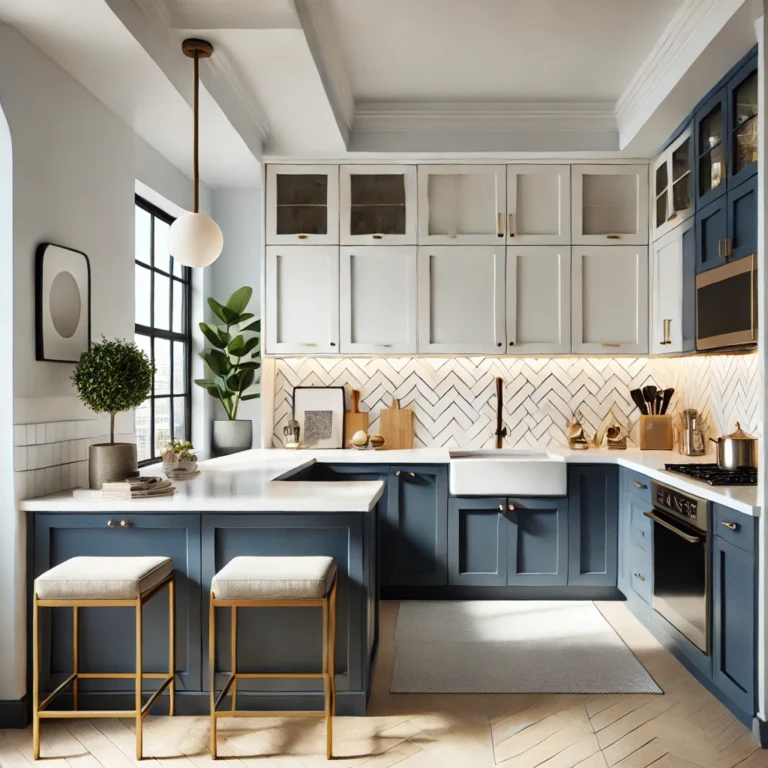
The L-shaped layout uses two adjacent walls, forming a natural corner workstation. It is extremely versatile and works well in open-plan ADUs where the kitchen flows into a dining or living area. Additionally, the corner junction can be fitted with a lazy Susan, pull-out drawers, or a corner carousel to eliminate wasted space.
- Best for: Open-plan ADUs, units with a combined kitchen-living area
- Minimum space needed: Roughly 8 × 8 feet of floor area
- Key advantage: Creates a natural work triangle; allows a breakfast bar on the open end
- Watch out for: Corner cabinets require smart hardware to remain accessible
3. U-Shaped Kitchen Layout
A U-shaped kitchen wraps around three walls, delivering maximum counter space and storage. It works best in larger ADUs — typically 800 square feet or more — where a dedicated kitchen room is feasible. However, in smaller units a U-shape can feel enclosed and dark, so careful attention to lighting and color is essential.
- Best for: Larger ADUs with a separate kitchen space; households that cook frequently
- Minimum width needed: At least 8 feet between opposing walls
- Key advantage: Abundant storage; can accommodate two cooks comfortably
- Watch out for: Requires careful planning of the work triangle to avoid excessive movement
4. Single-Wall Kitchen Layout
In a single-wall layout, all appliances, cabinets, and counters run along one wall. It is the most space-efficient option of all and is particularly well-suited to studio ADUs or units where the kitchen must share a wall with the living or sleeping area. Consequently, it is a popular choice for junior ADUs (JADUs — a type of ADU created by converting living space within an existing home) under 500 square feet.
- Best for: JADUs, studio ADUs, units under 500 sq ft
- Minimum wall length needed: 8–10 feet for a functional run
- Key advantage: Leaves maximum floor area open for living space
- Watch out for: Limited counter space; requires careful appliance selection
5. Island or Peninsula Addition
Adding a small island or peninsula to an L-shaped or U-shaped ADU kitchen provides extra prep space, additional seating, and a natural visual divider between the kitchen and the living area. However, islands require at least 42 inches of clearance on all sides — so confirm your ADU has sufficient floor area before committing to this option. In smaller units, a rolling butcher-block cart achieves a similar effect without the permanent footprint. Learn more in our kitchen design guide.
Appliances for ADU Kitchen Design: Right-Sizing Without Sacrificing Function
Appliance selection is where many ADU kitchen designs succeed or fail. Oversized appliances crowd the space and dominate the budget. In contrast, undersized or low-quality appliances frustrate daily use and hurt rental appeal. The goal is to find the right-sized appliance for each function — not simply the smallest available.
Refrigerators
Standard residential refrigerators are 30–36 inches wide. For most ADUs, a counter-depth or apartment-size refrigerator (24 inches wide, 10–12 cubic feet) is the right choice. It fits neatly within standard cabinet depth, creates a streamlined look, and still provides ample storage for one or two people. Furthermore, French-door and column refrigerators in this size range offer premium aesthetics without the premium footprint.
- Studio ADUs / JADUs: 18–20 inch mini refrigerator with a separate freezer drawer
- One-bedroom ADUs: 24-inch apartment-size refrigerator
- Two-bedroom ADUs: 30-inch counter-depth refrigerator
Cooking Appliances
Induction cooktops (smooth, glass-ceramic cooking surfaces that use electromagnetic energy rather than open flame or electric coil) are ideal for ADU kitchens. They heat faster than gas, are safer, easier to clean, and produce no combustion byproducts — making them a strong choice in compact, semi-open spaces. A two- or four-burner induction cooktop paired with a compact wall oven or combination microwave-convection oven covers virtually every cooking need.
- Two-burner induction cooktop: Best for studios and JADUs
- 24-inch range (cooktop + oven combined): Best for one- and two-bedroom ADUs
- Combination microwave-convection oven: Excellent space-saver; replaces both appliances with one unit
- Gas range: Available where gas is already plumbed; requires proper ventilation
Dishwashers
An 18-inch compact dishwasher fits neatly under a standard counter and handles the dishes of one or two people with ease. Alternatively, countertop dishwashers connect directly to the kitchen faucet and require no installation — a practical option for JADUs where plumbing modifications are restricted. For rental ADUs specifically, a dishwasher is a strong amenity that justifies higher rent.
Ventilation
Proper ventilation is required by California building code and is critical for indoor air quality in a compact ADU kitchen. A range hood vented to the exterior is the gold standard. However, where exterior ducting is difficult, a recirculating range hood with a high-quality activated carbon filter is an acceptable alternative. Above all, do not skip ventilation — it protects both the occupants and the finishes of the kitchen. For full build requirements see building an ADU in California.
Storage Solutions That Make ADU Kitchens Feel Twice as Large
Storage is where compact ADU kitchen designs most commonly fall short. The instinct is to reduce storage when space is tight. In reality, the opposite is true — a small kitchen needs more thoughtfully planned storage than a large one, because there is less room for clutter to hide.
Floor-to-Ceiling Cabinetry
Standard upper cabinets stop 18 inches below the ceiling, leaving a dead zone that collects dust. In an ADU kitchen, those upper 18 inches are prime real estate. Extending cabinets all the way to the ceiling adds approximately 30% more cabinet volume without using any additional floor space. Use the uppermost shelves for infrequently accessed items — seasonal cookware, bulk pantry goods, appliance boxes.
Pull-Out Pantry Cabinets
A pull-out pantry — a tall, narrow cabinet fitted with full-extension pull-out shelves — can store an entire pantry’s worth of dry goods in a footprint as narrow as nine inches. Similarly, pull-out base cabinet organizers eliminate the need to unload everything to reach items at the back of a deep cabinet. These are particularly valuable in galley and single-wall ADU kitchen designs where base cabinet depth is the primary storage resource.
Corner Storage Hardware
Corners are the most misused space in any kitchen. A standard blind corner cabinet leaves half its volume inaccessible. In contrast, a corner carousel (also called a lazy Susan — a rotating shelf system that brings items at the back of a corner cabinet within reach), a Le Mans pull-out system (a two-part kidney-shaped shelf that swings out of the corner), or a magic corner unit transforms that dead space into fully functional storage.
Under-Counter and Toe-Kick Drawers
The toe-kick — the recessed base beneath lower cabinets — is almost always wasted in conventional kitchens. However, toe-kick drawers (shallow drawers mounted in the kick-plate area) can store flat items like baking sheets, cutting boards, and placemats. Additionally, under-counter drawer stacks outperform deep base cabinets for accessibility, since items in shallow drawers are always visible and within reach.
Open Shelving Strategies
Open shelving is visually lighter than upper cabinets and can make a small ADU kitchen feel more open. However, it requires discipline — open shelves only work as a design feature when items are well-organized and consistently tidy. Therefore, use open shelving for frequently used items (glasses, everyday dishes, a few cookbooks) and keep upper cabinets for everything else.
Countertop Materials for ADU Kitchens: Beauty, Durability, and Budget
Countertops have an outsized visual impact in a small kitchen. In an ADU, the countertop material you choose affects both the perceived quality of the space and the long-term maintenance burden. For guidance on balancing aesthetics and budget, see our great ADU design recommendations. Here is how the most popular options compare.
| Material | Cost per Sq Ft | Durability | Maintenance | Best For |
|---|---|---|---|---|
| Quartz | $50–$120 | Excellent | Low (non-porous) | Rental ADUs, high-use kitchens |
| Butcher Block | $40–$100 | Good (with oiling) | Medium | Warm aesthetic, owner-occupied ADUs |
| Porcelain Tile | $20–$60 | Excellent | Low–Medium (grout) | Budget-conscious builds |
| Laminate | $15–$40 | Fair | Low | Entry-level ADUs, tight budgets |
| Granite | $60–$150 | Excellent | Medium (sealing needed) | Luxury ADUs, premium builds |
For most ADU kitchen designs, quartz offers the best combination of durability, low maintenance, and visual appeal. It requires no sealing, resists staining, and is available in a wide range of colors to complement any cabinet finish. In contrast, natural stone like granite adds undeniable beauty but requires periodic sealing — which is easy to neglect in a rental unit.
Multi-Functional Features That Set Great ADU Kitchens Apart
In a compact ADU kitchen, multi-functional features are not just nice to have — they are essential. The most effective ones multiply the usable space without adding square footage. For a deeper walkthrough, see our ADU Loans Chino.
Fold-Down Dining Tables
A wall-mounted fold-down dining table (sometimes called a Murphy table) stores flat against the wall when not in use, then unfolds to seat two or four people at mealtimes. This approach saves 12–20 square feet of floor area compared to a permanent dining table — floor area that can instead serve as kitchen workspace or living space. Specifically, they are a game-changer in studio ADUs where one room serves multiple functions.
Pull-Out Cutting Boards and Prep Surfaces
A built-in pull-out cutting board adds a second work surface that slides away when not needed. Similarly, a butcher-block extension at the end of a cabinet run creates an informal breakfast bar that doubles as prep space. These features add functionality without claiming permanent counter area.
Integrated Sink Accessories
Modern kitchen sinks are available with fitted accessories — cutting boards, colanders, and drying racks that span the sink basin — transforming the sink into a multi-station workspace. In a small ADU kitchen where counter space is limited, a well-accessorized sink can effectively add 12–18 inches of functional prep area at zero cost to the floor plan.
Appliance Garages and Hidden Charging Stations
An appliance garage — a cabinet with a roll-up or lift-up door positioned at countertop level — keeps small appliances accessible but out of sight, maintaining a clean counter appearance. Additionally, integrating USB outlets and standard power plugs inside the appliance garage creates a concealed charging station that keeps cables off the counter entirely.
Lighting Design for ADU Kitchens
Lighting is one of the most powerful — and most underutilized — tools in ADU kitchen design. Excellent lighting makes a small kitchen feel larger, safer, and more inviting. A complete lighting plan includes three distinct layers. For a deeper walkthrough, see our ADU Loans Bellflower.
Ambient Lighting
Ambient lighting provides overall illumination for the room. Recessed LED downlights (also called can lights) are the most popular choice for ADU kitchens — they are flush with the ceiling, unobtrusive, and highly efficient. For a more design-forward look, a pendant light or small flush-mount fixture above an island or dining area adds character while contributing to the overall light level.
Task Lighting
Task lighting targets specific work areas — primarily the countertop and cooktop. Under-cabinet LED strip lights are the most effective and affordable solution. They eliminate shadows cast by overhead lights, making food prep safer and more precise. Above all, under-cabinet lighting is a relatively low-cost addition that dramatically upgrades the perceived quality of a kitchen.
Accent and Natural Lighting
Where possible, maximize natural light through windows or a skylight. Natural light reduces the need for artificial lighting during the day and makes the space feel more connected to the outdoors. Furthermore, light-colored reflective surfaces — white or light gray cabinets, glossy tile backsplashes, mirrors — amplify whatever natural light is available.
2025 ADU Kitchen Design Trends
Design trends shape what renters and buyers expect from a contemporary ADU kitchen. Staying current with these smart ADU design ideas helps ensure your investment retains its appeal for years to come.
Two-Tone Cabinetry
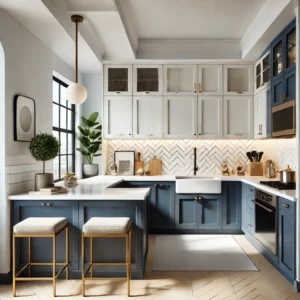
Combining two cabinet colors — typically a darker, bolder shade on the lower cabinets and a lighter neutral on the upper — creates visual depth and draws the eye upward. This technique makes ceilings appear higher and the room feel larger. Popular combinations in 2025 include navy lower / white upper, forest green lower / natural oak upper, and charcoal lower / warm cream upper.
Bold Backsplashes
In a compact ADU kitchen, the backsplash is one of the few surfaces large enough to make a strong design statement. Textured zellige tiles (handmade Moroccan clay tiles with a slightly irregular surface and a rich glaze), graphic cement tiles, vertically stacked subway tiles, and large-format porcelain slabs are all popular in 2025. Specifically, a bold backsplash lets you keep the rest of the palette neutral while still creating a memorable kitchen.
Sustainable and Natural Materials
Eco-conscious materials are growing in popularity across all ADU kitchen designs. Bamboo cabinetry, reclaimed wood open shelves, recycled glass countertops, and low-VOC (Volatile Organic Compound — chemical off-gassing from paints, adhesives, and finishes) paints and adhesives all reduce environmental impact. Moreover, sustainable materials often look and feel premium — there is no trade-off between good design and responsible building.
Integrated Smart Technology
Smart kitchen technology is increasingly expected in modern ADUs. Touchless faucets, app-controlled ranges, smart refrigerators with interior cameras, and voice-activated lighting all enhance the user experience. Furthermore, smart appliances often consume less energy — which is both an operating cost advantage and a selling point for eco-minded renters.
Handleless Cabinet Fronts
Push-to-open or J-pull cabinet fronts (where a routed groove along the top or side of the door replaces a traditional handle) create a seamless, furniture-like appearance. In a small ADU kitchen, eliminating hardware removes visual clutter and makes the space feel cleaner and more expansive.
ADU Kitchen Design Costs: What to Expect in California
Budget is a central concern for every ADU kitchen project. Costs vary significantly based on size, materials, appliance quality, and labor rates in your area. However, having realistic benchmarks helps you plan effectively and avoid expensive surprises mid-project.
Budget Tier: $10,000–$18,000
This tier covers a functional, attractive ADU kitchen using mid-grade materials and standard appliances. Specifically, you can expect: For a deeper walkthrough, see our ADU Loans Compton.
- Ready-to-assemble (RTA) or semi-custom cabinets
- Laminate or mid-range quartz countertops
- Stainless steel appliances in apartment sizes
- Standard plumbing and electrical
- Basic backsplash tile
Mid-Range Tier: $18,000–$30,000
This tier delivers a noticeably upgraded experience — the level that most rental ADUs benefit most from. In addition to the budget tier, you can expect:
- Semi-custom or full-custom cabinetry with soft-close hardware
- Premium quartz or natural stone countertops
- Designer backsplash tile (subway, zellige, or large-format)
- Upgraded fixtures (touchless faucet, undermount sink)
- Under-cabinet LED lighting
- Smart appliances
Premium Tier: $30,000–$60,000+
Premium ADU kitchen designs use full-custom cabinetry, high-end appliance brands (Bosch, Thermador, Miele), natural stone slabs, integrated smart home systems, and bespoke design details. This level is appropriate for luxury ADUs in high-value markets, ADUs serving as primary living spaces, or builds where maximizing property value is the primary objective.
California ADU Kitchen Regulations: What Every Homeowner Must Know
California’s ADU laws — significantly updated in 2020, 2022, and 2024 — set clear requirements for what constitutes a legal ADU kitchen. However, state law sets the floor, not the ceiling. Your local jurisdiction may impose additional requirements. For broader context on Accessory Dwelling Units in California, see our comprehensive guide.
State Minimum Requirements
Under California Government Code Section 65852.2, every ADU must include:
- A permanent cooking appliance (gas, electric, or induction)
- A kitchen sink with hot and cold running water
- Adequate counter space for food preparation
- Food storage (cabinets, pantry, or equivalent)
Additional Local Requirements (Common in Southern California)
- Ventilation: Range hood or mechanical exhaust ventilation meeting California Building Code Section 1203.4
- Clearances: Minimum 30-inch clearance above cooktop to non-combustible surface; 24 inches to combustible surface
- GFCI outlets: Required within 6 feet of a sink and in all countertop areas per NEC 210.8
- Plumbing: All waste connections must meet California Plumbing Code requirements
Junior ADU (JADU) Kitchen Requirements
Junior ADUs — units of 500 square feet or less created within the walls of an existing home — are permitted under California law to have an efficiency kitchen rather than a full kitchen. Specifically, a JADU kitchen requires a cooking appliance and a food preparation counter, but does NOT require a full sink if there is a shared bathroom within the primary dwelling. This makes JADUs significantly easier and less expensive to create.
Space-Saving Strategies: 10 Expert Tips for Compact ADU Kitchens
Every ADU kitchen design benefits from space-saving thinking, regardless of the overall ADU size. The following strategies are drawn from real ADU projects completed by The ADU Pro team. For a deeper walkthrough, see our Creating the Perfect ADU: Exploring Interior Design Schemes.
- Extend cabinets to the ceiling. As discussed above, this single change adds up to 30% more cabinet volume with no floor space cost.
- Use a single deep drawer instead of two shallow ones. Deep drawers are more ergonomic and make items more accessible than digging to the back of a lower cabinet.
- Install pocket doors or barn doors. Swing doors require up to 9 square feet of clearance arc. In contrast, pocket doors (doors that slide into the wall cavity) or barn doors (sliding doors mounted on an overhead rail) eliminate that clearance requirement entirely.
- Use a microwave drawer under the counter. A microwave drawer mounted under the counter frees the entire upper countertop and eliminates the need for an overhead microwave cabinet.
- Choose an undermount sink. An undermount sink (mounted below the countertop surface rather than dropped through it) makes wiping counter debris directly into the sink easier and creates a cleaner visual line that makes the counter feel larger.
- Add a magnetic knife strip. A magnetic strip on the backsplash or wall keeps knives off the counter and off the drawer space, while also looking intentional and professional.
- Use consistent flooring throughout the ADU. Running the same flooring material from the kitchen into the adjacent living area (rather than transitioning to a different material at the kitchen threshold) makes both spaces feel larger by removing visual interruptions.
- Choose integrated appliances where budget allows. Panel-ready appliances (refrigerators and dishwashers designed to accept a cabinet-front panel) blend seamlessly into the cabinetry, reducing visual noise and making the kitchen feel more like a composed piece of furniture.
- Maximize natural light. A kitchen that receives good natural light always feels larger than its square footage. Therefore, if a window location can be improved during the build, that investment pays dividends in daily enjoyment and photography for rental listings.
- Go minimalist on hardware. Simpler hardware — or no hardware at all on handleless cabinets — reduces visual clutter. Furthermore, consistent hardware throughout (rather than mixing styles) creates a more cohesive and considered look.
Financing Your ADU Kitchen Design Project
A high-quality ADU kitchen is an investment with measurable returns — in rental income, property value, and personal enjoyment. Fortunately, several financing paths make that investment accessible. For a deeper walkthrough, see our ADU Loans Anaheim.
Home Equity Loan or HELOC
A Home Equity Loan gives you a lump sum secured against your home’s equity, with a fixed interest rate and fixed repayment schedule. A HELOC (Home Equity Line of Credit — a revolving line of credit secured by your equity) is more flexible, letting you draw funds as needed during the build. Both options typically offer lower interest rates than personal loans or credit cards. Specifically, homeowners in Southern California with significant property equity often find this the most cost-effective financing route.
ADU-Specific Construction Loans
Several California lenders now offer construction loans designed specifically for ADU projects. These products take the ADU’s projected rental income into account during underwriting — which means you may qualify for more than a standard renovation loan would allow. RenoFi (a lending platform that specializes in renovation financing based on the home’s after-renovation value) is one example of a lender that works frequently with ADU projects. For a deeper walkthrough, see our ADU Loans Chino Hills.
Tax Credits and Energy Rebates
California’s Self-Generation Incentive Program (SGIP) and federal tax credits under the Inflation Reduction Act may apply to energy-efficient appliances, induction cooktops, and heat pump systems installed in a new ADU. Furthermore, many Southern California utilities (including SCE and SDG&E) offer rebates for qualifying Energy Star appliances. These incentives can meaningfully reduce the effective cost of appliance upgrades.
Our Financing Partners
The ADU Pro works with trusted lending partners to help you find the best financing solution for your project: For a deeper walkthrough, see our ADU Installer Santa Monica.


Click here to explore ADU financing options →
The ADU Pro’s Approach to ADU Kitchen Design
At The ADU Pro, we have designed and built ADU kitchens across Southern California for over 30 years. Our process is built around four commitments that every project reflects. For a deeper walkthrough, see our ADU Installer Pomona.
Fully Customized Design
We do not use cookie-cutter kitchen packages. Instead, we design each ADU kitchen from scratch based on your specific unit size, layout constraints, use case (rental, owner-occupancy, multigenerational living), and budget. Consequently, every kitchen we deliver is purpose-built for the space it lives in.
Permits and Compliance — Handled
We manage all permitting for your ADU kitchen, from initial plan submission through final inspection. Our team knows the specific requirements of every Southern California jurisdiction we work in — find licensed ADU builders in California and a step-by-step contractor guide to avoid costly surprises and delays caused by non-compliant plans.
Craftsmanship That Lasts
Our kitchens are built to last decades, not just look good at handover. We use professional-grade installation techniques, trusted cabinet and appliance brands, and a thorough quality inspection before any project closes. Furthermore, we stand behind our work with a warranty that protects your investment.
Sustainable and Energy-Efficient by Default
We default to energy-efficient appliances, low-VOC materials, and sustainable cabinet options on every project. This is both the right thing to do and the smart financial decision — energy-efficient ADUs have lower operating costs, which means higher net rental income and stronger appeal to eco-conscious renters.
Frequently Asked Questions About ADU Kitchen Design
Start Your ADU Kitchen Design Project with The ADU Pro
Your ADU kitchen deserves expert design — not a template. Whether you are starting from scratch or upgrading an existing unit, The ADU Pro will design a kitchen that fits your space, meets every California code requirement, and delivers lasting value. For a deeper walkthrough, see our ADU Loans Colton.
Ready to design your ADU kitchen?
📞 Call or text: (877) 398-8002
🌐 Visit: www.theadupro.com
📍 The ADU Pro, Inc. — Author: Daniel Messina, Licensed General Building Contractor (CSLB #1128679) with 30+ years experience in ADU construction. | 15338 Central Ave., Chino CA 91710
→ Click here to schedule a free consultation
Conclusion
Exceptional ADU kitchen design is the result of deliberate decisions made at every stage — from layout selection and appliance sizing to storage planning, material choices, and compliance with California code. Read more about ADU design styles and top ideas to inspire your project. Each of those decisions compounds. A well-designed ADU kitchen makes the unit more livable, more rentable, and more valuable. In contrast, a poorly designed one creates daily frustrations and leaves money on the table.
The ADU Pro brings 30+ years of California ADU experience, fully custom design, complete permit management, and a commitment to sustainable craftsmanship to every kitchen project. Therefore, if you are ready to create an ADU kitchen that stands out — functionally, visually, and financially — contact us today. Your ideal kitchen starts with a single conversation. For a deeper walkthrough, see our ADU Loans Burbank.