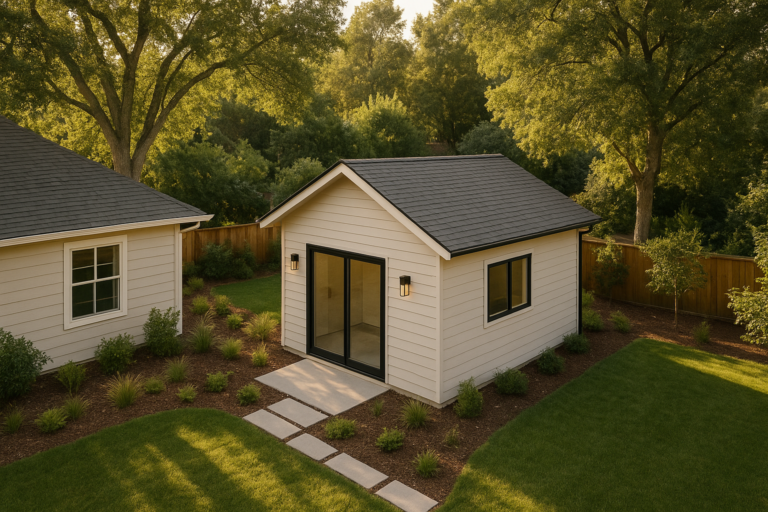
Accessory dwelling units cost is the first serious question every homeowner faces before a single shovel hits the ground — and in 2025, the honest answer spans a wider range than most expect. Total project budgets run from as little as $20,000 for a Junior ADU interior conversion all the way past $350,000 for a fully custom detached backyard cottage in a high-cost metro. Understanding precisely where every dollar goes is the difference between a project that succeeds and one that stalls halfway through construction.
This guide breaks down every major ADU cost estimate — ADU type, square footage, regional labor rates, permit fees, site conditions, finishes, financing, and hidden expenses — so you can build a realistic, defensible budget before you hire anyone.
Quick Answer — 2025 Cost Summary
- Junior ADU (JADU): $20,000 – $80,000
- Garage Conversion ADU: $50,000 – $150,000
- Attached ADU: $80,000 – $200,000
- Detached ADU: $100,000 – $400,000+
- Cost per sq ft: $150 – $500+ depending on region and type
What Is an Accessory Dwelling Unit? Accessory Dwelling Units Cost Basics
An accessory dwelling unit (ADU) is a self-contained secondary residential unit on the same parcel as a primary single-family home. Sometimes called granny flats, in-law suites, backyard cottages, or secondary suites, ADUs have undergone a nationwide regulatory renaissance since 2017, when California’s landmark SB 1069 and AB 2299 slashed permitting barriers. Dozens of other states have since followed with their own streamlining legislation.
There are four legally recognized ADU types, and the type you choose is the single biggest lever you control over your total accessory dwelling units cost. Each type carries a fundamentally different cost structure because of how much new construction, new foundation work, and new utility infrastructure is required.
Detached ADU
A fully independent structure in the backyard or side yard, with its own foundation, roof, utilities, and entrance. The highest accessory dwelling units cost category — but also the highest rental income potential and the greatest flexibility in design.
Attached ADU
A new addition built onto the side or rear of the primary home, sharing at least one wall. Lower foundation and roofing costs than a detached build, but still requires full permitting, new construction, and a separate entrance.
Garage Conversion ADU
An attached or detached garage transformed into habitable living space. Lower accessory dwelling units cost than new construction because the structural shell and slab already exist — but HVAC, insulation, plumbing, and electrical upgrades are still required.
Junior ADU (JADU)
A unit of up to 500 sq ft carved from within the existing primary home’s footprint. No new exterior construction required. The most affordable accessory dwelling units cost option — and the fastest path through permitting in most California cities.
Accessory Dwelling Units Cost by Type — Full 2025 Breakdown
The table below reflects total all-in project cost in 2025, including design, permits, site work, construction, and standard finishes. These are not construction-only estimates. Land cost is excluded since you already own the parcel.
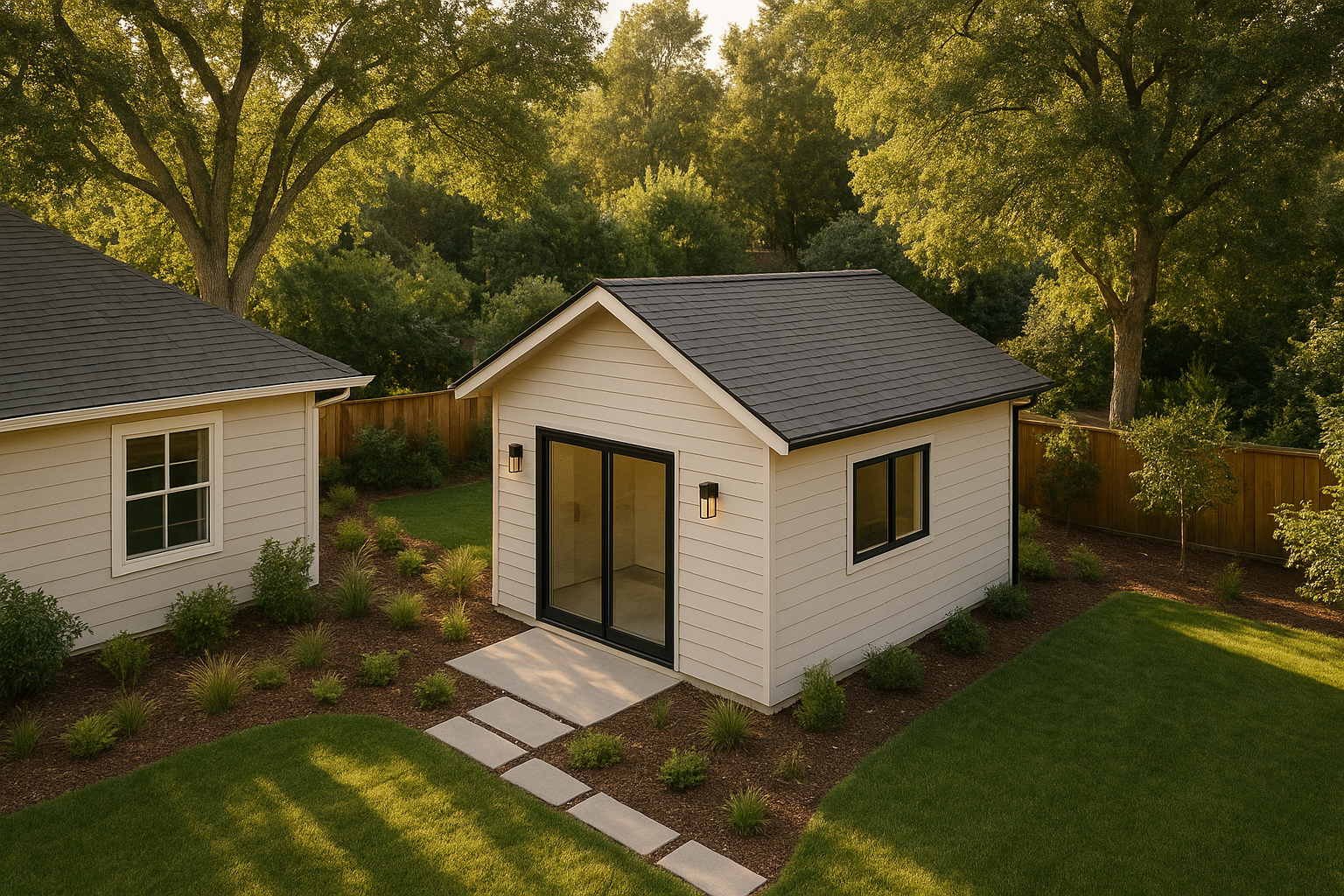
A detached accessory dwelling unit represents the highest accessory dwelling units cost tier — but also the greatest rental income and property value upside. For a deeper walkthrough, see our ADU complete guide and our Accessory Dwelling Unit Permit: Complete Guide 2024.
How ADU Size Affects Total Cost
Square footage has a compounding effect on 2 Bedroom ADU cost. Larger units don’t just add proportionally more framing — they also require larger HVAC systems, more plumbing runs, additional electrical circuits, and more finish materials. The table below illustrates how total project cost scales for a new detached ADU at different sizes, using a mid-range $300/sq ft labor and materials figure common in moderate-cost U.S. markets:
⚡ Fixed Cost Warning
Many ADU costs are fixed regardless of size — permit processing fees, utility connection charges, design fees, and soil testing cost the same whether you build 300 sq ft or 1,200 sq ft. This means the cost-per-square-foot is significantly higher on smaller ADUs. A 300 sq ft unit may effectively cost $400–$500/sq ft once fixed costs are spread across fewer square feet.
ADU Cost by Region — Why Location Changes Everything
Geographic location is one of the most powerful variables in accessory dwelling units cost. Labor rates, permit fees, utility connection requirements, and material supply chains vary dramatically from one market to the next. Here’s a realistic regional snapshot for a 600 sq ft detached ADU in 2025:
The Six Major Cost Categories — Where Every Dollar Goes
No matter which ADU type you choose, your total accessory dwelling units cost breaks into six major categories. Knowing each one gives you the power to evaluate bids accurately, spot overcharges, and identify which line items offer room to negotiate.
1. Design, Architecture, and Engineering Fees
Nearly every jurisdiction requires stamped architectural drawings before issuing a building permit. Custom design fees for a new ADU typically run $5,000 to $25,000, depending on project complexity, the architect’s hourly rate, and how many revision rounds are needed.
- Pre-approved city plan libraries: Many cities now offer free or low-cost pre-approved ADU plan sets that can eliminate most design fees. Los Angeles, San Jose, and Sacramento are among the leaders in this program.
- Prefab/ADU company plans: Prefab providers often include design and engineering in their package price, reducing this line item to $1,500 – $5,000.
- Structural engineering: Required for detached ADUs and any work involving soil conditions, slopes, or seismic zones. Add $2,000 – $8,000 for a structural engineer’s report and stamp.
- Title 24 energy compliance (California): California projects must demonstrate energy code compliance, sometimes requiring a third-party HERS rater at $500 – $1,500.
2. Permit, Impact, and Government Fees
Permit fees are one of the most variable elements in accessory dwelling units cost — and the one most homeowners underestimate. There are typically multiple fee categories stacked on top of each other:
- Building permit fees: Assessed as a percentage of project valuation. Typically $2,000 – $12,000 in most U.S. cities.
- Plan check / review fees: A separate fee for plan review, often $1,000 – $5,000 and sometimes requiring multiple re-submittals.
- School impact fees: California charges school impact fees on new ADUs (typically $3.79 – $4.08 per sq ft as of 2024-2025 for residential).
- Utility connection/capacity fees: Water and sewer agencies often charge new connection or capacity fees ranging from $5,000 to $30,000+ in dense urban areas.
- Fire sprinkler requirements: Some jurisdictions require fire sprinkler systems when a new detached ADU exceeds a certain size threshold, adding $4,000 – $12,000.
California Permit Fee Cap (AB 68)
Under California state law, cities cannot charge impact fees on ADUs under 750 sq ft. This is a significant cost protection for homeowners building smaller units in the state. Always verify whether your jurisdiction is enforcing this cap.
3. Site Preparation, Grading, and Foundation
Site preparation is the most unpredictable cost category in any detached ADU project. Until you dig, you genuinely don’t know what’s underneath. Key site prep cost factors include:
- Grading and excavation: $1,500 – $10,000 for a flat lot; $5,000 – $30,000+ for sloped terrain requiring retaining walls or cut-and-fill earthwork.
- Soil testing / geotechnical report: $1,500 – $4,000. Required in most jurisdictions and critical for determining foundation type.
- Standard slab-on-grade foundation: $8,000 – $18,000 for a 600 sq ft footprint.
- Raised foundation (pier-and-beam or crawl space): $15,000 – $35,000. Required on hillside lots and common in Northern California.
- Engineered foundation (expansive soils, seismic zone): $20,000 – $50,000+ in worst-case scenarios.
- Tree removal: $800 – $4,000 per mature tree; protected species may require arborist reports and mitigation planting.
4. Construction and Labor
Labor is the single largest line item in most ADU budgets. In 2025, construction costs for a site-built ADU range from $150 to $500 per square foot for materials and labor combined, depending on region, unit type, and finish level. Here’s how that breaks down by trade:
- Framing: $20,000 – $55,000 for a 600 sq ft detached ADU. Wood framing remains the most common structural system.
- Roofing: $8,000 – $22,000 depending on roof complexity, pitch, and material (composition shingles vs. standing seam metal).
- Rough plumbing: $8,000 – $20,000 for interior rough-in. Add $5,000 – $25,000 for sewer lateral connection if a new line is required.
- Electrical: $8,000 – $18,000 for rough wiring, panel, and finish electrical. Panel upgrade on main home may add $3,000 – $10,000.
- HVAC / mechanical: $6,000 – $18,000. Mini-split heat pumps are the most efficient and popular choice for ADUs.
- Insulation and drywall: $6,000 – $15,000. Critical for energy performance — spray foam is increasingly common in California Title 24 compliance.
- Windows and exterior doors: $6,000 – $20,000 depending on count, glazing spec, and frame material.
Prefab vs. Site-Built: Real Cost Comparison
Prefab and modular ADUs typically reduce the construction labor component by 10–25%, since factory manufacturing is more efficient. However, delivery costs ($2,000 – $12,000 for crane placement), site prep, foundation, and utility hookup costs are identical to site-built. In high-labor markets like the Bay Area, prefab savings are most pronounced. In lower-labor markets, the advantage narrows.
5. Utility Connections and Infrastructure
Utility connection costs are a frequently underestimated component of accessory dwelling units cost — particularly for detached ADUs, which may require entirely new service laterals. Key items:
- Water meter / service connection: $3,000 – $15,000 for a new meter or upsized service depending on utility district.
- Sewer lateral: $5,000 – $20,000 for a new lateral to the street main, or $3,000 – $8,000 to tie into the existing lateral.
- Electrical service drop: $2,000 – $8,000 for a separate 100A or 200A service to the ADU.
- Gas connection: $1,500 – $6,000 if the ADU will have gas appliances. Many new ADUs are going all-electric to avoid this cost and comply with local electrification ordinances.
- Internet / low-voltage: $500 – $2,000 for conduit and cabling to a detached structure.
6. Interior Finishes, Fixtures, and Appliances
Interior finishes represent the most flexible lever in your ADU budget. Choosing thoughtfully here can save $20,000 – $40,000 without meaningfully degrading the unit’s livability or rental appeal.
- Flooring: $3,000 – $14,000. Luxury vinyl plank (LVP) offers the best value for rental ADUs — durable, waterproof, and visually appealing.
- Kitchen cabinetry and countertops: $6,000 – $22,000. Stock cabinets from IKEA or Home Depot reduce this dramatically vs. semi-custom or custom millwork.
- Bathroom fixtures and tile: $4,000 – $14,000 per bathroom. Walk-in showers and frameless glass cost significantly more than tub/shower combos.
- Appliances: $3,500 – $10,000 for a full set (refrigerator, range, dishwasher, washer/dryer). Budget-tier appliances are entirely appropriate for ADU rentals.
- Lighting and hardware: $2,000 – $7,000 for fixtures, outlets, switches, and door hardware.
- Interior doors, trim, and paint: $3,000 – $9,000 depending on ceiling height and room count.
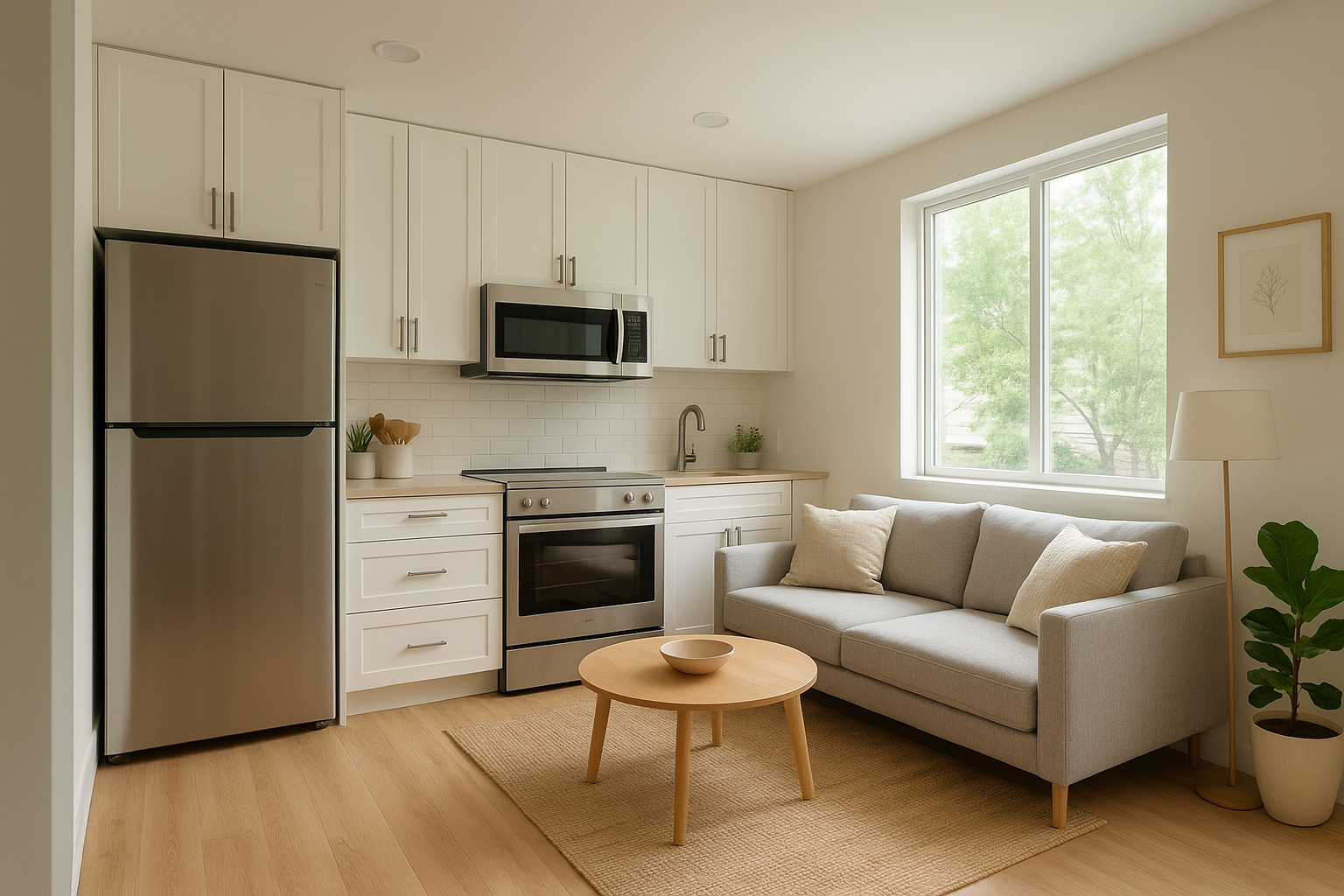
Interior finish quality is the most flexible budget lever in controlling total accessory dwelling units cost — without compromising rental appeal.
Hidden Costs That Blindside Even Experienced Builders
The most dangerous number in any ADU budget is the contractor’s base estimate — because it rarely captures the full picture. Budget a contingency reserve of 15–20% above your contractor’s bid. Here are the hidden costs that most frequently catch homeowners off guard:
- Soil remediation and engineered foundations: Expansive clay, poor drainage, or contaminated soil can require engineered solutions adding $10,000 – $50,000. Impossible to know without a geotechnical report.
- Electrical panel upgrade on primary home: Older 100A panels may need upgrading to 200A to carry the additional load of a new ADU. Cost: $3,000 – $10,000.
- Fire sprinkler system: Required by some jurisdictions for detached ADUs over a certain threshold. Cost: $4,000 – $12,000.
- Asbestos or lead paint remediation (conversions): Garage conversions in pre-1980 homes may encounter hazardous materials requiring licensed abatement. Cost: $2,000 – $15,000+.
- Design revision and permit re-submittal fees: Mid-project changes can trigger expensive re-review cycles with the building department, sometimes adding weeks of delay and $1,500 – $5,000 in fees.
- Landscaping, fencing, and access paths: Creating a private entrance pathway, restoring disturbed landscaping, or adding a privacy fence adds $2,000 – $20,000.
- Property tax reassessment: Building an ADU increases your assessed property value. In California, only the new improvement is reassessed (not the entire home), but in other states a full reassessment may apply. Budget for a modest ongoing increase in annual taxes.
- Construction loan carrying costs: If you’re financing with a construction loan, you pay interest on drawn funds during the build period — typically 6–18 months of interest payments at current rates.
- Temporary accommodations: Garage conversion projects sometimes require residents to temporarily relocate appliances or parking — with associated logistics costs.
Garage Conversion ADU Cost — A Detailed Deep Dive
Garage conversions are the most popular starting point for homeowners new to the ADU process because the existing structure dramatically reduces new construction costs. But the total accessory dwelling units cost for a garage conversion is often higher than homeowners initially expect, because the garage was never designed for human habitation.
Typical scope of work for a 600 sq ft attached garage conversion in 2025:
Financing Your ADU — All the Options Compared
The vast majority of homeowners finance their ADU rather than paying cash. Choosing the right financing product can save or cost you tens of thousands of dollars over the life of the project. Here’s a complete comparison of every major ADU financing option available in 2025:
For detailed guidance on ADU financing strategies, cost calculators, and project planning tools, The ADU Pro offers practical resources tailored specifically to ADU projects.
Return on Investment — Does the Accessory Dwelling Units Cost Pay Off?
The financial case for building an ADU is compelling in most U.S. markets — but it requires realistic numbers. Let’s walk through a concrete ROI analysis for a $200,000 detached ADU generating rental income:
Example: 600 Sq Ft Detached ADU — Los Angeles. Compare with a typical 2-bedroom ADU cost breakdown for sizing and finish tradeoffs.
- Total project cost: $220,000
- Monthly rental income: $2,200 (conservative for LA market)
- Annual gross rental income: $26,400
- Annual operating expenses (insurance, maintenance, vacancy): ~$4,000
- Annual net income: ~$22,400
- Simple payback period: ~9.8 years
- Net yield on investment: ~10.2% annually
- Property value increase (estimated): $180,000 – $250,000 based on comparable ADU sales
Rental income across U.S. markets ranges from $900/month in Midwestern cities to $3,500+/month in coastal metros. The National Association of Home Builders has consistently documented that ADUs increase overall property values — often by more than their construction cost in high-demand housing markets.
Beyond the rental return, consider these additional value drivers:
- Multi-generational housing value: Housing a parent or adult child eliminates $2,000 – $6,000/month in separate rent or assisted living costs — value that never shows up on a pro forma.
- Short-term rental premium: In markets where STRs are permitted, Airbnb income can significantly exceed long-term rental rates — sometimes doubling gross revenue.
- Depreciation tax benefits: The ADU structure is depreciable over 27.5 years under IRS residential property rules, creating annual tax deductions against rental income.
- Home sale premium: Properties with permitted, well-built ADUs command significant premiums in competitive markets, particularly in California and the Pacific Northwest.
How to Reduce Your ADU Cost Without Cutting Corners
Accessory dwelling units cost can be meaningfully reduced through smart decisions at each project stage — without sacrificing quality or rentability. Here are the highest-impact strategies used by experienced ADU builders:
- Use a city pre-approved plan: Save $5,000 – $15,000 in design fees and shorten permit review time by 2–4 months in participating jurisdictions.
- Choose a simple rectangular floor plan: Complex rooflines, angular walls, and bump-outs add significant framing and roofing cost. A simple rectangular footprint minimizes waste and labor.
- Stack wet walls: Locating the kitchen and bathroom back-to-back on a shared plumbing wall dramatically reduces rough plumbing runs and cost.
- Go all-electric: Eliminating gas connections saves $1,500 – $6,000 in gas infrastructure costs and may qualify for utility rebates or IRA tax credits on heat pump equipment.
- Choose LVP over hardwood or tile: Luxury vinyl plank costs $3 – $6/sq ft installed versus $10 – $20+ for hardwood — and outperforms both for rental durability.
- Get three itemized bids: Bid spreads of 30–50% are common in ADU construction. Itemized bids let you compare specific line items rather than lump-sum totals.
- Explore prefab or ADU kit companies: Companies like Abodu, Mighty Buildings, and Villa offer turnkey detached ADUs with predictable pricing — useful for budgeting even if you ultimately choose site-built.
- Apply for state and local grants: California’s CalHFA ADU Grant Program has offered up to $40,000 in forgivable grants for qualifying owner-occupants. Check your state’s housing finance agency for current programs.
Step-by-Step: How to Budget an ADU Project From Scratch
Follow this sequential process to build a defensible, realistic budget before you commit to a contractor or financing product.
-
Confirm ADU eligibility and zoning rules
Check your city’s ADU ordinance for allowed types, maximum square footage, setback requirements, height limits, owner-occupancy rules, and any deed restrictions. Many cities now post interactive ADU eligibility checkers on their planning department websites.
-
Identify your ADU type and target size
Based on your lot, budget, and goals (rental income vs. family housing vs. resale value), select the most appropriate ADU type and target square footage. Smaller ADUs cost less but have higher cost-per-square-foot due to fixed costs.
-
Request a pre-application meeting with your building department
Most cities offer pre-application consultations (free or low-cost) where a planner reviews your site and provides a written summary of requirements, fees, and any known complications. This is the single most valuable hour you can spend early in the process.
-
Order a preliminary site assessment and utility research
Have a contractor or civil engineer walk your site to identify grading challenges, utility access points, and soil conditions. Call your water and sewer utility to ask about connection fees and capacity requirements for a new ADU.
-
Obtain three itemized contractor bids
Provide each bidding contractor with the same scope document (type, size, finish level, and any known site conditions). Request itemized bids broken down by trade or CSI division so you can compare line items — not just totals.
-
Build your complete budget with all six cost categories
Add up all six cost categories: design/engineering, permits/fees, site prep/foundation, construction/labor, utility connections, and finishes/appliances. Do not use the contractor’s single-line total as your budget.
-
Add a 15–20% contingency reserve
Apply 15% for straightforward conversions on flat lots with no known complications. Use 20% for new detached builds, sloped lots, older homes, or any project where soil conditions are unknown.
-
Compare financing options and secure pre-approval
Run side-by-side comparisons of HELOC, home equity loan, cash-out refi, and any ADU-specific programs in your state. Secure a pre-approval or commitment letter before signing a construction contract.
Master Budget Checklist — review our ADU budget worksheet and planning notes.
- Confirm ADU type, target size, and zoning eligibility
- Research permit fees, impact fees, and utility connection charges
- Conduct a preliminary site assessment (soil, utilities, grading)
- Collect three itemized contractor bids
- Build a six-category budget (not just construction cost)
- Add 15–20% contingency reserve
- Compare all financing options side by side
- Check state and local grant programs before signing contracts
Frequently Asked Questions About Accessory Dwelling Units Cost
What is the average accessory dwelling units cost in 2025?
The average accessory dwelling units cost in 2025 ranges from $100,000 to $400,000 for a new detached build, depending on size, region, and finish level. Garage conversions typically run $50,000 to $150,000, while Junior ADUs are the most affordable at $20,000 to $80,000. For projected pricing updates see our 2026 pricing guide.
How much does a garage conversion ADU cost in 2025?
A garage conversion ADU typically costs $50,000 to $150,000 in 2025. While the existing structure saves framing and foundation costs, you still need full plumbing, electrical, HVAC, insulation, and interior finishing — all of which must meet residential habitability standards.
What is the cheapest type of ADU to build?
A Junior ADU (JADU) is the least expensive option, costing $20,000 to $80,000 because it is created entirely within the existing home’s footprint with no new exterior construction. There is no foundation, no new roof, and no utility lateral required.
What is the cost per square foot for a detached ADU?
Detached ADUs typically cost $200 to $500 per square foot for construction alone. When design, permits, site prep, and utility connections are included, the all-in cost per square foot often ranges from $250 to $600+, with smaller units carrying a higher per-square-foot cost due to fixed expenses being spread over fewer square feet.
Do ADU permit fees vary significantly by city?
Yes — substantially. Rural jurisdictions may charge $500 to $2,000 in total permit fees. In contrast, cities like San Francisco can charge $20,000 to $40,000 in combined building permit, plan check, school impact, and utility connection fees for a new detached ADU. Always research your specific city’s fee schedule before budgeting.
How long does it take to build an ADU?
Most ADU projects take 6 to 18 months from permit application to a certificate of occupancy. Permitting alone takes 2 to 6 months in most cities. Garage conversions are typically faster (6–10 months) while new detached builds can take 12–18 months. Prefab ADUs can significantly compress the construction phase but permitting timelines remain similar.
Can I finance an ADU with a HELOC or home equity loan?
Yes. A HELOC or home equity loan is one of the most common ways to finance an ADU. A HELOC is revolving and variable-rate; a home equity loan provides a fixed lump sum at a fixed rate. Other options include cash-out refinancing, construction loans, FHA 203k renovation loans, and ADU-specific CDFI programs available in some states with below-market rates.
Does building an ADU increase property taxes?
In most jurisdictions, yes — an ADU increases your assessed property value, which raises your annual property tax. In California under Proposition 13, only the newly constructed ADU is reassessed, not the entire property. In other states, a full reassessment of the entire parcel may occur. Budget for a modest ongoing tax increase as part of your ownership cost analysis.
Are prefab or modular ADUs cheaper than site-built?
Prefab and modular ADUs reduce the construction labor component by 10–25% compared to custom site-built projects. However, site preparation, foundation work, utility hookups, and delivery/crane placement costs are identical. In high-labor markets like the Bay Area, prefab savings are most pronounced. Companies like Abodu, Mighty Buildings, and Villa offer turnkey pricing that can simplify the budgeting process.
What hidden costs should I budget for in an ADU project?
The most common hidden costs include: soil testing and engineered foundations ($10,000–$50,000), electrical panel upgrades ($3,000–$10,000), fire sprinkler systems ($4,000–$12,000), asbestos/lead remediation in older homes ($2,000–$15,000), design revision and re-submittal fees ($1,500–$5,000), and utility connection fees ($5,000–$30,000). Always add a 15–20% contingency reserve above your contractor’s base estimate.
How much rental income can an ADU generate?
Long-term rental income for ADUs ranges from approximately $900/month in lower-cost Midwestern markets to $3,500+/month in coastal metros like Los Angeles, San Francisco, and Seattle. Short-term rental income via Airbnb can significantly exceed long-term rates in markets where STRs are permitted. In most urban markets, a well-built ADU pays back its construction cost within 8–12 years through rental income alone.
What is a Junior ADU and how much does it cost?
A Junior ADU (JADU) is a unit of up to 500 square feet created entirely within the footprint of the existing primary home — typically a converted bedroom or interior suite. JADUs typically cost $20,000 to $80,000, require no new exterior construction, and often qualify for streamlined permitting under California state law (SB 13). They are the fastest and most budget-friendly ADU path for most homeowners.
Do I need an architect to design an ADU?
Most jurisdictions require stamped plans from a licensed architect or structural engineer for an ADU building permit. Custom architect fees run $5,000 to $25,000. However, many cities now offer free pre-approved plan libraries that eliminate this cost, and prefab ADU providers typically include engineering and design in their package price.
Are there grants available to help pay for ADU construction?
Yes. California’s CalHFA ADU Grant Program has provided up to $40,000 in forgivable grants to qualifying owner-occupants. Several cities and counties also offer local grant and loan programs, particularly for affordable housing ADUs. Check your state’s housing finance agency (HFA) and local community development department for currently active programs before signing any construction contracts.
Final Thoughts: Building a Budget That Actually Works
Understanding the true accessory dwelling units cost — every single category, not just the contractor’s construction quote — is what separates projects that finish on budget from those that spiral. The homeowners who avoid budget disasters all do the same things: they research their city’s specific fees before hiring anyone, they build a six-category budget, they get itemized bids, and they maintain a proper contingency reserve.
Whether your goal is generating rental income, housing a family member, or increasing your property’s long-term value, a well-planned ADU remains one of the most financially sound home investments available in 2025. The key is knowing your numbers before you commit — and that’s exactly what this guide is designed to help you do.
For project-specific ADU cost calculators, financing tools, and expert guidance, visit The ADU Pro — a resource built specifically for homeowners navigating the ADU planning and construction process.