
An ADU property value increase is one of the most compelling financial reasons Southern California homeowners are choosing to build accessory dwelling units today. In simple terms, an ADU property value increase refers to the measurable rise in a home’s market value after a permitted accessory dwelling unit — such as a detached guest house, garage conversion, or attached addition — is constructed on the property. For homeowners in Orange County, Los Angeles County, and Riverside County, the numbers are hard to ignore.
According to Zillow Research, homes with ADUs in high-demand urban markets can sell for 35% more than comparable homes without them. Furthermore, the income potential of a rentable unit adds a layer of value that standard home improvements simply cannot match. In this guide, we break down exactly how ADUs drive property value, which types deliver the strongest returns, and how to approach the process strategically.
What Is an ADU Property Value Increase?
An ADU, or accessory dwelling unit, is a secondary housing unit on a single-family residential lot. It can be detached from the main home, attached to it, or converted from an existing structure like a garage. When a permitted ADU is added to a property, appraisers recognize two distinct value drivers: the additional square footage and the income-generating potential of the unit.
Therefore, the value increase is typically higher than what you would see from a standard room addition of the same size. A bedroom addition adds livable space; an ADU adds livable space plus the possibility of monthly rental income, which appraisers weigh heavily when using the income approach to valuation.
In Southern California specifically, where housing demand consistently outpaces supply, the premium placed on properties with ADUs is especially pronounced. Buyers actively seek homes with income-producing units, and sellers benefit accordingly.
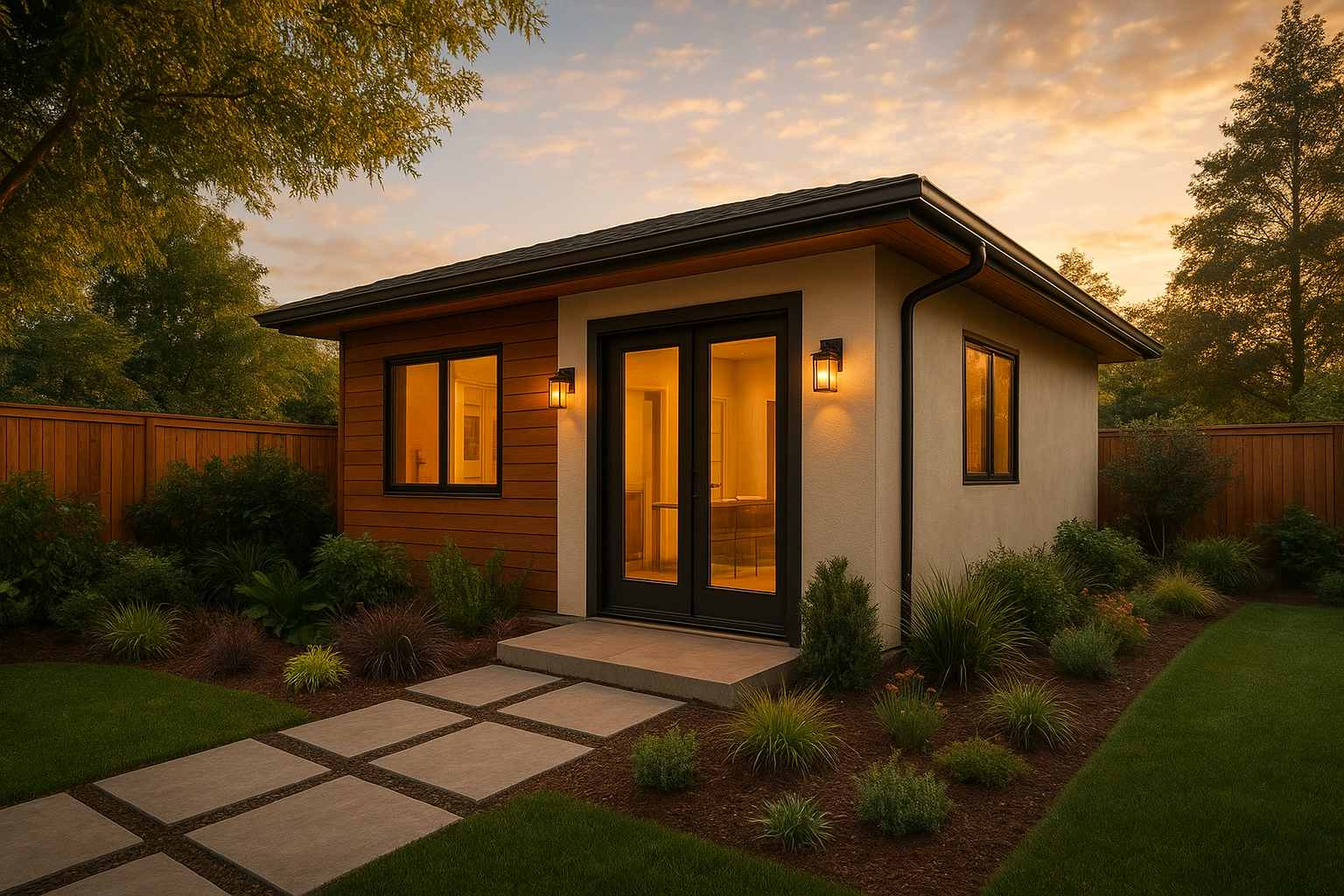
A well-built detached ADU can deliver one of the strongest property value increases available to Southern California homeowners.
How Much Value Does an ADU Add to Your Home?
The honest answer depends on several factors: the type of ADU, its size, finish quality, and your local market. However, research and real-world data point to consistent and meaningful gains. In Southern California markets, a well-constructed ADU commonly adds between $100,000 and $300,000 to a property’s appraised value.
For example, a 600-square-foot detached ADU in Anaheim or Pasadena that rents for $2,200 per month could add roughly $200,000 to $250,000 in appraised value using the income capitalization approach. Consequently, even after construction costs of $180,000 to $220,000, many homeowners find they break even on paper at completion — and then begin building equity from day one of rental income.
The National Association of Realtors has noted that accessory units are among the most sought-after features by buyers in competitive markets, further supporting the case for ADU investment.
ADU Type Comparison: Which Adds the Most Value?
Not all ADU types deliver equal returns. Here is a general breakdown of how each compares:
- Detached ADU: Highest value addition; functions as a fully independent unit with private entrance, kitchen, and bathroom.
- Attached ADU: Strong value addition; shares a wall with the primary home but retains separate living functions.
- Garage Conversion ADU: Cost-effective with solid ROI; typically 60–80% of build costs returned in added value.
- Junior ADU (JADU): Lower cost and lower value gain, but still improves marketability and rental income potential.
For a deeper look at how each option fits your specific property, explore strategies for maximizing your property’s potential with ADUs from The ADU Pro’s resource library.
How Appraisers Measure ADU Home Value
Understanding how appraisers calculate value helps homeowners make smarter building decisions. In general, appraisers use one or more of three approaches when evaluating a property with an ADU.
First, the income approach estimates value based on the rental income the ADU can realistically generate. Appraisers apply a capitalization rate to the projected annual rent to arrive at a value figure. In high-rent markets like Los Angeles, this method often produces the highest valuation.
Second, the sales comparison approach looks at recent sales of comparable properties with ADUs in your area. As more ADUs are built and sold across Southern California, this data pool grows richer, which generally benefits sellers.
Third, the cost approach estimates the value of the ADU based on what it would cost to rebuild it. This method is less commonly used for ADU valuation but may be applied in certain circumstances.
To understand the full valuation picture, you can also visit The ADU Pro’s valuation resources for market-specific guidance.

Appraisers use income, sales comparison, and cost approaches to determine how much an ADU raises a property’s market value.
Step-by-Step: How to Maximize Your ADU Property Value Increase
Building an ADU strategically — rather than haphazardly — is the key to maximizing your return. Follow these five steps to ensure your project delivers the strongest possible value gain.
- Assess Your Property’s ADU Potential. Review your lot size, zoning designation, and existing structures. Determine which ADU type — detached, attached, garage conversion, or JADU — fits your property and aligns with your financial goals.
- Choose the Right ADU Design for Maximum Value. Work with an experienced contractor to select a design that maximizes square footage, natural light, and functional layout. These factors directly influence appraised value and rental desirability.
- Navigate Permits and Local Regulations. Submit permit applications to your local jurisdiction and ensure full compliance with California ADU laws, including setback requirements, height limits, and utility connection standards. Under AB 68 and related legislation, cities must approve or deny ADU permits within 60 days.
- Build with Quality Materials and Craftsmanship. Use high-quality finishes, energy-efficient systems, and durable materials. These choices ensure the ADU commands top rental rates and appraises at maximum value — not just at completion, but for years to come.
- Pass Final Inspection and Document Everything. Obtain all final sign-offs and certificates of occupancy. Keep thorough records of permits, plans, and construction receipts. This documentation supports a higher appraisal and simplifies any future sale or refinancing.
Rental Income: The Ongoing Value Engine
Beyond the one-time bump in appraised value, ADUs offer a continuous financial benefit through rental income. In Southern California, ADU rentals typically generate between $1,500 and $3,500 per month, depending on location, size, and amenities. Over a 10-year period, that represents $180,000 to $420,000 in gross rental revenue.
Furthermore, rental income can be used to offset mortgage payments, fund property improvements, or simply build savings. In many cases, homeowners recoup their full ADU construction cost within five to seven years through rent alone — before factoring in the equity gain.
The California Department of Housing and Community Development actively encourages ADU construction as a solution to the state’s housing shortage, which means regulatory conditions remain favorable for homeowners looking to build and rent.
ADU Value for Multigenerational Families
Not every homeowner builds an ADU to rent it out. Many Southern California families use ADUs to house aging parents, adult children, or other relatives. In these cases, the value proposition shifts slightly — but it does not disappear. The ADU still adds measurable equity, and the property becomes more attractive to future buyers who may have similar multigenerational needs.
In addition, multigenerational living can reduce overall household expenses, effectively freeing up income that would otherwise go toward separate housing costs. This lifestyle benefit, combined with the equity gain, makes ADUs one of the most versatile investments available to homeowners today. For more on how this works, see how an ADU can increase your property value.

ADUs serve multigenerational families while still delivering a meaningful property value increase over time.
California ADU Regulations and What They Mean for Value
California has been among the most proactive states in the nation when it comes to streamlining ADU approvals. A series of laws — including AB 68, SB 9, and AB 881 — have significantly reduced barriers to ADU construction by limiting local government restrictions on setbacks, parking, and owner-occupancy requirements.
As a result, homeowners in Orange County, Los Angeles County, and Riverside County now have more flexibility than ever to build ADUs that maximize both livable space and property value. Specifically, many jurisdictions now allow ADUs on lots that previously could not support them, opening up a larger pool of eligible properties.
Working with a contractor who deeply understands these evolving regulations is therefore critical. The ADU Pro specializes in navigating California’s ADU laws across all three counties, ensuring every project is compliant, efficient, and positioned for maximum value from the start. You can also explore ADU potential insights to see how different projects perform across the region.
Common Mistakes That Reduce ADU Value
Unfortunately, not every ADU project delivers its full value potential. Several common mistakes can significantly reduce the return on your investment. Being aware of these pitfalls helps you avoid them.
- Skipping permits: An unpermitted ADU is essentially invisible to appraisers and cannot legally be rented out. Moreover, it creates liability during a sale.
- Poor layout design: A cramped or poorly designed unit will struggle to attract tenants and appraise below its potential.
- Low-quality finishes: Cutting corners on materials and fixtures reduces rental appeal and long-term durability.
- Ignoring energy efficiency: California’s Title 24 energy standards are mandatory, and energy-efficient ADUs command higher rents and better appraisals.
- Choosing the wrong contractor: An inexperienced builder can cause costly delays, code violations, and substandard workmanship that undermines your investment.
In contrast, partnering with a top-rated, experienced ADU contractor eliminates most of these risks from the outset. You can also explore ADU value topics for additional guidance on protecting your investment.
Frequently Asked Questions About ADU Property Value Increase
How much does an ADU property value increase add to a home?
An ADU property value increase typically adds between $100,000 and $300,000 to a home’s market value in Southern California, depending on size, quality, and location. Appraisers consider both the added square footage and the income potential of the unit.
What type of ADU adds the most property value?
Detached ADUs generally add the most property value because they function as fully independent living spaces. However, garage conversions and attached ADUs also deliver strong returns, especially in high-demand rental markets like Los Angeles and Orange County.
How do appraisers calculate ADU value?
Appraisers use the income approach, the sales comparison approach, or a combination of both. The income approach estimates value based on the rental income the ADU can generate, while the sales comparison approach looks at similar properties with ADUs nearby.
Does a garage conversion increase property value?
Yes, a garage conversion ADU can significantly increase property value, often returning 60% to 80% of construction costs in added home equity. The increase depends on the quality of the conversion and local rental demand.
How long does it take to build an ADU in California?
Most ADU projects in California take between 6 and 12 months from permit approval to final inspection. Design and permitting typically add another 2 to 4 months, though experienced contractors can streamline the process significantly.
What is the average cost to build an ADU in Southern California?
The average cost to build an ADU in Southern California ranges from $150,000 to $400,000, depending on the type, size, and finishes. Garage conversions tend to be less expensive, while custom detached ADUs cost more.
Can I rent out my ADU to generate income?
Yes, renting out an ADU is one of the primary financial benefits of building one. In Southern California, ADU rentals can generate between $1,500 and $3,500 per month depending on location and size, helping offset construction costs quickly.
Does an ADU increase property taxes?
Yes, adding an ADU will generally increase your property tax assessment because it increases the assessed value of your property. However, only the newly constructed portion is reassessed — your existing home’s base value is not affected under California’s Proposition 13.
Is it worth building an ADU for multigenerational living?
Absolutely. ADUs are ideal for multigenerational households because they provide private, independent living space while keeping family members close. Beyond the lifestyle benefits, they still add measurable equity to the property.
What permits are required to build an ADU in California?
California requires a building permit for all ADU construction. Local jurisdictions may also require separate electrical, plumbing, and mechanical permits. Under AB 68 and related legislation, cities must approve or deny ADU permits within 60 days.
What is a junior ADU and does it add value?
A junior ADU (JADU) is a smaller unit of up to 500 square feet created within the existing footprint of a home. While it adds less value than a full ADU, it is a cost-effective way to increase rental income potential and overall property appeal.
How does an ADU compare to a home addition for increasing value?
ADUs often outperform standard home additions in value because they create a separate, rentable unit. A home addition increases livable square footage, but an ADU adds both square footage and income-generating potential, which appraisers value more highly.
Conclusion: Why ADU Property Value Increase Is a Smart Long-Term Move
In summary, the ADU property value increase is one of the most powerful and well-documented financial benefits available to Southern California homeowners. Whether your goal is to generate rental income, accommodate family members, or simply grow your home equity, a permitted, well-built ADU delivers on all fronts. The combination of appraised value gains, ongoing rental revenue, and favorable California regulations creates a compelling case for action. Above all, working with an experienced contractor who understands local codes, design best practices, and the full development process is the single most important factor in realizing the maximum return on your ADU investment. If you are ready to explore what an ADU could do for your property, The ADU Pro is here to guide you every step of the way.