
Accessory dwelling unit grants are non-repayable funding awards from government agencies, state housing finance authorities, and nonprofit organizations that help homeowners plan, permit, or build a secondary unit on their property. Unlike a loan, a grant never has to be paid back — it simply reduces what you owe out of pocket. Because housing costs keep climbing nationwide, the number of grant, forgivable-loan, and fee-waiver programs supporting ADU construction has expanded dramatically over the past few years, and knowing where to look now matters more than ever.
This guide goes beyond a single state program. It walks through every layer of funding — federal, state, local, and nonprofit — along with eligibility rules, real dollar amounts, application steps, and the mistakes that sink most applications. In addition, you’ll see exactly how accessory dwelling unit grants fit alongside loans and other financing so you can build a complete funding strategy instead of chasing a single program.
What Are Accessory Dwelling Unit Grants, Exactly?
An accessory dwelling unit (often shortened to ADU) is a secondary home built on the same lot as an existing house — a detached backyard cottage, a converted garage, a basement apartment, or an attached addition. According to Wikipedia’s overview of accessory dwelling units, these small secondary homes have become a central tool for expanding affordable housing supply without changing a neighborhood’s character.
Grants differ from loans in one crucial way: they transfer money directly to a qualifying homeowner with no expectation of repayment. As a result, households that could never qualify for — or afford — a large construction loan can still move forward with an ADU, provided they meet the program’s criteria. If you’re also weighing what an ADU could do for your property’s value, our guide on maximizing your property’s potential with an ADU is a useful companion read.

Accessory dwelling unit grants can turn the dream of a backyard cottage into a financial reality. For itemized cost breakdowns, see our Accessory Dwelling Unit Cost Estimate: 2026 Pricing Guide.
Why ADU Grant Demand Has Surged Since 2023
Rising rents and a persistent shortage of starter homes have pushed both state legislatures and city councils to treat ADUs as a fast, low-impact way to add housing units. Consequently, dozens of new grant, fee-waiver, and forgivable-loan programs have launched or expanded their budgets since 2023. Understanding this landscape early gives you a real head start, since many programs award funds on a rolling, first-come basis rather than through a lottery.
Furthermore, several programs now stack: a homeowner might combine a city permit-fee waiver, a state predevelopment grant, and a federally-funded local program all on the same project. Because these layers rarely overlap in what they cover, pursuing more than one is usually not just possible but encouraged by program administrators themselves.
California’s ADU Grant Landscape, In Depth
California remains the most active state for ADU-specific funding, so it deserves a close look. The CalHFA ADU Grant Program, administered through the California Housing Finance Agency, has provided eligible homeowners with up to $40,000 to cover predevelopment costs — architectural drawings, soil and site reports, impact fees, and permit costs. Because this money is disbursed as reimbursement for pre-construction expenses, it’s specifically designed to remove the upfront barrier that stops many homeowners before they even get a permit.
CalHFA Eligibility Snapshot
Eligibility has historically centered on household income limits tied to area median income, along with owner-occupancy requirements. In practice, this means the program targets moderate-income homeowners rather than investors or absentee owners. Because funding rounds open and close based on the state budget, checking the California Department of Housing and Community Development (HCD) website directly is the most reliable way to confirm current availability.
Beyond CalHFA: City-Level California Programs
In addition to the statewide program, several California cities run their own predevelopment grants ranging from $10,000 to $25,000, funded through local housing trust funds. These local pools are smaller, but they also draw far fewer applicants than a statewide program — which, as a result, often means better approval odds for homeowners who apply early.
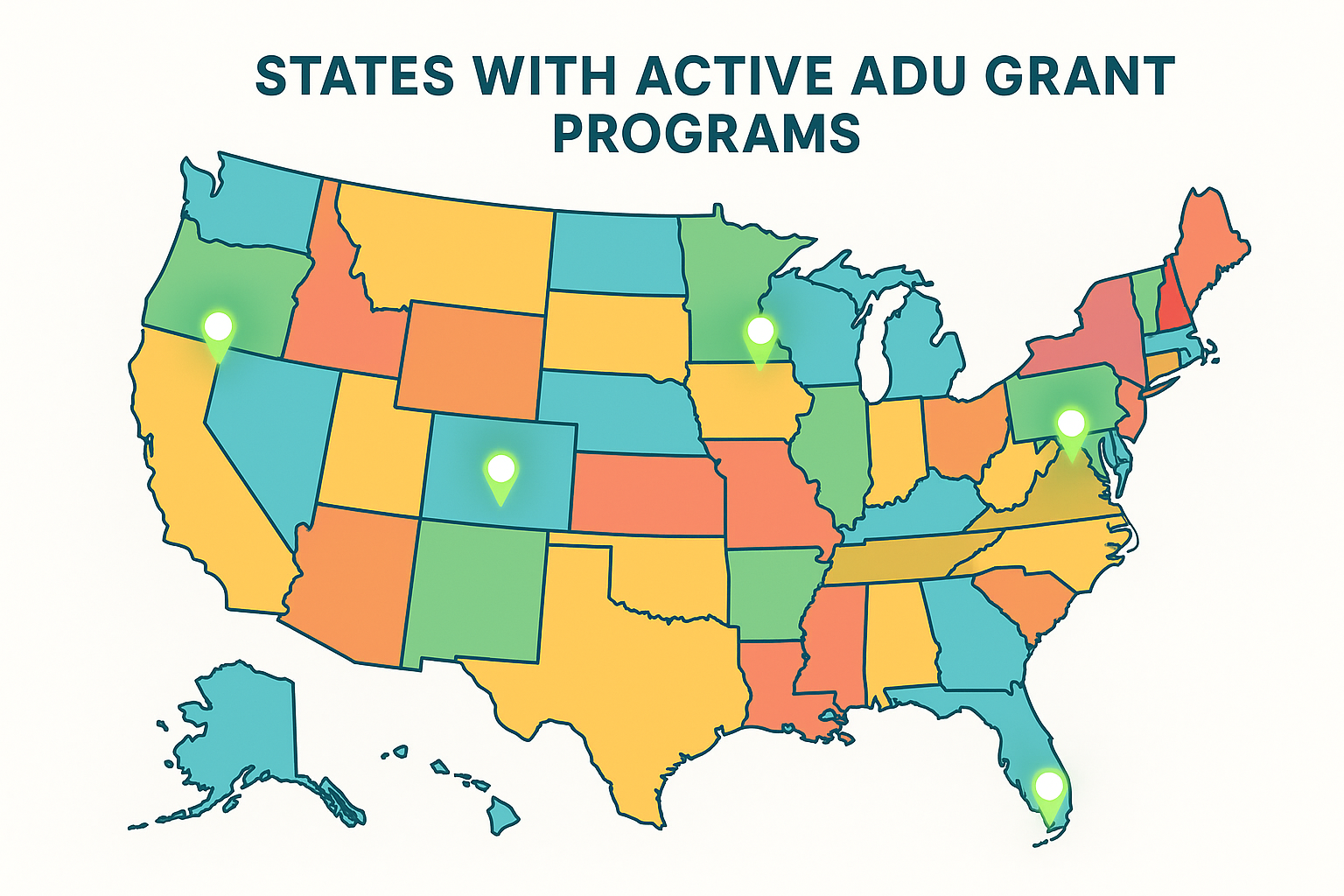
Grant availability varies significantly by state, so checking your local housing finance agency is a critical first step.
Federal Programs That Fund ADU Construction
At the federal level, the largest funding channel is the HUD Community Development Block Grant (CDBG) program. HUD distributes CDBG funds annually to cities and counties, which then design their own housing programs locally. Many municipalities funnel these dollars specifically into ADU assistance for low-to-moderate income homeowners.
Similarly, the HOME Investment Partnerships Program is a second federal channel some localities direct toward ADU development. However, because both programs pass through state and local governments first, you never apply to HUD directly — instead, you apply through your city or county housing office.
How to Track Down Federally-Funded Local Programs
Search your city’s official website for terms like “housing assistance,” “ADU program,” or “home improvement grant.” Because CDBG allocations shift every fiscal year, programs open and close on their own schedule. For this reason, it’s worth checking back every few months even if a program currently shows as closed. Our guide to finding an accessory dwelling unit near you also walks through how to identify local resources block by block.
State-Level Grant Programs Outside California
California isn’t alone. Oregon, Washington, Vermont, and Minnesota have each rolled out pilot grant programs or forgivable-loan structures that function like grants in practice. Specifically, a forgivable loan converts into a grant once a homeowner meets certain conditions — for example, renting the ADU at an affordable rate for five to ten years — which makes it financially equivalent to an outright grant for most applicants.
Meanwhile, several Oregon cities have piloted design-assistance grants and permit-fee waivers, which reduce project costs just as effectively as a cash award. Because every state legislature sets its own rules and budget cycle, the smartest move is to check your state’s housing finance agency directly rather than relying on a single national list that may already be outdated.
Local, Municipal, and Nonprofit ADU Funding
Beyond state and federal sources, many cities and counties run standalone ADU grant or subsidy programs entirely on their own. Local programs typically have shorter application windows and a smaller applicant pool, which often means your odds of approval are higher than in a large statewide competition. Therefore, prioritizing local programs before pursuing bigger state grants is a smart sequencing strategy.
Nonprofit and Community Land Trust Funding
Nonprofit housing organizations and community land trusts also distribute ADU-related grants in certain regions. These groups typically prioritize senior homeowners, households with disabled family members, or properties in historically underserved neighborhoods. Although smaller in scale, these programs can be highly targeted — and therefore easier to qualify for if you fit the demographic criteria.
Accessory Dwelling Unit Grant Eligibility Requirements
Although every program is different, most accessory dwelling unit grants share a common eligibility framework. Understanding these shared rules upfront saves you from wasting time on a program you can’t actually use.
- Income limits: Most programs cap eligibility at 80% to 120% of area median income, targeting low-to-moderate income households first.
- Owner-occupancy: Applicants typically must live in the primary residence on the same lot, ruling out most absentee investors.
- Affordability terms: Some programs require the ADU be rented below market rate for a set number of years — often five to ten.
- Pre-approval timing: Nearly all programs require approval before construction begins; funds are rarely awarded retroactively.
- Property standing: Clear title, current property taxes, and no active code violations are commonly required.
How Much Money Can You Actually Receive?
Grant amounts vary widely depending on the program’s funding source and purpose. Below is a realistic breakdown so you know what to expect before you apply.
- Predevelopment grants: $2,000 to $40,000, typically covering permits, drawings, and soil reports (CalHFA is the largest example at up to $40,000).
- Local municipal grants: $10,000 to $25,000, often funded through city housing trust funds.
- Fee waivers: $3,000 to $15,000 in avoided permit and impact fees — not cash, but a real reduction in total project cost.
- Nonprofit and land trust grants: $5,000 to $20,000, usually reserved for seniors or households with a disabled family member.
Because most single grants cover only a fraction of an $80,000 to $200,000+ ADU project, stacking multiple funding sources is the realistic path for most homeowners — a strategy covered in detail further below.
Step-by-Step: How to Apply for Accessory Dwelling Unit Grants
Applying for grants rewards preparation. Follow these steps in order to maximize your chances of approval.
- Research every available program. Check your city, county, and state housing agency websites first. Resources like The ADU Pro also aggregate current funding opportunities and program updates in one place, saving hours of manual searching.
- Confirm your eligibility before applying. Review income limits, owner-occupancy requirements, and any affordability restrictions tied to the program so you don’t waste time on a mismatch.
- Gather your documentation early. Most programs require proof of ownership, recent tax returns or income verification, a project cost estimate, and sometimes a contractor bid or architectural drawings.
- Submit a fully complete application. Incomplete applications remain the single most common reason for rejection, so double-check every required field and attachment before you hit submit.
- Track deadlines and follow up consistently. Grant cycles open and close quickly, so set calendar reminders and contact program administrators if you don’t hear back within the stated processing window.
Once your grant is approved, the next question becomes design and construction planning. Our ultimate guide to ADU design and construction picks up exactly where this step-by-step process ends.
Combining Grants With Other ADU Financing
Because most grants cover only a portion of total project costs, combining them with other financing tools is common — and, in many cases, necessary. Home equity loans, construction loans, and cash-out refinancing are frequently layered on top of grant awards to bridge the remaining gap.
Additionally, some homeowners pair grants with low-interest, ADU-specific loan programs offered by state housing finance agencies. In California, for instance, the CalHFA ADU loan program can be used alongside the predevelopment grant to cover both early-stage and construction-phase costs. This layered approach is increasingly common, and it’s explicitly encouraged by many program administrators rather than discouraged. If you want to compare rates and terms across financing types, our breakdown of easy ADU financing for real estate success covers the loan side of this equation in full.
For a comprehensive overview of every ADU financing strategy — including grants, loans, and equity-based options — The ADU Pro provides guidance tailored to different property types and budget scenarios.
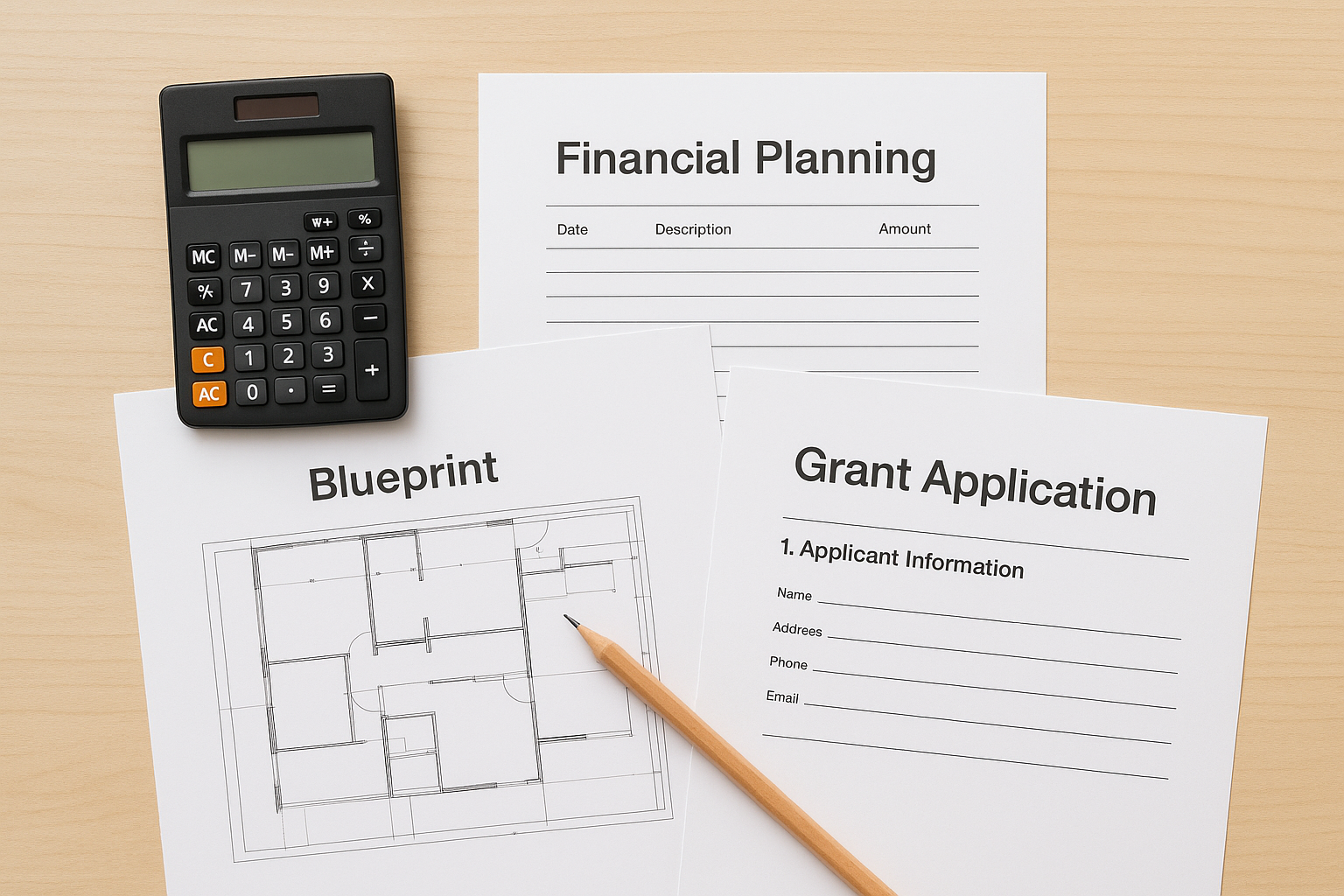
Careful financial planning — combining grant funds with complementary financing — is the most effective way to fund an ADU project.
Grants vs. Loans vs. Tax Incentives: What’s the Real Difference?
Homeowners often lump every funding option together, but each works differently. Grants require no repayment at all. Loans, in contrast, must be repaid with interest, though ADU-specific loans often carry better terms than a standard personal loan. Tax incentives — such as certain property tax adjustments or depreciation benefits for rental ADUs — reduce your ongoing tax burden rather than your upfront cost.
Consequently, the strongest funding strategy usually combines all three: a grant to lower upfront costs, a loan to cover the remaining balance, and tax planning to improve long-term returns once the unit is rented. Because grant funds may carry tax implications depending on how they’re used, it’s worth reviewing guidance from the IRS or consulting a tax professional before assuming any award is automatically tax-free.
Common Mistakes That Disqualify ADU Grant Applicants
Many applicants lose out on funding due to avoidable errors. First, applying for programs you don’t actually qualify for wastes time and delays your project unnecessarily. Second, submitting incomplete documentation remains the single most common cause of rejection across virtually every program.
Furthermore, waiting until construction has already started often disqualifies applicants entirely, since most programs require approval before any work begins. Finally, overlooking local municipal programs in favor of better-known state programs is a missed opportunity — local programs frequently move faster and face far less competition.
Are Accessory Dwelling Unit Grants Worth Pursuing?
Absolutely. Even a $10,000 grant meaningfully reduces the financial risk of a project that might cost $80,000 to $200,000 or more. Because grants require no repayment, every dollar awarded directly improves your return on investment and lowers the monthly carrying cost of any construction loan taken alongside it.
In short, accessory dwelling unit grants remain one of the most underused tools available to homeowners today. By researching federal, state, local, and nonprofit programs, preparing a thorough application, and pairing grant funds with complementary financing, you can dramatically cut the true cost of building an ADU — and speed up the timeline for rental income or housing a family member.
Frequently Asked Questions About Accessory Dwelling Unit Grants
What are accessory dwelling unit grants?
Accessory dwelling unit grants are non-repayable funds from government agencies or nonprofits that help homeowners cover ADU planning, permitting, or construction costs. They reduce the total financial burden of building a secondary unit on your property. For a deeper walkthrough, see our Accessory Dwelling Unit Permit: Complete Guide 2024.
Who qualifies for ADU grants?
Eligibility varies by program, but most target low-to-moderate income owner-occupants, seniors, or residents in designated housing shortage areas. Some programs additionally require the ADU be rented at affordable rates for a set number of years.
How much money can I receive from an ADU grant?
Amounts range from a few thousand dollars for predevelopment costs to $40,000 or more for construction assistance. California’s CalHFA ADU Grant Program has offered up to $40,000 specifically for predevelopment expenses such as permits and architectural plans.
Where can I find ADU grant programs near me?
Start with your city or county housing department, your state’s housing finance agency, and HUD’s CDBG program page. Additionally, resources like The ADU Pro compile current funding opportunities across multiple states in one place.
Do ADU grants cover the full cost of construction?
Most ADU grants cover only a portion of total costs. Homeowners typically combine grant funds with loans, home equity products, or personal savings to bridge the remaining gap.
What is the difference between an ADU grant and an ADU loan?
A grant does not require repayment, while a loan must be paid back with interest. Grants are more competitive and harder to qualify for, but they eliminate debt entirely, making them more financially advantageous when available.
Can I use an ADU grant for a detached backyard cottage?
Many programs allow grants for detached ADUs, but some restrict funding to attached units or garage conversions. Always review the specific program guidelines before applying to confirm eligible structure types.
Are ADU grant funds considered taxable income?
In many cases, grant funds used strictly for construction may not be taxable, but this depends on the specific program and your situation. Consult a qualified tax professional or the IRS before assuming any grant is automatically tax-free.
How long does it take to receive an ADU grant?
Processing times vary significantly. Local programs may award funds within a few weeks, while state or federal programs can take several months from application submission to disbursement.
What documents do I need to apply for an ADU grant?
Typical requirements include proof of property ownership, income verification, a project cost estimate, and sometimes architectural drawings or a contractor bid. Each program publishes its own checklist, so review it carefully before applying.
Can investors or landlords apply for ADU grants?
Most ADU grant programs are designed for owner-occupants rather than investors. However, some programs accept landlord applications when the applicant agrees to rent the ADU at affordable rates for a defined period.
What is the CDBG program and how does it fund ADUs?
The Community Development Block Grant (CDBG) is a federal HUD program that distributes funds to local governments for housing and community development. Some municipalities use CDBG allocations to create ADU construction assistance programs for qualifying low-to-moderate income residents.
Can I combine multiple accessory dwelling unit grants on one project?
Yes, in many cases. Because a permit-fee waiver, a predevelopment grant, and a nonprofit grant often cover different cost categories, stacking them is common and typically allowed, provided each program’s individual rules don’t explicitly prohibit it.
Do accessory dwelling unit grants affect my property taxes?
Building an ADU can increase your property’s assessed value in some jurisdictions, regardless of whether the construction was grant-funded. Check with your county assessor’s office to understand how local reassessment rules apply to your specific project.