
Functional ADU designs are accessory dwelling unit layouts that turn compact square footage into genuinely livable, efficient homes — and they are transforming how Southern California homeowners think about their properties. See ADU design Buena Park for a nearby local example. Whether you are planning a detached guest house, a garage conversion, or a junior unit inside your existing home, the right design approach determines whether your ADU feels spacious and practical or cramped and underused. In this guide, you will find everything you need to plan an ADU that works beautifully for years to come.
What Makes Functional ADU Designs Effective?
A functional ADU design is one that meets the daily needs of its occupants without wasting a single square foot. According to the California Department of Housing and Community Development, ADUs can be as small as 150 square feet — which means thoughtful design is not optional; it is essential.
Specifically, functional ADU layouts share several core characteristics; see our great ADU design. They prioritize natural light, provide adequate storage, and use multi-purpose spaces that adapt to different activities. Furthermore, they anticipate how the unit will be used — whether by a renter, an aging parent, or a young adult family member — and plan accordingly.
In contrast, poorly planned ADUs often feel like an afterthought. Narrow hallways, insufficient kitchen counter space, and awkward bedroom placement are common pitfalls. As a result, investing time in the design phase pays dividends throughout the life of the unit.
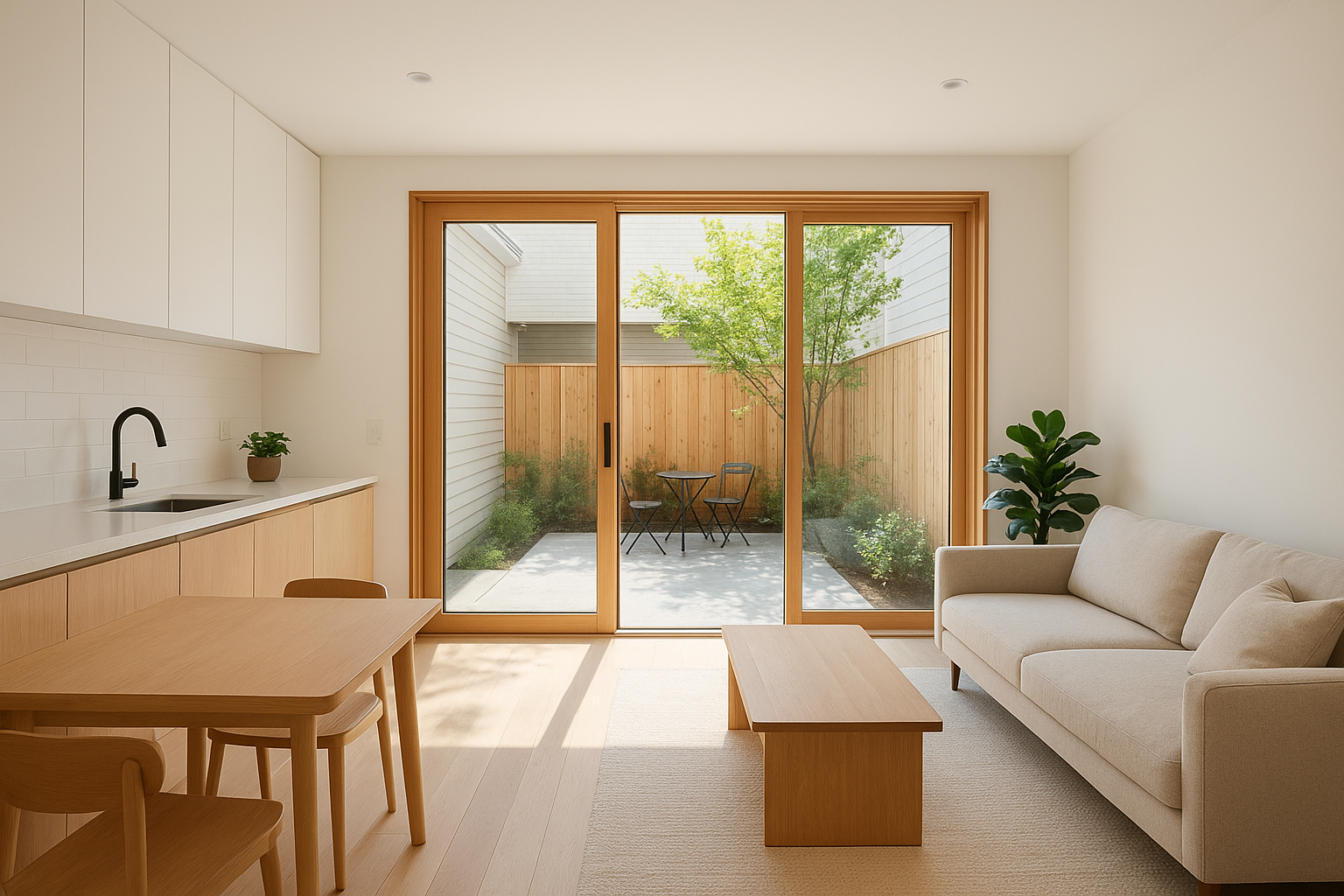
An open-plan interior is one of the hallmarks of functional ADU designs, making compact spaces feel airy and versatile.
The Four Main ADU Types and Their Design Considerations
Before diving into specific design strategies, it helps to understand the four primary ADU categories. Each type presents unique opportunities and constraints that shape the design process.
1. Detached ADUs
Detached ADUs are standalone structures separate from the main house. They offer the greatest design freedom because they are not constrained by an existing structure’s footprint. However, they also require the most site work, including foundation, utility connections, and setback compliance. For homeowners seeking maximum privacy — for a tenant or a family member — a detached unit is often the best choice.
2. Attached ADUs
Attached ADUs share at least one wall with the primary residence. They tend to cost less than detached units because they can leverage existing structural elements. In addition, they often allow for shared utility connections, which reduces installation costs. The design challenge, therefore, is ensuring acoustic separation and creating a sense of independence for the occupant.
3. Garage Conversion ADUs
Garage conversions are among the most popular and cost-effective ADU options in Southern California. The existing slab, walls, and roof dramatically reduce construction costs. Consequently, many homeowners in Orange County and Los Angeles County choose this path first. The main design consideration is insulation, natural light (garages rarely have windows), and ceiling height.
4. Junior ADUs (JADUs)
A junior ADU is a unit of up to 500 square feet created within the existing footprint of the primary home — typically from a converted bedroom or interior space. JADUs are subject to specific California rules, including an efficiency kitchen requirement and, in many cases, an owner-occupancy requirement. Nevertheless, they represent an affordable entry point into ADU development.
For detailed design guidance tailored to your city, explore the ADU design options in Santa Ana or review ADU design services in San Diego County for region-specific insights.
Key Principles of Smart ADU Space Planning
Effective space planning is the backbone of any successful ADU project. The American Institute of Architects recommends several strategies for small-space design that translate directly to ADU contexts; for regional examples, see Southern California ADU designs.
Core Space-Planning Principles for Functional ADU Designs:
- Open floor plans — Combine kitchen, dining, and living areas to eliminate wasted corridor space.
- Vertical storage — Use floor-to-ceiling shelving and cabinetry to keep floor space clear.
- Multi-functional furniture — Murphy beds, fold-down desks, and extendable dining tables serve double duty.
- Large windows and glass doors — Natural light makes small spaces feel significantly larger.
- Consistent materials and colors — Light, neutral palettes visually expand a space and create cohesion.
- Outdoor connection — A small patio or deck extends the living area at relatively low cost.
Furthermore, consider how residents will move through the space. A well-designed circulation path — the route people take from the entrance through each room — minimizes wasted hallway footage and makes the unit feel intuitive to navigate.
How to Plan Functional ADU Designs Step by Step
Planning an ADU can feel overwhelming, but breaking the process into clear stages makes it manageable. Here is a proven five-step approach used by experienced ADU planning contractors throughout Southern California.
- Define Your Goals and Budget. Determine whether your ADU will serve as a rental unit, multigenerational housing, or a dedicated workspace. Then establish a realistic budget that accounts for design fees, permitting costs, and construction. For detailed planning, see our ADU guide for homeowners. In Southern California, total project costs typically range from $150,000 to $350,000 or more, depending on size and complexity.
- Evaluate Your Lot and Zoning Requirements. Review your property’s setback requirements, maximum lot coverage, and any applicable HOA restrictions. Confirm which ADU types are permitted on your parcel under California state law and your local municipality’s codes. See ADU permits for a step-by-step permits overview. California’s ADU laws have been substantially updated since 2020, so working with a knowledgeable contractor is essential.
- Choose the Right ADU Type and Floor Plan. Select from detached, attached, garage conversion, or junior ADU options based on your goals and site constraints. Work with an experienced designer to create a floor plan that maximizes usable space without sacrificing comfort. For inspiration, review our ADU design ideas for maximizing space and style.
- Submit Plans and Obtain Permits. Work with your contractor to prepare permit-ready architectural drawings and submit them to your local building department. Respond promptly to any plan-check corrections to avoid costly delays. California’s streamlined ADU permitting laws have reduced approval times in many jurisdictions, but timelines still vary significantly by city.
- Begin Construction and Schedule Inspections. Once permits are approved, construction begins with site preparation, framing, and mechanical, electrical, and plumbing (MEP) work. Schedule required inspections at each phase to ensure code compliance and a smooth final sign-off. A reputable contractor will coordinate all inspections on your behalf.
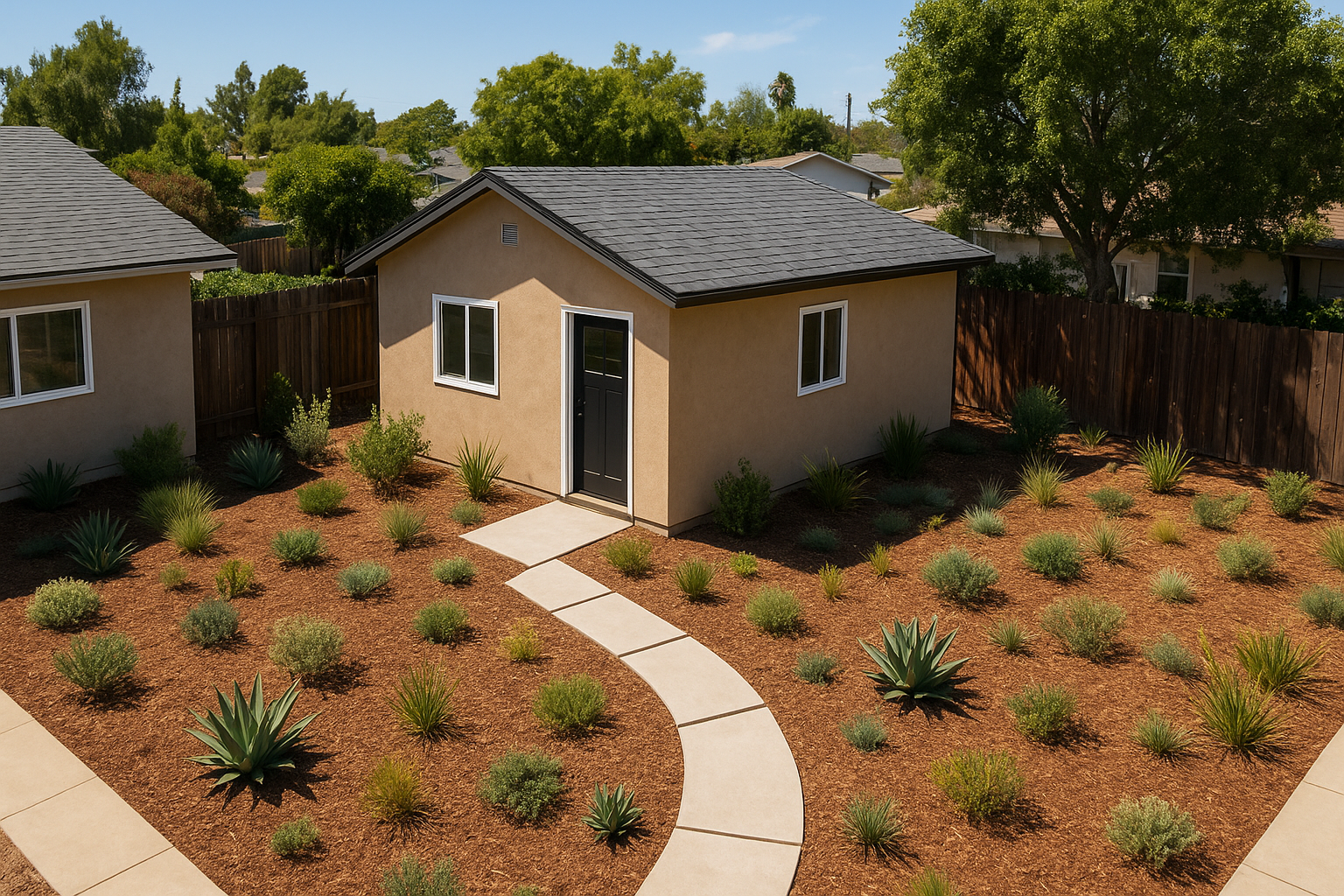
A detached ADU with a well-planned site layout maximizes both privacy and outdoor living potential.
California ADU Regulations You Need to Know
California has enacted some of the most ADU-friendly legislation in the United States. Since 2020, a series of state laws — including AB 68, SB 13, and AB 3182 — have significantly relaxed restrictions on ADU development. As a result, homeowners across Orange County, Los Angeles County, and Riverside County now have more flexibility than ever before. Learn how these rules apply to ADUs in multi-family residences.
Key provisions under current California law include:
- Ministerial (non-discretionary) approval for most ADU applications, meaning local agencies cannot deny compliant projects based on subjective criteria.
- Reduced or waived impact fees for ADUs under 750 square feet.
- Prohibition on minimum parking requirements when an ADU is within half a mile of public transit.
- Permission to convert non-livable spaces (garages, storage rooms) into ADUs by right.
According to the California HCD, ADU permit applications statewide have increased by more than 1,000% since 2017, reflecting how dramatically the regulatory environment has shifted in favor of homeowners. Understanding these rules is critical to designing an ADU that sails through permitting without surprises.
To learn more about how the design process works from start to finish, visit the ADU design process overview at theadupro.com.
Choosing the Right ADU Design for Your Specific Property
No two properties are identical, which is why a one-size-fits-all approach to ADU design rarely produces the best results. Instead, the most successful projects begin with a site analysis guide. Factors such as lot orientation, existing trees, neighboring structures, and utility locations all influence which design will be most functional for your specific parcel.
For example, a south-facing lot in Orange County may allow for passive solar design that reduces energy costs year-round (see ADU design Lake Forest). Similarly, a long, narrow lot might favor a detached ADU positioned at the rear with a dedicated side-yard access path. In contrast, a smaller urban lot in Los Angeles might make a garage conversion the only viable option — and that is perfectly fine, because garage conversions can be just as functional and attractive as purpose-built units.
If you are unsure which direction to take, the guide on how to choose the right design for your ADU offers a helpful framework for evaluating your options. The team at theadupro.com also provides personalized consultations for homeowners throughout Southern California, helping you identify the best design path for your goals and budget.
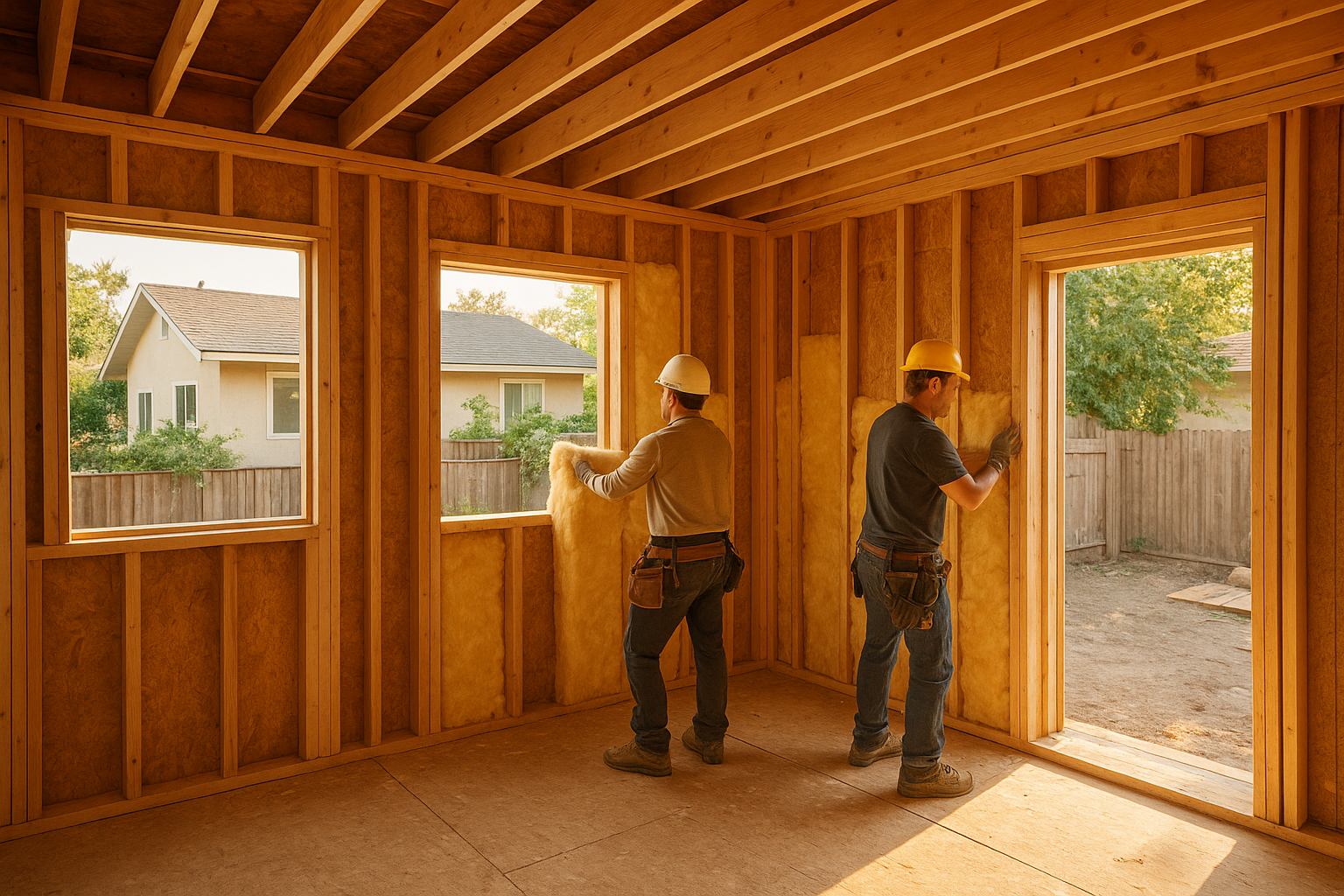
Garage conversion ADUs offer a cost-effective path to functional ADU designs by leveraging existing structures.
Design Features That Add Real Value
Beyond basic livability, certain design choices consistently add measurable value — both in terms of ADU features and property resale value. Research from Zillow Research indicates that homes with ADUs sell for an average of 35% more than comparable homes without them in major California markets.
Therefore, consider incorporating these high-value design features into your ADU:
- Separate entrance: Privacy is a top priority for renters and family members alike. A dedicated exterior entrance — not shared with the main house — commands higher rents and broader appeal.
- Full kitchen: Even a compact kitchen with full-size appliances is far more desirable than an efficiency setup. Prioritize counter space and storage over appliance size.
- In-unit laundry: A stacked washer/dryer in a closet significantly increases rental desirability and tenant satisfaction.
- Energy-efficient systems: Mini-split HVAC systems, LED lighting, and high-efficiency water heaters reduce operating costs and appeal to eco-conscious renters.
- Accessible design elements: Wide doorways, no-step entries, and roll-in showers future-proof the unit for aging-in-place use — a growing priority in multigenerational households.
Frequently Asked Questions About Functional ADU Designs
What are functional ADU designs?
Functional ADU designs are accessory dwelling unit layouts that prioritize efficient use of space, smart storage, and livability within a compact footprint. They balance practical needs like sleeping, cooking, and bathing with comfort and style, making every square foot count.
California law allows ADUs as small as 150 square feet for efficiency units. However, most local jurisdictions and design experts recommend at least 400 to 500 square feet for a comfortable, functional living space. See ADU size requirements for full details.
California law allows ADUs as small as 150 square feet — see ADU size requirements. However, most local jurisdictions and design experts recommend at least 400 to 500 square feet for a comfortable, functional living space.
How much does it cost to build a functional ADU in Southern California?
Costs typically range from $150,000 to $350,000 or more in Southern California, depending on size, type, finishes, and site conditions. Garage conversions tend to be less expensive, while detached ADUs cost more due to foundation and utility work.
What types of ADU designs are most functional for rental income?
Detached ADUs with private entrances, separate utility meters, and open-plan layouts tend to maximize ADU rental potential. A one-bedroom or studio design with full kitchen and bathroom is highly desirable for long-term renters.
Can I convert my garage into a functional ADU?
Yes, garage conversions are one of the most cost-effective ways to create a functional ADU. The existing structure reduces construction costs, and California law generally supports garage-to-ADU conversions with streamlined permitting.
How long does it take to design and build an ADU in California?
The full process typically takes 6 to 18 months from design through final inspection. Permitting alone can take 2 to 6 months depending on the municipality, while construction usually takes 3 to 9 months.
What design features make an ADU feel larger than it is?
High ceilings, large windows, open floor plans, built-in storage, and light-colored finishes all help small ADUs feel more spacious. Multi-functional furniture such as Murphy beds and fold-down tables also maximize usable space.
Do functional ADU designs need to match the main house?
Many local jurisdictions in California require ADUs to be architecturally compatible with the primary residence. However, interior design can differ significantly. A contractor familiar with local codes can help you balance compliance with creative expression.
What is a junior ADU (JADU) and how does it differ from a standard ADU?
A junior ADU is a smaller unit of up to 500 square feet created within the existing footprint of a primary residence, such as a converted bedroom. Unlike standard ADUs, JADUs typically share a bathroom with the main home and have an efficiency kitchen rather than a full one.
What are the most common mistakes in ADU design?
Common mistakes include underestimating storage needs, ignoring natural light, neglecting outdoor access, and failing to plan for utility connections early. Working with an experienced ADU contractor from the start helps avoid costly redesigns and permitting delays.
How do I choose the right ADU design for my property?
Start by identifying your primary goal — rental income, multigenerational living, or a home office. Then evaluate your lot size, setback requirements, and budget. An experienced ADU designer can help you identify the best layout for your specific site and goals.
Are prefab or modular ADU designs functional options?
Yes, prefab ADUs can be highly functional and are often faster to build than site-built units. However, they may have limitations in customization and must still comply with local building codes and zoning requirements in California.
Conclusion: Start With the Right Design Partner
Functional ADU designs are the foundation of every successful accessory dwelling unit project. From choosing the right ADU type to optimizing your floor plan for light, storage, and livability, every design decision has a direct impact on how well your unit serves its occupants — and how much value it adds to your property. Furthermore, navigating California’s evolving ADU regulations requires local expertise that only an experienced contractor can provide. Learn more about projected returns in our ADU financial return guide.
The team at theadupro.com specializes in end-to-end ADU development for homeowners throughout Orange County, Los Angeles County, and Riverside County. From initial design through final inspection, they handle every phase of the process with transparency, skill, and a deep understanding of what makes an ADU truly functional. If you are ready to maximize your property’s potential, reaching out to a trusted local ADU contractor is the most important first step you can take. Last updated: 2026-06-26. Author: The ADU Pro team. Last updated: 2026-06-26. Author: The ADU Pro team.