Accessory Dwelling Unit Ordinance Los Angeles: The Complete 2024 Guide
The accessory dwelling unit ordinance Los Angeles is the official legal framework governing how homeowners and investors can build, convert, or legalize secondary housing units on residential and multifamily properties throughout the city. Whether you’re planning a detached backyard unit, a garage conversion, or a Junior ADU inside your home, this ordinance defines every rule you must follow — from size and height to setbacks, permits, and rental restrictions. Add an author byline and a brief 1–2 sentence bio plus a ‘Last updated: 2026-06-26’ timestamp to improve E‑E‑A‑T and reader trust.
Los Angeles has undergone dramatic regulatory reform since 2020, streamlining ADU approvals in response to California’s statewide housing shortage. But city-specific rules still layer important details on top of California’s baseline ADU statutes. Understanding both levels of regulation — state and local — will protect your budget and your timeline.
Quick Answer: In Los Angeles, the accessory dwelling unit ordinance allows property owners to build detached ADUs up to 1,200 sq ft, attached ADUs up to 50% of the primary home's floor area, garage conversions, and Junior ADUs (JADUs) up to 500 sq ft. These units are subject to setback, height, design, and permitting standards administered by the Los Angeles Department of Building and Safety (LADBS). Most projects receive ministerial (by-right) approval without discretionary review. See our Southern California guide for regional policy context and examples.
What the Accessory Dwelling Unit Ordinance Los Angeles Actually Covers
The accessory dwelling unit ordinance Los Angeles is a local zoning and building code amendment codified under the Los Angeles Municipal Code (LAMC). It defines the types, sizes, locations, design standards, and permitting procedures for all ADU development within city limits. The ordinance was most significantly updated in 2020 to align with California’s expanded ADU laws — specifically AB 68, AB 881, SB 13, and AB 3182 — and has seen incremental refinements since then to reflect new state mandates. For design-to-build examples and ADU home configurations, see our ADU homes guide.
The ordinance governs four primary ADU categories, each with distinct rules:
- Detached ADUs: Freestanding units built separately from the primary home, either as new construction or as a replacement of an existing structure like a garage.
- Attached ADUs: Units added to the primary residence as a physical addition, sharing at least one wall with the main home.
- Conversion ADUs: Existing non-habitable space (garages, storage rooms, basements) converted to livable dwelling units.
- Junior ADUs (JADUs): Units of up to 500 square feet created entirely within the walls of an existing single-family home, including conversions of attached garages.
The ordinance also addresses which zoning districts allow ADUs (all single-family and multifamily residential zones), which approval pathway applies (ministerial for most projects), and what special overlay zones trigger additional review. Understanding these distinctions before drawing a single plan can save weeks of redesign time.
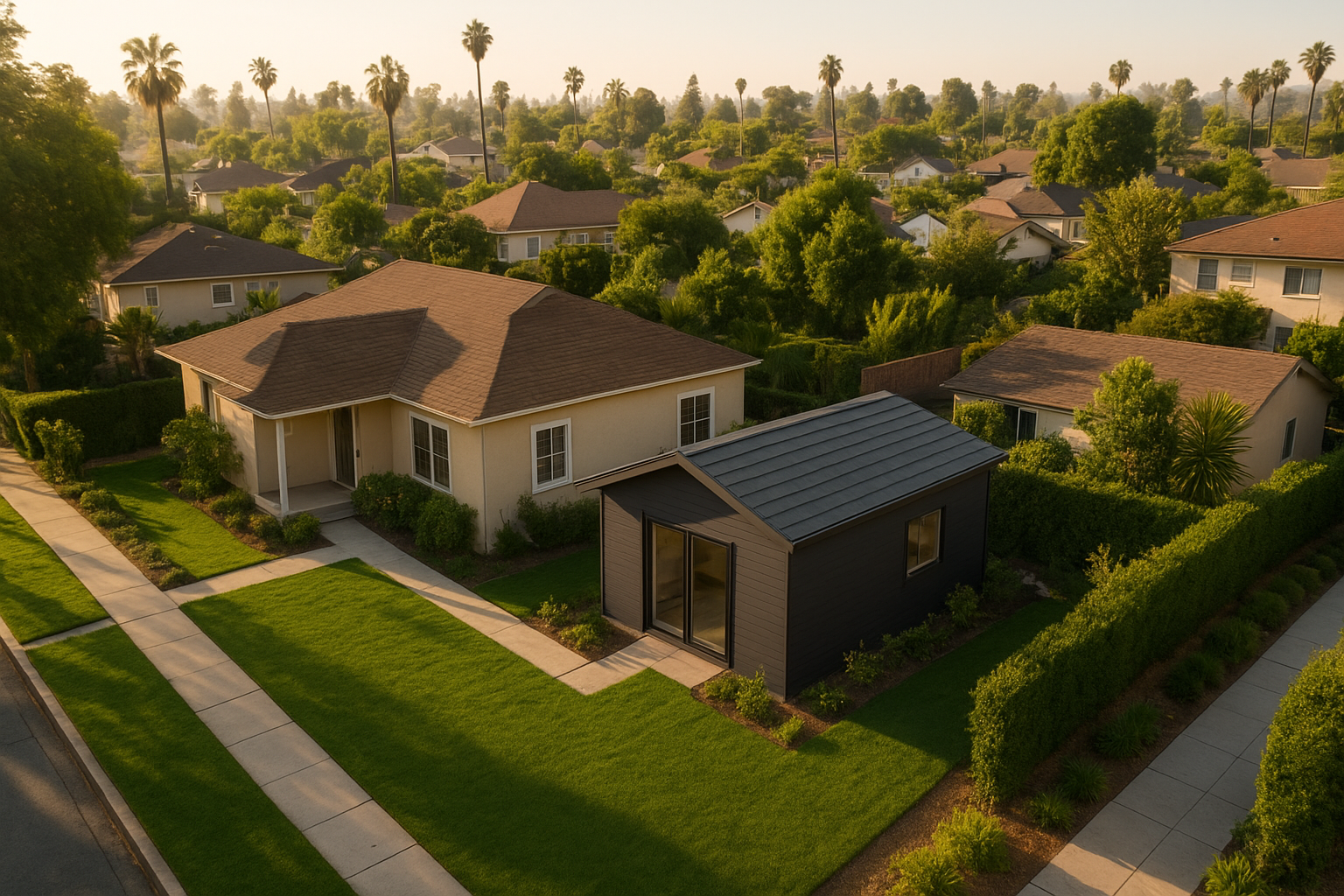
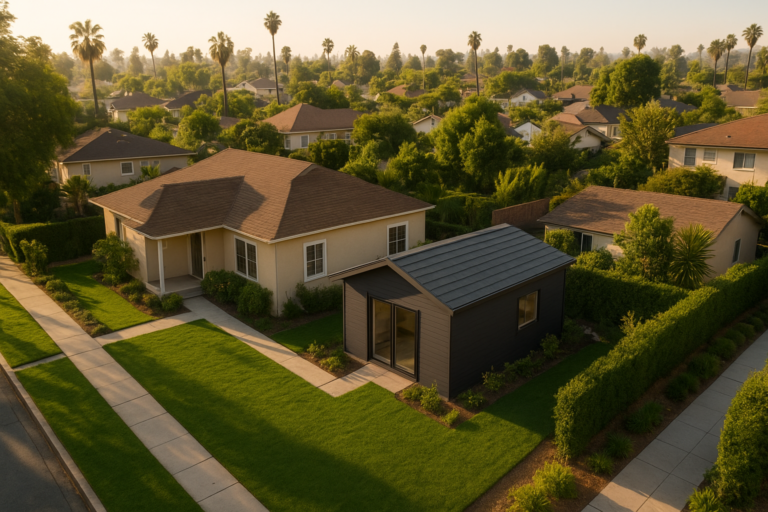
A detached ADU in a Los Angeles backyard — one of the most popular project types permitted under the city’s ADU ordinance. For a deeper walkthrough, see our Mirasol – The ADU Pro®.
Zoning Eligibility: Which Properties Qualify Under the LA ADU Ordinance?
Under the current accessory dwelling unit ordinance Los Angeles, ADUs are permitted by right on virtually every residentially zoned parcel in the city. Qualifying zones include:
- Single-family zones (R1, RE, RS, RA): Eligible for one ADU plus one JADU.
- Multifamily zones (RD, R2, R3, R4, RAS): Eligible for detached ADUs plus internal conversions, subject to specific limits.
- Mixed-use and commercial zones with residential uses: May qualify depending on the residential component of the property.
There is no minimum lot size required under current California or Los Angeles law. However, your ADU must still comply with the setback, height, and lot coverage standards of the underlying zone. Properties in specific overlay zones — including Historic Preservation Overlay Zones (HPOZs), Hillside Areas, Very High Fire Hazard Severity Zones (VHFHSZs), and Coastal Zone parcels — may face additional design or review requirements that are not applied to standard parcels.
Historic Preservation Overlay Zones (HPOZs)
Los Angeles has over 30 designated HPOZs, including Angelino Heights, Bungalow Heaven, and Carthay Circle. ADUs in HPOZs are still permitted, but design plans may require a Certificate of Appropriateness from the Office of Historic Resources. This adds time and design constraints — particularly for detached new construction that is visible from the street. Garage conversions in HPOZs often face fewer design restrictions because they involve no exterior additions visible from the public right-of-way.
Hillside and Fire Hazard Zones
Insert internal link: ADU housing guide.
Size Limits for Every ADU Type in Los Angeles
Size limits under the accessory dwelling unit ordinance Los Angeles vary by ADU type and, in some cases, by the size of the existing primary residence. Here is a complete breakdown: For a deeper walkthrough, see our ADU Guide 2025.
An important clarification on attached ADUs: while the general rule is 50% of the primary home’s floor area, California law guarantees a minimum allowable size of 800 square feet for any ADU regardless of the primary home’s footprint. This means even a very small primary residence cannot prevent you from building a reasonably sized attached ADU.
Height Limits and Two-Story ADUs
Under the Los Angeles ADU ordinance, height limits are tiered based on location and ADU type: For a deeper walkthrough, see our GET A FREE QUOTE.
- Standard detached ADUs: Maximum 16 feet.
- Detached ADUs within a half-mile of a major transit stop: Maximum 18 feet under transit-oriented development provisions.
- ADUs above detached garages: Up to 24 feet is permissible in some configurations, particularly when the garage is rebuilt to accommodate the unit above.
- Attached ADUs: Subject to the height limit of the primary zone, not the standalone ADU height cap. For a deeper walkthrough, see our Landscape Design for ADUs.
Two-story detached ADUs are therefore achievable in many Los Angeles neighborhoods, which significantly increases usable floor area on lots where ground coverage is constrained. Properties located near Metro Rail stations, bus rapid transit lines, or other major transit corridors benefit the most from the transit-adjacency height bonus.
Setback Requirements Under the LA ADU Ordinance
Setback rules are one of the most practically impactful provisions of the accessory dwelling unit ordinance Los Angeles. Here’s what applies:
- Rear and side setbacks: Minimum 4 feet from the property line for detached ADUs. For a deeper walkthrough, see our Maximizing Your Property’s Potential with ADUs.
- Front setbacks: Follow the primary zoning district’s front yard standards (typically 15–25 feet depending on zone).
- Existing structure replacement exception: ADUs that replace existing permitted accessory structures — such as a detached garage — may be built to the existing footprint with no setback requirement, provided the height does not exceed 16 feet.
- Conversion ADUs: Interior conversions of existing structures have no setback requirement whatsoever, regardless of how close the structure sits to the property line.
The existing-structure exception is one of the most powerful provisions in the LA ADU ordinance. Many Los Angeles garages were built within inches of the property line — often legally nonconforming. Under this exception, those structures can be demolished and rebuilt as ADUs (or simply converted) without being required to move. This is why garage replacements and conversions dominate ADU activity in high-density LA neighborhoods like Silver Lake, Echo Park, and Mid-City.
How Many ADUs Are Allowed on One Parcel in Los Angeles?
The number of ADUs permitted on a Los Angeles property depends on whether the lot is zoned single-family or multifamily. Here is the full breakdown:
Single-Family Residential Lots
A standard single-family lot in Los Angeles may have:
- One ADU (detached or attached)
- One Junior ADU (JADU) simultaneously
This means a single-family property can theoretically accommodate three separate dwelling units: the primary home, one ADU, and one JADU. This is commonly called a “duplex + JADU” configuration and is increasingly popular among LA homeowners seeking to maximize rental income from a single-family lot.
Multifamily Residential Lots
Multifamily properties have considerably more ADU capacity. Under AB 3182 and the Los Angeles ADU ordinance:
- Up to two detached ADUs may be added to the property.
- Up to 25% of existing units within the multifamily structure may be converted to ADUs.
- Detached ADU additions and internal conversions can occur simultaneously, stacking the total unit count significantly.
Practical example: A 16-unit apartment building in Los Angeles could convert up to four internal units into ADUs (25% of 16) and simultaneously add two detached ADUs on the property grounds. That represents a total capacity increase of six new dwelling units from a single lot — entirely through ministerial permitting with no discretionary review.
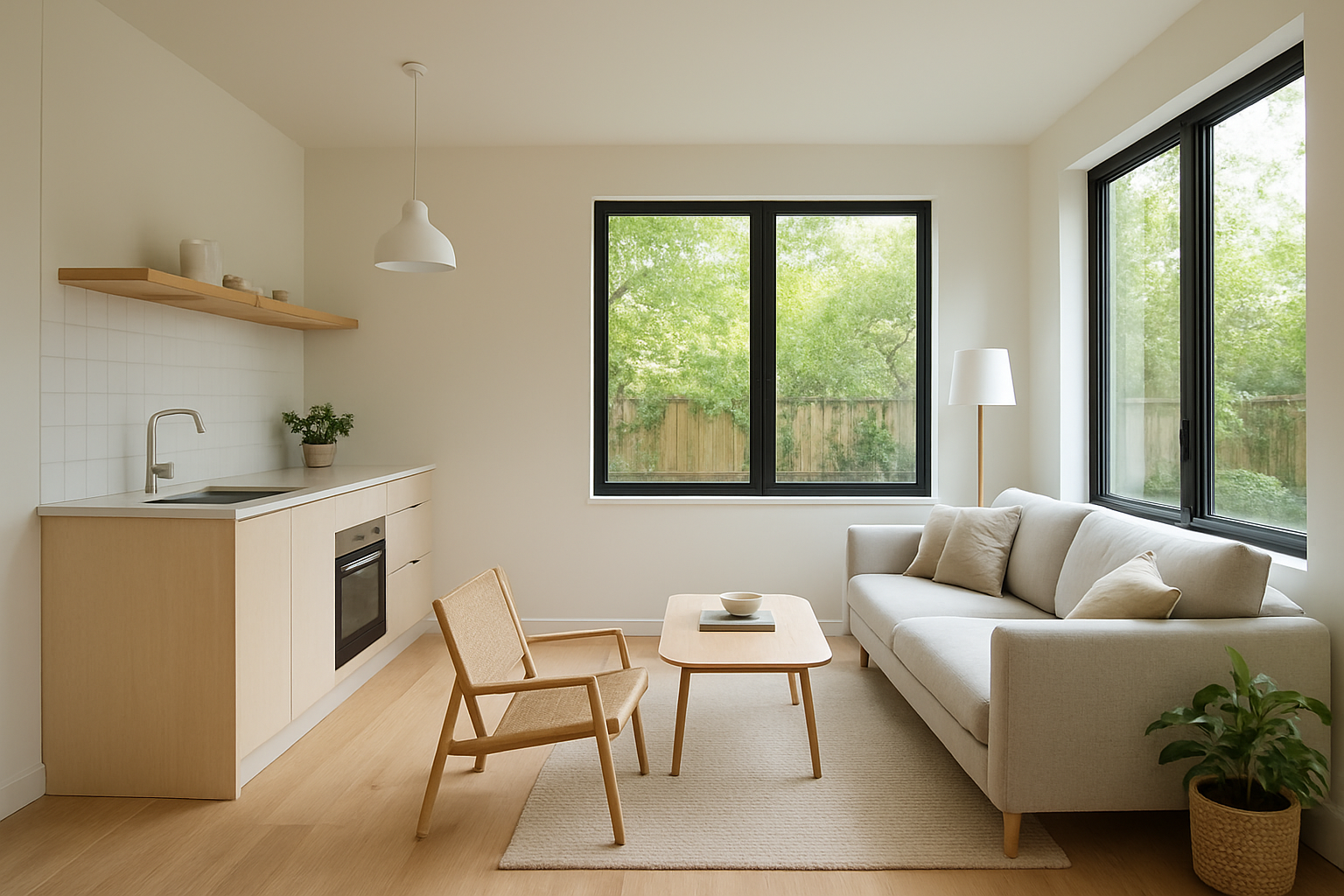
Well-designed ADU interiors maximize livability within the square footage limits set by the Los Angeles ADU ordinance.
Parking Requirements Under the LA ADU Ordinance
Parking is one of the most misunderstood aspects of the accessory dwelling unit ordinance Los Angeles. Here is what you need to know:
- No parking is required for an ADU when it is located within a half-mile of a public transit stop. For a deeper walkthrough, see our Margarita.
- No parking is required for any ADU that involves converting an existing garage, carport, or covered parking structure.
- No parking is required for ADUs located within a historic district.
- No replacement parking is required when a garage used for required parking is converted to an ADU — even though the parking space is eliminated.
In practice, because virtually all of Los Angeles is within a half-mile of a bus line, the transit-adjacency exemption effectively eliminates parking requirements for nearly every ADU project citywide. This was an intentional policy decision by state and local legislators to remove one of the most significant historical barriers to ADU construction.
Step-by-Step: How to Permit an ADU in Los Angeles
The Los Angeles Department of Building and Safety (LADBS) administers all ADU permits within the city. Here is the complete permitting process: For a deeper walkthrough, see our ADU housing guide.
- Determine Property Eligibility: Verify your zoning designation (R1, RD, R2, etc.), confirm your lot is not subject to special overlay restrictions (HPOZ, coastal zone, hillside), and check for any existing code violations on the property. LADBS will not approve ADU permits on properties with unresolved building code violations. For broader planning context, see our Complete ADU guide.
- Select Your ADU Type and Configuration: Choose between detached new construction, attached addition, garage or structure conversion, or JADU based on your budget, goals, and property layout. Each type has different cost profiles, timelines, and regulatory requirements.
- Engage a Licensed Architect or Designer: Hire a California-licensed architect or experienced ADU designer to prepare permit-ready drawings. Plans must include site plan, floor plans, elevations, and structural details. Consider using a pre-approved ADU plan set (discussed below) to accelerate this step significantly. For help, choose the right ADU contractor.
- Submit Plans for Plan Check Review: Submit plans through the LADBS online permitting portal (ePlanLA) or in person at a District Office. LADBS will assign a plan check number and begin review. First-time submissions typically receive initial comments within 4–8 weeks for standard projects. For a detailed walkthrough, see How to Build an ADU.
- Address Plan Check Corrections: Respond to any plan check corrections (PCCs) from LADBS reviewers by revising plans and resubmitting. Complex projects may require multiple rounds. Having an experienced designer significantly reduces correction cycles.
- Pay Permit Fees and Pull the Building Permit: Once plans are approved, pay applicable permit fees (typically $5,000–$15,000 for most ADU projects) and receive your building permit. Work cannot legally begin until the permit is issued and posted at the job site.
- Complete Construction with a Licensed Contractor: All ADU construction in Los Angeles must be performed by a licensed California contractor. Progress inspections are required at foundation, framing, rough electrical, rough plumbing, insulation, and other phases as specified in the permit. Learn how to select ADU builders for superior results.
- Final Inspection and Certificate of Occupancy: Pass all required final inspections with LADBS and receive a Certificate of Occupancy (C of O). The C of O is the legal authorization to occupy the unit. You cannot legally rent or live in the ADU without it.
Pre-Approved ADU Plan Sets: The Fast Track Option
Los Angeles offers a pre-approved ADU plan set program through LADBS. Pre-approved plans are standard ADU designs that have already been reviewed and approved by LADBS for building code compliance. Using a pre-approved plan set reduces plan check time to as little as 2–4 weeks compared to the standard 4–12 week timeline for custom plans. These plans are available in multiple unit types and sizes and can be adapted to individual lot conditions while retaining their expedited review status.
Permit Fees, Impact Fee Waivers, and Connection Fees
Permit fees in Los Angeles typically range from $5,000 to $15,000 depending on project valuation and scope. However, the more significant financial consideration for most projects involves impact fees and utility connection fees:
- Impact fee waiver (ADUs under 750 sq ft): ADUs under 750 square feet are fully exempt from school, park, and utility impact fees — which can otherwise total $10,000–$30,000 or more depending on the project.
- Proportional impact fees (ADUs 750+ sq ft): ADUs of 750 square feet or larger are assessed impact fees proportional to their size relative to the primary dwelling. These fees are significantly lower than those applied to new primary residences.
- Separate utility connections: If your ADU requires its own LADWP electric meter or SoCalGas connection (rather than sharing with the primary home), expect to pay connection fees that vary based on distance from existing infrastructure and capacity availability.
- Sewer lateral upgrade: If LADBS determines your existing sewer lateral is undersized for the added dwelling unit, a sewer lateral upgrade may be required. This is a common — and often unexpected — cost, particularly for older properties.
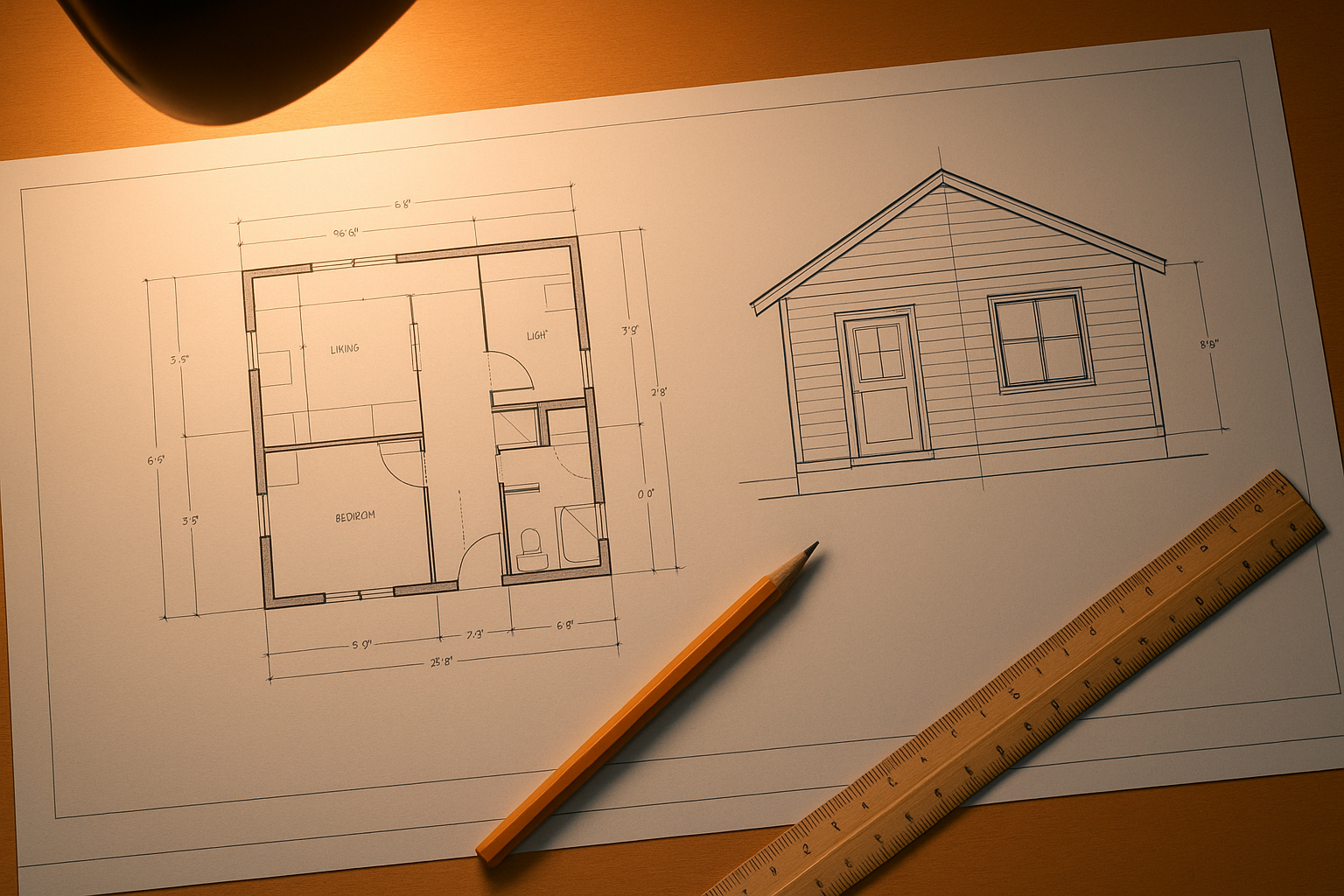
Accurate, permit-ready architectural drawings are essential for a smooth LADBS plan check submission under the Los Angeles ADU ordinance.
Utility Connections and Infrastructure Requirements
Utility requirements are a frequently underestimated aspect of ADU planning in Los Angeles. Here’s what the accessory dwelling unit ordinance Los Angeles and related utility agency rules require: For a deeper walkthrough, see our What Are The Homeowner’s Association Rules For My New ADU?.
Water and Sewer
Insert internal link: ADU projects Southern California.
Electrical (LADWP)
Most ADUs in Los Angeles are served by the Los Angeles Department of Water and Power (LADWP). ADUs may share an electrical meter with the primary home or have a separate sub-panel. If a new ADU substantially increases electrical load, the main panel may require an upgrade to 200-amp service — a cost of $2,000–$5,000 that many homeowners fail to budget for. Separate LADWP meter installation for independent billing adds another $2,000–$4,000 in fees and infrastructure costs.
Gas (SoCalGas)
ADUs with gas appliances require either connection to the primary home’s existing gas service or a new separate SoCalGas connection. Note that many newer ADU designs are built fully electric (heat pump HVAC, electric water heaters, induction cooking) to avoid gas connection fees and to comply with increasingly strict California building energy codes.
Owner Occupancy Rules: What’s Required in 2024?
The owner-occupancy question is one of the most common sources of confusion about the accessory dwelling unit ordinance Los Angeles. Here is the current state of the law:
- ADUs (standard): The owner-occupancy requirement was suspended for ADUs permitted between 2020 and 2025. During this window, you do not need to live on the property to build, rent, or sell an ADU. This applies to both single-family and multifamily properties.
- Junior ADUs (JADUs): Owner occupancy is always required for JADUs. The property owner must reside in either the primary dwelling or the JADU at all times as a condition of the JADU permit.
The practical implication is that investors can currently purchase a property and immediately permit and rent an ADU without living on-site — a significant incentive that has driven investor-driven ADU development across Los Angeles during this period. The status of the owner-occupancy suspension after 2025 will depend on future legislative action at the state level.
Rental Rules, Short-Term Rental Restrictions, and Rent Control
Los Angeles has some of the most important — and most frequently misunderstood — rental rules governing ADUs in California. Getting these wrong can result in fines, permit revocation, and legal liability.
Short-Term Rental Prohibition
Los Angeles strictly prohibits renting ADUs as short-term rentals. ADUs must be rented for a minimum of 30 consecutive days. This rule applies regardless of whether the primary dwelling is registered as a short-term rental under the city’s Home Sharing program. Violations can result in significant fines from the Los Angeles Housing Department (LAHD) and, in serious cases, permit revocation and mandatory removal of the unit.
Rent Control and the Rent Stabilization Ordinance (RSO)
This is a critical topic that many ADU guides fail to address adequately. Whether a Los Angeles ADU is subject to rent control under the Rent Stabilization Ordinance (RSO) depends on when it was built:
- ADUs built after February 1, 1995: Generally exempt from RSO rent control under California Civil Code Section 1954.52 (Costa-Hawkins Act), which prohibits local rent control on units built after that date.
- ADUs created through conversion of existing pre-1978 structures: May be subject to RSO if the conversion does not constitute “new construction” under RSO guidelines. LAHD determinations vary by project.
- Units within multifamily properties subject to RSO: Converted internal units in RSO-covered buildings may inherit RSO status. Consult with a real estate attorney before undertaking multifamily ADU conversion projects.
Understanding RSO applicability before building is essential for accurate rental income projections. An RSO-exempt ADU gives you full market-rate rental flexibility; an RSO-covered unit limits annual rent increases to the city’s allowable percentage.
Design Standards and Habitability Requirements
Beyond size and setback, the accessory dwelling unit ordinance Los Angeles sets minimum habitability and design standards that all ADUs must meet at the time of final inspection:
- Minimum ceiling height: 7 feet 6 inches in habitable rooms (7 feet in bathrooms, hallways, and kitchens).
- Natural light and ventilation: Habitable rooms must have windows equal to at least 10% of the floor area for light and 5% for ventilation, or mechanical ventilation systems meeting Title 24 standards.
- Egress: Sleeping rooms require a window with a minimum opening of 5.7 square feet, minimum 24-inch height and 20-inch width, and a maximum sill height of 44 inches above the floor.
- Kitchen facilities: All ADUs (not JADUs) must include a full kitchen with sink, cooking appliance, and refrigeration space.
- Bathroom: All ADUs must include a bathroom with toilet, sink, and bathtub or shower.
- Insulation: Walls, ceiling, and floor must meet California Energy Code (Title 24) requirements. Garage conversions frequently require significant insulation upgrades.
- Separate entrance: ADUs must have an independent exterior entrance — they cannot be accessed exclusively through the primary dwelling (JADUs may share an interior connection but must also have an exterior entrance).
Design Standards for Historic Preservation Overlay Zones
In HPOZs, detached ADUs visible from the public right-of-way must demonstrate design compatibility with the historic character of the neighborhood. This typically means matching or complementing the architectural style, scale, materials, and color palette of contributing structures in the HPOZ. The Office of Historic Resources provides design guidelines for each individual HPOZ that applicants must reference during design.
Legalizing Unpermitted ADUs Under the LA Ordinance
One of the most impactful — and underutilized — provisions of the accessory dwelling unit ordinance Los Angeles is its pathway for legalizing existing unpermitted ADUs. Hundreds of thousands of unpermitted units exist throughout Los Angeles, and the ordinance provides a streamlined legalization process:
- Reduced fee amnesty: Under SB 13, impact fees are waived for ADUs under 750 sq ft regardless of when the unpermitted construction was originally built.
- Building code compliance: Unpermitted units must be brought up to current California Building Code standards for health and safety — but are generally not required to meet every current code provision that would apply to new construction (e.g., energy efficiency standards may be relaxed).
- No penalty for prior unpermitted construction: Los Angeles currently does not assess fines for the period during which the unit was unpermitted, provided the owner proactively pursues legalization.
- Separate entrance requirement: Unpermitted units legalized as ADUs must have an independent exterior entrance installed if one does not already exist.
Legalizing an unpermitted ADU typically costs $15,000–$60,000 depending on the extent of required upgrades, but it dramatically increases property value, enables legal rental income reporting, and protects the property owner from liability and code enforcement actions.
Common Mistakes Property Owners Make Under the LA ADU Ordinance
Even with an increasingly streamlined process, many Los Angeles property owners encounter costly and avoidable problems. Here are the most common mistakes — and how to avoid them:
- Starting construction before permits are approved: Unpermitted construction triggers LADBS stop-work orders, potential demolition requirements, and doubled permit fees. Never break ground before your building permit is physically in hand and posted at the site.
- Assuming all ADUs are automatically by-right: While most LA ADUs qualify for ministerial approval, parcels in HPOZs, hillside areas, VHFHSZs, coastal zones, or with existing code violations require additional steps. Always run a parcel-specific zoning check before finalizing a design.
- Underestimating utility upgrade costs: Electrical panel upgrades, sewer lateral replacements, and new LADWP meter installations are frequently the largest unexpected budget items in LA ADU projects. Budget a contingency of at least 15%–20% for utility-related work.
- Ignoring rent control applicability: Multifamily ADU conversion projects may inadvertently create RSO-covered units, limiting rental income potential. Always verify RSO status before committing to a conversion strategy.
- Failing to secure a Certificate of Occupancy before renting: Renting an ADU without a C of O is a code violation and creates significant legal exposure, including liability for tenant injury and inability to enforce lease terms.
- Choosing the wrong ADU type for the budget: Detached new construction ADUs cost $200,000–$400,000+ in Los Angeles. Garage conversions and JADUs can be completed for $50,000–$150,000. Matching the ADU type to the available budget and ROI target is essential for a financially successful project.
ADU Costs in Los Angeles: What to Budget in 2024
Total ADU construction costs in Los Angeles vary enormously by type, size, and location. Here is a realistic cost range breakdown for 2024: For regional comparisons, see ADUs in the OC.
These figures include design, permits, construction, and basic landscaping but may not include utility upgrades, soil engineering (required on hillside lots), or premium finishes. Los Angeles labor costs are among the highest in the nation, and material prices remain elevated through 2024. Obtaining at least three contractor bids is strongly recommended for any ADU project. Compare detailed cost breakdowns in our Average cost to build article.
Financing Options for Los Angeles ADU Projects
Financing is a practical barrier for many homeowners pursuing ADU projects. Here are the most common financing options available to Los Angeles property owners in 2024:
- Home Equity Line of Credit (HELOC): The most common financing method for ADUs in LA. Draws on accumulated equity in the primary residence at typically lower interest rates than construction loans.
- Cash-Out Refinance: Refinance your existing mortgage and extract equity as a lump sum. Best when current rates are favorable relative to your existing mortgage rate.
- ADU-Specific Construction Loans: Several California-focused lenders now offer ADU-specific construction-to-permanent loan products. These are underwritten on the future value of the completed ADU.
- CalHFA ADU Grant Program: The California Housing Finance Agency (CalHFA) has offered grant programs covering up to $40,000 in predevelopment costs for qualifying moderate-income owner-occupants. Program availability varies by year; check CalHFA’s website for current offerings.
- PACE Financing: Property Assessed Clean Energy financing allows ADU construction costs to be repaid through property tax assessments. Available through programs like Renovate America’s Benji and California PACE.
Frequently Asked Questions About the Accessory Dwelling Unit Ordinance Los Angeles
What is the accessory dwelling unit ordinance in Los Angeles?
The accessory dwelling unit ordinance Los Angeles is a local zoning and building code regulation governing how property owners build, convert, or legalize secondary housing units on residential lots. It aligns with California state ADU law (AB 68, AB 881, SB 13) while adding city-specific standards for size, setbacks, height, design, and permitting procedures administered by LADBS. See our Complete Guide 2025 for the latest updates.
How large can an ADU be in Los Angeles?
Detached ADUs can be up to 1,200 square feet. Attached ADUs are capped at 50% of the primary home’s floor area (with a guaranteed minimum of 800 sq ft), also with a 1,200 sq ft maximum. JADUs are limited to 500 square feet and must be created within an existing single-family home.
What are the setback requirements for ADUs in Los Angeles?
Detached ADUs must maintain a minimum 4-foot setback from rear and side property lines. Front setbacks follow the primary zone’s standards. ADUs replacing existing permitted accessory structures can be rebuilt to the existing footprint with no setback requirement. Conversion ADUs (no new construction) have no setback requirements at all.
Is owner occupancy required to build an ADU in Los Angeles?
For standard ADUs, the owner-occupancy requirement is suspended for units permitted between 2020 and 2025 — meaning you do not need to live on the property. However, Junior ADUs (JADUs) always require the property owner to occupy either the main home or the JADU.
What is a Junior ADU (JADU) and how does it differ from an ADU?
A JADU is a unit of up to 500 square feet created entirely within an existing single-family home (including an attached garage). Unlike a standard ADU, a JADU requires owner occupancy on-site, shares utilities with the primary residence, and may have an interior connection to the main home. JADUs do not require full kitchens — an efficiency kitchen (sink, countertop, cooking appliance) is sufficient.
How much does it cost to permit and build an ADU in Los Angeles?
Permit fees alone typically range from $5,000 to $15,000. Total construction costs range from $30,000–$80,000 for a JADU, $50,000–$150,000 for a garage conversion, $150,000–$300,000 for an attached addition, and $200,000–$450,000+ for a detached new construction ADU. ADUs under 750 sq ft are exempt from impact fees, saving $10,000–$30,000.
Can I convert my garage into an ADU in Los Angeles?
Yes. Garage conversions are among the most popular ADU types in LA because they benefit from the existing-structure exception (no setback required), no replacement parking mandate, and lower construction costs. The converted space must meet habitability standards including minimum ceiling height (7’6″), egress windows, insulation, ventilation, and a separate exterior entrance.
How long does ADU permit approval take in Los Angeles?
Standard plan check review takes 4–12 weeks depending on project complexity and LADBS workload. Using a pre-approved ADU plan set through LADBS’s pre-approved plans program can reduce this to as little as 2–4 weeks. Projects in HPOZs or hillside zones may require additional review time beyond the standard timeline.
Can I have more than one ADU on my property in Los Angeles?
Single-family lots may have one ADU and one JADU (three total dwelling units including the main home). Multifamily properties may add up to two detached ADUs plus convert up to 25% of existing units into ADUs — all through ministerial permitting.
Are Los Angeles ADUs subject to rent control?
Most newly constructed ADUs are exempt from the LA Rent Stabilization Ordinance (RSO) under the Costa-Hawkins Act, which prohibits local rent control on units built after February 1, 1995. However, ADUs created through conversion of existing units in RSO-covered multifamily buildings may inherit RSO status. Always verify RSO applicability with the Los Angeles Housing Department before proceeding.
Can I rent out my ADU on a short-term basis in Los Angeles?
No. Los Angeles strictly prohibits ADU short-term rentals. ADUs must be rented for periods of 30 consecutive days or longer. Violations can result in fines from the Los Angeles Housing Department and permit revocation.
Do ADUs in Los Angeles need separate utility connections?
ADUs may share utility connections with the primary home or have separate meters. Conversion ADUs are generally not required to install separate connections. New construction detached ADUs may require new sewer laterals or electrical service upgrades depending on size and existing infrastructure capacity. Separate LADWP meter installation costs $2,000–$4,000.
What is the minimum lot size to build an ADU in Los Angeles?
There is no minimum lot size requirement under current California or Los Angeles law. Any residentially zoned parcel may have an ADU, as long as the project complies with setback, height, and lot coverage standards of the underlying zone.
What parking is required for an ADU in Los Angeles?
No parking is required for ADUs within a half-mile of a public transit stop, for ADUs created through conversion of existing parking structures, or for ADUs in historic districts. Because nearly all of Los Angeles qualifies for the transit-adjacency exemption, parking requirements are effectively eliminated for the vast majority of ADU projects citywide.
Can I legalize an existing unpermitted ADU in Los Angeles?
Yes. The Los Angeles ADU ordinance provides a streamlined legalization pathway for existing unpermitted units. Impact fees are waived for units under 750 sq ft, and no penalties are assessed for prior unpermitted construction when the owner proactively pursues legalization. The unit must be brought up to current health and safety code standards.
Key Takeaways for Los Angeles Property Owners
The accessory dwelling unit ordinance Los Angeles offers one of the most flexible and accessible ADU frameworks in the country. Here are the essential rules every property owner should know. Add an author bio (name, role, credentials) and a clear "Last updated" date at the top or bottom of the article to improve trust and E-E-A-T.
- Detached ADUs up to 1,200 sq ft are permitted on virtually every residential parcel in LA.
- 4-foot rear and side setbacks apply, with a complete exception for existing-structure replacements and conversions.
- No parking is required for the vast majority of LA ADU projects due to the transit-adjacency exemption. For a deeper walkthrough, see our La Habra.
- Impact fees are waived for ADUs under 750 sq ft — a savings of $10,000–$30,000 on qualifying projects.
- Short-term rentals are prohibited — all ADU rentals must be 30+ consecutive days. For a deeper walkthrough, see our La Verne.
- Most projects receive ministerial approval with no discretionary review or neighborhood hearings.
- Unpermitted ADUs can be legalized with impact fee waivers and no penalties for prior unpermitted status.
- Overlay zones — HPOZs, hillside areas, fire hazard zones — add requirements that can affect design, cost, and timeline.
Because parcel-specific overlay conditions, existing code violations, and utility infrastructure all affect ADU feasibility, engaging an experienced ADU professional before committing to a design is strongly recommended. Early due diligence prevents costly redesigns, permit delays, and budget overruns — and gets your unit permitted, built, and earning rental income as quickly as possible. According to Wikipedia’s overview of accessory dwelling units, ADUs have become California’s primary tool for achieving gentle urban densification at scale. Last updated: 2026-08-10. Author: The ADU Pro® — licensed California ADU specialists with LADBS plan-check experience. Author: The ADU Pro® — ADU policy and permitting experts. Last updated: 2026-07-26.