

Lender referrals for ADU loans give Southern California homeowners a faster, more reliable path to financing an accessory dwelling unit (ADU) — a secondary living space built on the same lot as a single-family home. Rather than cold-calling banks, a homeowner working with an experienced ADU contractor gets introduced to lenders who already understand how ADU construction loans, draw schedules, and permitting timelines actually work.
Direct answer: Lender referrals for ADU loans are introductions a contractor makes between a homeowner and vetted third-party lenders offering HELOCs, construction loans, or ADU-specific financing programs. The contractor does not lend money directly; it simply narrows the search to lenders who already understand ADU underwriting.
Financing remains the single biggest obstacle for most homeowners considering a backyard unit, garage conversion, or JADU. In addition, many traditional banks still treat ADU projects as an unfamiliar hybrid between a renovation loan and new construction. As a result, homeowners who skip the referral step often spend weeks chasing lenders who ultimately decline the project.

Choosing the right lender referral helps homeowners avoid financing delays before construction begins.
What Are Lender Referrals for ADU Loans?
Lender referrals for ADU loans are simply warm introductions. Instead of approaching lenders cold, a homeowner is connected with lending partners who already have experience financing detached ADUs, attached additions, and garage conversions. Specifically, these referral networks typically include HELOC providers, construction-loan lenders, and companies offering ADU-specific loan products built around smaller project sizes.
This matters because ADU budgets, which commonly run from roughly $150,000 to $400,000 depending on size and finish level, don’t always fit neatly into standard mortgage products. Therefore, a referral shortens the research phase and reduces the risk of applying with a lender unfamiliar with ADU underwriting standards.
Why Southern California Homeowners Need Referred ADU Lenders
Southern California’s ADU market has grown quickly since state law loosened restrictions on lot size, parking, and owner-occupancy requirements. However, that growth hasn’t been matched by every bank’s internal lending guidelines. Many conventional loan officers still default to standard home-improvement loan caps that fall short of real ADU construction costs.
In contrast, referred lenders working regularly with ADU contractors in Orange County, Los Angeles County, and western Riverside County understand local permitting timelines, typical draw schedules, and realistic project budgets. Consequently, homeowners who use lender referrals for ADU loans tend to move through underwriting with fewer surprises and fewer rejected applications.
How ADU Financing Options Compare
Several financing paths exist for ADU projects, and each one fits a different equity position. Above all, homeowners should understand the trade-offs before committing to one option.
| Financing Option | Best For | Key Trait |
|---|---|---|
| HELOC | Homeowners with strong equity | Flexible, revolving access to funds |
| Construction Loan | New builds with staged draws | Funds released at build milestones |
| ADU-Specific Program | Smaller projects, limited equity | Underwriting tailored to ADU scope |
For example, a homeowner with substantial equity in Laguna Beach may prefer a HELOC, while a homeowner in Moreno Valley with a smaller lot and tighter budget might fit better with an ADU-specific loan program. Similarly, a staged construction loan often suits larger detached ADU builds where draws align with framing, plumbing, and finish milestones.
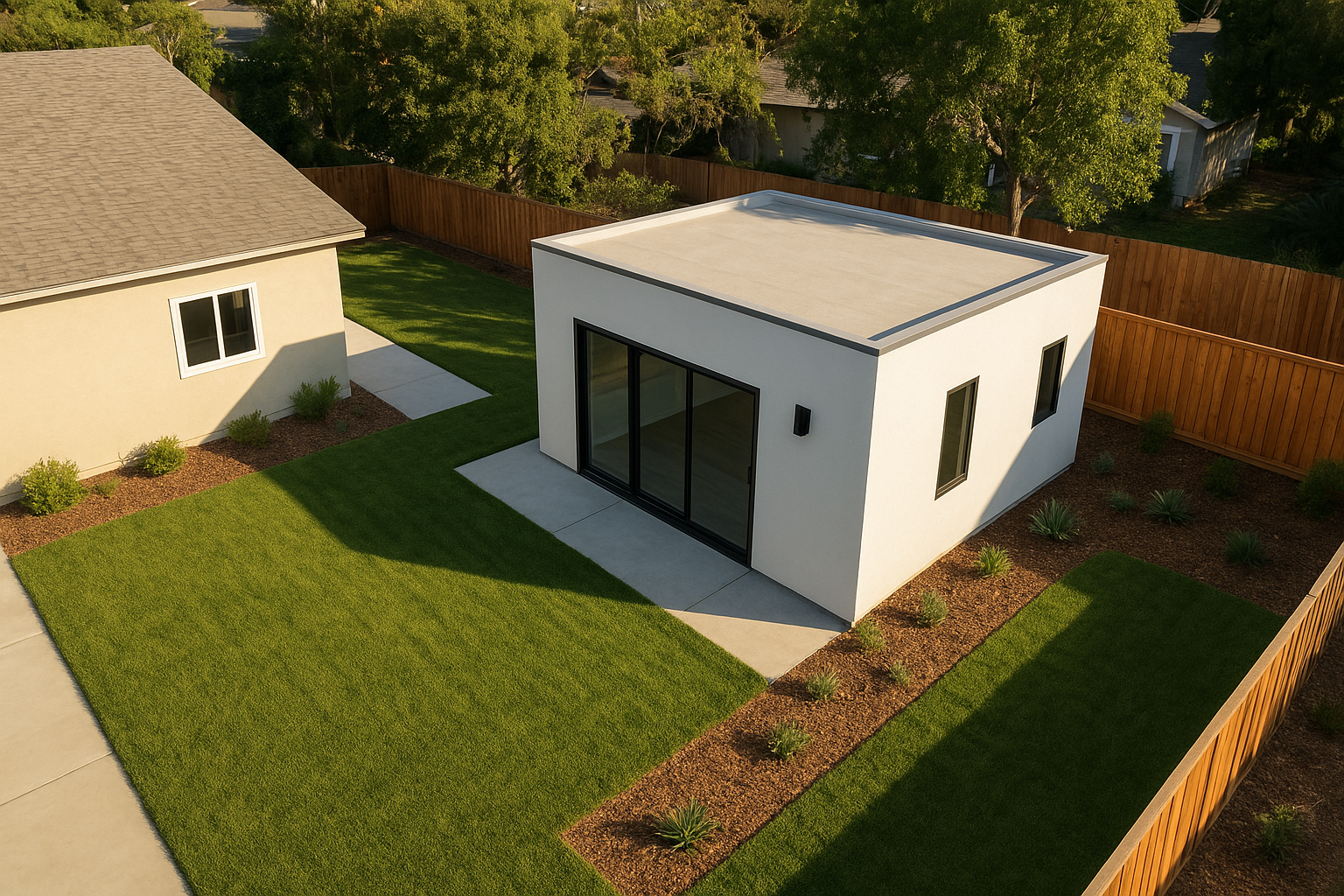
Detached ADUs like this one are commonly financed through HELOCs or staged construction loans.
How The ADU Pro’s Lender Referral Process Works
The referral process itself follows a consistent sequence, regardless of which city the project is located in. Below is the typical order of steps a homeowner can expect.
- Request a free site assessment and project scope review so lenders can see accurate cost estimates before underwriting begins.
- Receive referrals to two or three vetted lending partners whose HELOC, construction loan, or ADU-specific programs match the project size and timeline.
- Compare rate structures, draw schedules, and closing costs directly with each lender’s loan officer before choosing one.
- Finalize loan terms and coordinate the draw schedule with the construction timeline so payments align with permitting and build milestones.
Notably, this process keeps the homeowner in full control of the final lending decision. The contractor’s role stops at the introduction; from there, underwriting, approval, and funding happen directly between the homeowner and the lender, consistent with guidance from the Consumer Financial Protection Bureau on comparing home equity lending offers.
ADU-Specific Financing Programs Across Southern California Cities
Loan availability and lender familiarity with ADUs can vary from city to city, even within the same county. For instance, homeowners researching ADU loans in Riverside may find different program options than those exploring ADU loans in Chino, simply because local lenders differ in how often they fund projects in each market.
Similarly, homeowners in the Inland Empire corridor can review financing details specific to ADU loans in Redlands or ADU loans in Moreno Valley, while coastal Orange County homeowners often start with the ADU loans in Laguna Beach overview. In each case, a lender referral narrows the search to partners already comfortable funding projects in that specific city.
Common Mistakes Homeowners Make With ADU Loan Financing
Above all, timing mistakes cause the most frustration. Many homeowners apply for financing before they have firm construction numbers, which leads to approved amounts that fall short of actual costs. Consequently, the project stalls mid-build while the homeowner scrambles for a second loan.
In addition, some homeowners accept the first loan offer without comparing terms across multiple referred lenders. Rate differences of even half a percentage point can add thousands of dollars over a loan’s life. Therefore, comparing at least two or three referred options before signing remains a smart practice. According to the California Department of Housing and Community Development, ADU adoption has risen sharply statewide since 2017 reforms, which has also pushed more lenders to build dedicated ADU loan products in response to demand.
What to Ask Before Accepting a Lender Referral
Before accepting any referred lender’s offer, homeowners should ask a short list of direct questions. Specifically: What is the all-in interest rate? How is the draw schedule structured? Are there prepayment penalties? What documentation is required, and how long does approval typically take?
Furthermore, homeowners should confirm whether the loan accounts for permitting delays, which are common across Southern California jurisdictions. An accessory dwelling unit, as defined by Wikipedia’s overview of secondary suites, is a secondary housing unit on a single-family lot, and its construction timeline often depends as much on city review as on the builder’s schedule. A lender familiar with that reality is less likely to impose unrealistic draw deadlines.
Choosing a Design-Build Partner With Financing Support
Homeowners evaluating contractors should look for one that treats financing as part of the overall project, not an afterthought handled separately. The ADU Pro, based in Chino and serving Orange County, Los Angeles County, and western Riverside County, pairs site assessments and custom design work with lender referrals so financing and construction planning move in parallel rather than in sequence.
That approach matters because design decisions — square footage, finish level, number of bedrooms — directly affect the loan amount a homeowner will need. As a result, aligning the design phase with lender conversations early tends to prevent budget mismatches later in the project.
Frequently Asked Questions About Lender Referrals for ADU Loans
What are lender referrals for ADU loans?
Lender referrals for ADU loans are introductions from an ADU contractor or platform to vetted third-party lenders who offer HELOCs, construction loans, or ADU-specific financing programs. The contractor does not issue the loan; it simply connects homeowners with lending partners suited to their project.
How do I know if my property qualifies for ADU loan financing?
Qualification typically depends on home equity, income, credit score, and lot feasibility for the ADU itself. A site assessment combined with a lender referral helps confirm both the buildability and the borrowing capacity before design begins.
What’s the difference between a HELOC and an ADU construction loan?
A HELOC draws against existing home equity and offers flexible, revolving access to funds, while an ADU construction loan is disbursed in stages tied to building milestones. Each option suits different equity positions and risk tolerances.
How much can Southern California homeowners typically borrow for an ADU?
Borrowing limits vary widely by lender, equity, and income, but many ADU projects in Orange County, Los Angeles County, and Riverside County range from roughly $150,000 to $400,000. A referred lender can provide a personalized estimate after reviewing financials.
How long does ADU loan approval usually take?
Approval timelines often run two to six weeks depending on the loan type, documentation readiness, and lender workload. Construction loans generally take longer to underwrite than a standard HELOC.
Does The ADU Pro issue ADU loans directly?
No. The ADU Pro does not lend money directly; it coordinates lender referrals for ADU loans through third-party lending partners. Homeowners work directly with the lender for underwriting, approval, and funding.
What credit score do lenders look for on ADU financing?
Many conventional HELOC and construction loan programs look for a credit score around 660 or higher, though specific thresholds vary by lender and loan product. Stronger credit generally unlocks better rates and terms.
Can I get a lender referral if I already have an existing mortgage?
Yes. Most ADU financing options are designed to work alongside an existing first mortgage, since they draw on remaining equity or add a separate construction loan. Lenders will factor your current mortgage into their debt-to-income calculations.
What mistakes do homeowners commonly make when financing an ADU?
Common mistakes include underestimating total project costs, choosing a loan before getting firm construction numbers, and skipping comparison between lenders. Getting a site assessment and multiple lender referrals first helps avoid costly surprises.
Will building an ADU trigger a property tax reassessment?
Under California law, only the new ADU construction is reassessed for property tax purposes, not the entire property. The existing home’s assessed value generally remains unchanged.
What documents do lenders need for an ADU construction loan?
Lenders typically request income verification, credit history, current mortgage statements, a construction budget, and approved or near-final plans. Having these ready speeds up the underwriting process significantly.
How much does ADU financing typically cost in interest and fees?
Rates and fees vary by lender and loan type, often running close to prevailing HELOC or construction loan rates at the time of application. A referred lender can provide an accurate, personalized quote based on current market conditions.
Are lender referrals for ADU loans free for homeowners?
Yes, lender referrals are typically offered at no cost to the homeowner as part of the design-build process. Any loan costs come directly from the lender, not from the referral itself.
Which Southern California cities does this ADU financing guidance cover?
This guidance applies broadly across Orange County, Los Angeles County, and western Riverside County, including cities such as Chino, Riverside, Redlands, Laguna Beach, and Moreno Valley. Loan availability can still vary by lender and property type.
Final Thoughts on Lender Referrals for ADU Loans
Financing remains one of the most confusing parts of building an ADU, but it doesn’t need to be the slowest part. In particular, lender referrals for ADU loans remove much of the guesswork by connecting homeowners with lenders who already understand ADU budgets, draw schedules, and local permitting timelines across Southern California.
Ultimately, pairing a referred lender with a site assessment and clear construction plan gives homeowners a realistic financing path from the very start. Whether the project is a detached ADU in Chino, a garage conversion in Riverside, or a second-story addition near Laguna Beach, starting with the right lender referral helps keep both the budget and the build on schedule.

