An accessory dwelling unit San Diego homeowners build today does far more than add square footage. In fact, it adds rental income, flexible family housing, and long-term resale value — all in one of the most ADU-friendly cities in California. Because state law now overrides many old local restrictions, nearly every single-family lot in San Diego qualifies for at least one accessory dwelling unit (ADU), which is a self-contained secondary home built on the same property as your existing house. Below, you’ll find real 2025 costs, current zoning rules, financing options, rental income data by neighborhood, and the exact steps required to get your project approved and built.
If you’re comparing this decision against other home upgrades, our complete ADU construction guide walks through the technical build process in even more depth. For now, let’s start with the fundamentals every San Diego homeowner should understand before breaking ground.
What Is an Accessory Dwelling Unit in San Diego?
An accessory dwelling unit (ADU) is a secondary residential unit located on the same parcel as a primary single-family or multi-family home. In San Diego, ADUs are governed by both California state housing law and the San Diego Municipal Code, with state law generally taking priority whenever local rules are more restrictive. Consequently, homeowners have far more flexibility today than they did even five years ago.
An ADU can take several forms — a detached backyard structure, an addition attached to the main home, or a conversion of existing space like a garage or basement. Regardless of type, every legal ADU must include its own kitchen, bathroom, and sleeping area, making it fully independent from the primary residence. As a result, ADU permit applications filed with the city have climbed sharply each year since 2020, and San Diego now ranks among the most active ADU markets in the state.
Types of ADUs San Diego Homeowners Can Build
Understanding your options is the first step toward a successful project. San Diego recognizes five practical ADU categories:
- Detached ADU: A freestanding unit in the backyard, fully separate from the main home and typically the highest-value option.
- Attached ADU: An addition that shares at least one wall with the primary residence, often faster and cheaper to build than a detached unit.
- Garage Conversion ADU: An existing garage transformed into a livable unit — usually the most affordable route since the shell already exists.
- Junior ADU (JADU): Up to 500 sq ft within the existing home footprint, requiring an owner-occupancy agreement and an efficiency kitchen.
- Multi-Family ADU: Available on apartment and condo lots, allowing owners to convert storage or parking areas into additional rentable units.
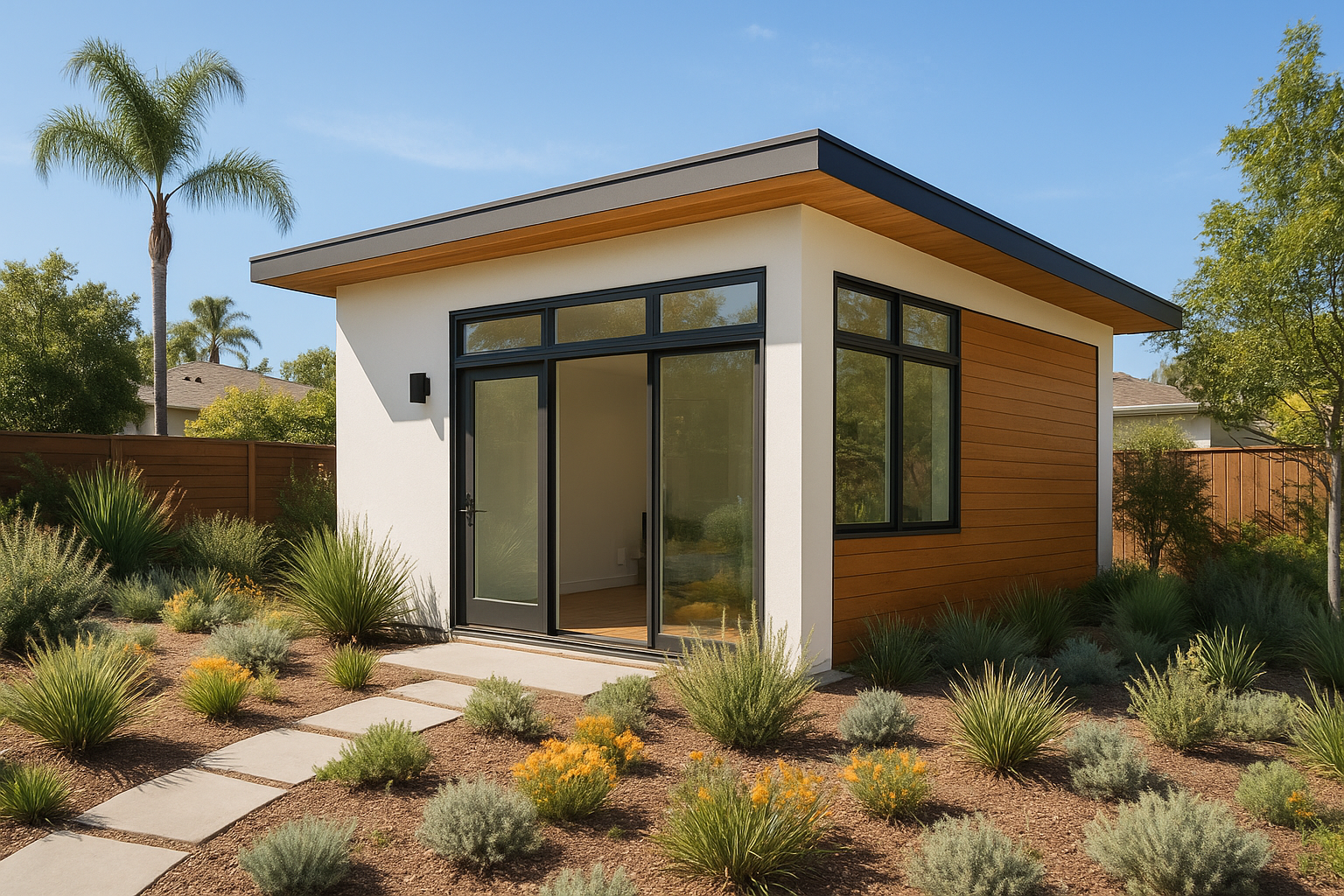
A detached accessory dwelling unit in San Diego can add significant living space and rental income potential.
Accessory Dwelling Unit San Diego Zoning, Size, and Setback Rules
San Diego’s zoning framework for ADUs is largely shaped by California state law, which overrides many local restrictions that once blocked construction. Therefore, most single-family and multi-family zoned parcels qualify for at least one ADU. Here are the size and setback rules you need to know before designing your unit:
Maximum Size: Detached ADUs may reach 1,200 sq ft. Attached ADUs are capped at 50% of the primary dwelling’s floor area, also not exceeding 1,200 sq ft.
Setbacks: A minimum 4-foot setback from side and rear property lines applies to most detached ADUs.
Height: Detached ADUs are generally limited to 16 feet, though units built above a garage may reach up to 24 feet in certain zones.
Parking: No additional parking is required when the ADU sits within half a mile of public transit or replaces a converted garage.
Additionally, San Diego does not require owner-occupancy for standard ADUs — only for JADUs. This distinction gives homeowners considerable flexibility when planning a rental strategy or long-term family use.
Height, Parking, and Owner-Occupancy Requirements Explained
Because height and parking rules vary slightly by zone, it’s worth confirming details with a designer before finalizing plans. For example, hillside or coastal-adjacent lots sometimes carry additional height restrictions tied to view-preservation ordinances. Similarly, owner-occupancy is only mandatory for JADUs, not standard detached or attached ADUs — a detail many homeowners overlook when comparing unit types.
ADUs in Historic Districts, Coastal Zones, and HOA Communities
Properties within a historic district or the California Coastal Zone often face an extra layer of design review, since exterior changes must respect the neighborhood’s architectural character. Meanwhile, homes governed by a homeowners association (HOA) may encounter CC&R restrictions — however, California law limits an HOA’s ability to outright ban ADUs, even though it can still regulate aesthetics like exterior finishes and landscaping. Consequently, it’s wise to review your HOA documents and consult the city’s historic resources staff early, before investing in full architectural drawings.
How to Build an ADU in San Diego: The Complete Step-by-Step Process
Building an ADU involves several sequential stages. Following them in order will save you both time and money.
Assess your property’s eligibility. Review your lot size, zoning designation, and existing structures. Most San Diego properties zoned RS-1-7 through RS-1-14 qualify, but confirming early avoids costly surprises later.
Choose your ADU type and review pre-approved plans. Consider your budget, goals, and available space. San Diego now offers a pre-approved plan library that can bypass a full plan check review, cutting weeks off your timeline.
Hire a designer or architect. Work with a licensed professional who understands San Diego’s specific codes. Specialists like those at The ADU Pro can streamline design and permitting significantly.
Submit your permit application. File construction documents with the San Diego Development Services Department. Plan check review typically takes 4 to 12 weeks depending on complexity.
Secure your financing. Line up a HELOC, cash-out refinance, construction loan, or ADU-specific lending program before construction begins so funds are ready when contractor draws are due.
Begin construction. Once your permit is approved, hire a licensed general contractor and schedule required inspections at each milestone — foundation, framing, electrical, plumbing, and final walkthrough.
Receive your certificate of occupancy. After passing all inspections, the city issues your CO. Only then can you legally occupy the unit or begin advertising it for rent.
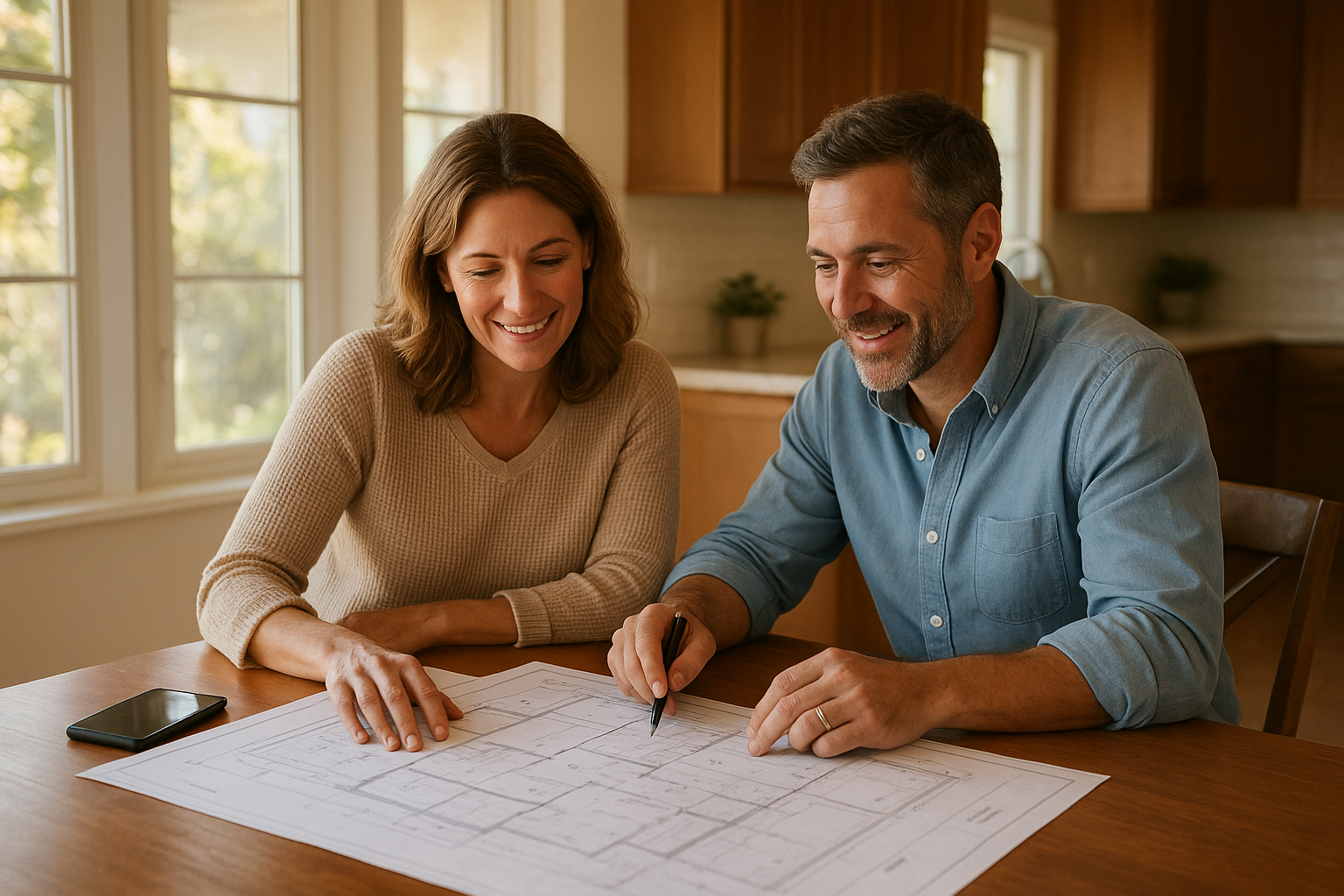
Working with an experienced ADU builder in California early in the process can reduce permit delays and costly revisions.
Working With a San Diego ADU Design-Build Team
Some homeowners try to manage design, permitting, and construction separately. However, a design-build team handles both under one contract, which reduces miscommunication between the architect and the crew pouring the foundation. As a result, projects often move faster and hit fewer surprises during inspection. Above all, ask any prospective team how many San Diego ADU permits they’ve personally shepherded through the city’s review process — direct local experience matters more than a polished portfolio alone.
San Diego ADU Cost Breakdown for 2025
Cost is often the first question homeowners ask. In practice, San Diego ADU costs vary widely based on type, size, and site conditions. Below are realistic ranges for 2025:
Garage Conversion
$80K – $150K
Most affordable option; reuses the existing structure and foundation.
Attached ADU
$150K – $250K
Shares walls with the main home; moderate cost and build time.
Detached ADU
$200K – $400K+
Maximum privacy and resale value; highest upfront investment.
These figures include design, permitting, and construction but exclude land costs and financing charges. Additionally, impact fees — which California law capped for ADUs under 750 sq ft — can meaningfully affect your final budget, so confirm your specific fee schedule with the city before finalizing plans.
Financing Options for Your San Diego ADU
Most homeowners finance their ADU through one of several methods: a home equity line of credit (HELOC), a cash-out refinance, a dedicated construction loan, or a specialized ADU loan program. Because San Diego home values are high, many owners have substantial equity available to tap. Furthermore, the California Department of Housing and Community Development (HCD) administers a state-backed ADU grant and financing resource page that lists low-interest options for qualifying low- and moderate-income homeowners, including grants that can offset pre-development soft costs like design and permitting fees.
ADU Rental Income and ROI in San Diego Neighborhoods
San Diego’s rental market is among the most competitive in the nation. Therefore, ADUs consistently generate strong returns for homeowners who build them well. A 600 sq ft detached unit in popular neighborhoods can command anywhere from $1,800 to $2,900 per month in long-term rent, depending on location and finish quality.
For example, a homeowner who spends $250,000 building a detached ADU and rents it for $2,200 per month generates $26,400 annually — a roughly 10.5% gross return before expenses. In contrast, most traditional investments rarely approach those figures in today’s market. Beyond monthly cash flow, an ADU is also one of the most reliable ways of boosting long-term property value in San Diego, since appraisers increasingly credit legal ADUs as separate income-producing square footage. For more detailed guidance on maximizing your investment, resources like The ADU Pro provide expert local insight tailored to specific neighborhoods.
San Diego ADU vs. Granny Flat vs. JADU: What’s the Difference?
“Granny flat,” “in-law suite,” and “backyard cottage” are all informal names for the same legal concept — an ADU. Officially, however, California recognizes only two categories: the standard ADU (up to 1,200 sq ft, no owner-occupancy requirement) and the JADU (up to 500 sq ft, built within the existing home, requiring the owner to live on-site). Consequently, when you see a builder advertise a “granny flat” in San Diego, they are almost always describing a standard detached or attached ADU under a friendlier, more familiar name.
How to Choose the Right ADU Builder in San Diego
Choosing the wrong builder is the single most expensive mistake a homeowner can make. Therefore, start by using our guide to finding an ADU builder near you to compare local specialists before signing anything. At minimum, verify the following:
- Active contractor’s license — confirm status directly through the California Contractors State License Board.
- General liability and workers’ comp insurance — ask for a certificate naming you as an additional insured.
- Local ADU-specific portfolio — a builder with San Diego permit experience will already know common plan-check corrections.
- Transparent, itemized contract — avoid vague lump-sum bids that hide soft costs like engineering or utility upgrades.
Common Mistakes to Avoid When Building an ADU
Even experienced homeowners make avoidable errors. Here are the most frequent pitfalls:
- Skipping a feasibility study — not every lot supports every ADU type, so confirm utility capacity and soil conditions first.
- Underestimating soft costs — design, permitting, and engineering fees can add 15–20% to your total budget.
- Choosing the wrong contractor — always verify licensing, insurance, and ADU-specific experience before signing.
- Ignoring utility upgrades — older homes may need panel upgrades or new sewer laterals, which can add $10,000–$30,000.
- Overlooking the solar requirement — California’s Title 24 energy code requires solar panels on most new ADU construction, so budget for this early rather than as a late change order.
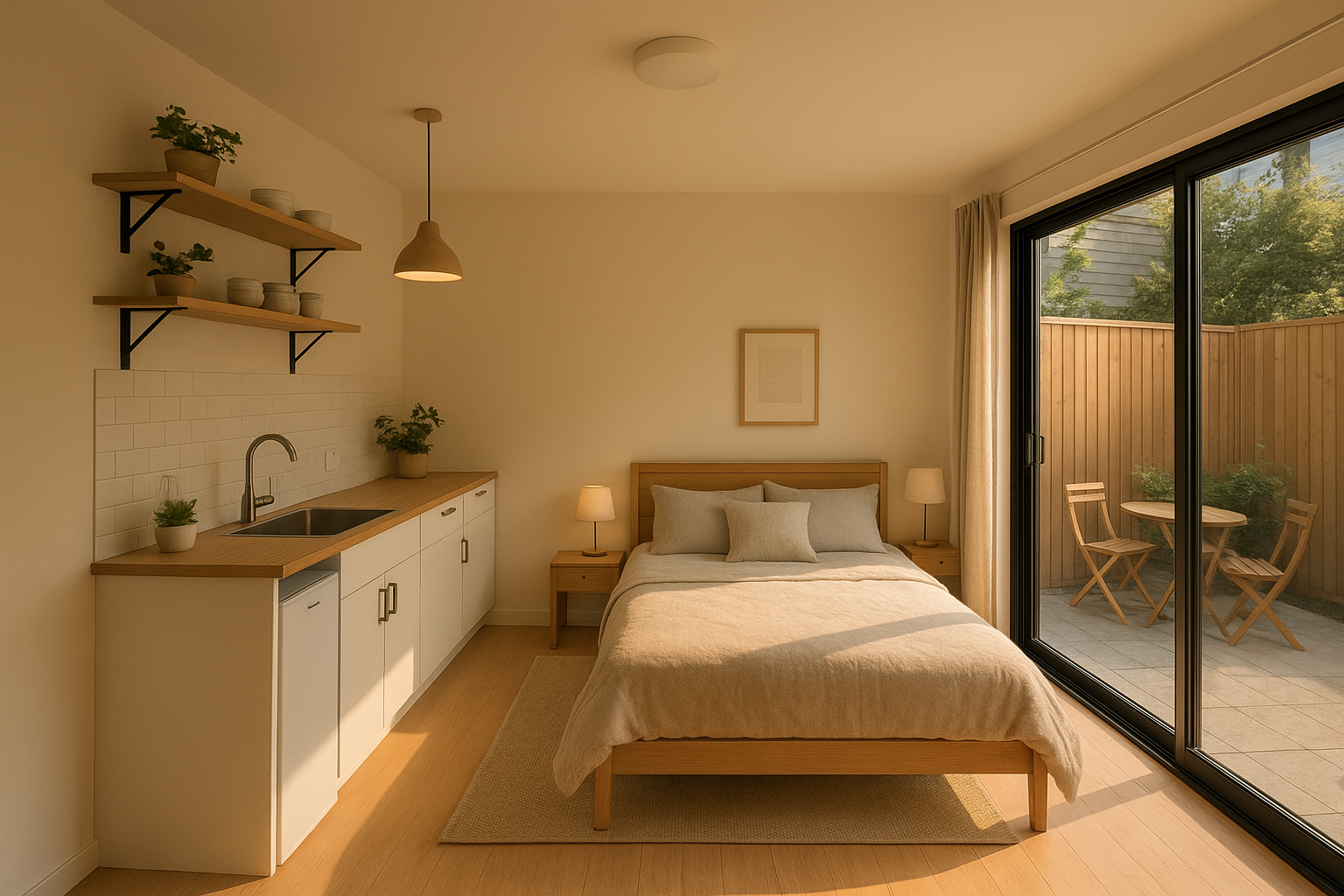
Well-designed ADU interiors maximize every square foot, making even smaller units highly desirable to renters.
Sustainability and Climate Considerations for San Diego ADUs
San Diego’s climate makes energy-efficient design especially rewarding. For instance, high-performance windows and proper insulation reduce cooling costs during inland heat waves, while solar panels — now required under Title 24 on most new residential construction — can offset a renter’s utility bills and make your unit more attractive on the rental market. In addition, drought-tolerant landscaping around a detached ADU lowers water bills and satisfies the county’s water-wise design guidelines referenced by organizations such as Wikipedia’s overview of secondary suites and similar housing resources.
Property Taxes, Insurance, and Legal Considerations for Your ADU
Adding an ADU will increase your property tax assessment because it adds value to the parcel. However, only the value of the new construction is reassessed — not the entire property — so the increase is typically modest relative to rental income. Similarly, your homeowners insurance policy will likely need an update to cover the additional structure and any liability tied to a tenant living on-site. Therefore, contact your insurer before renting the unit to confirm coverage gaps are closed.
San Diego ADU Policy Updates in 2025
California’s ongoing housing legislation continues to shape ADU rules. In 2025, several updates affect San Diego homeowners specifically. First, impact fee exemptions were extended for ADUs under 750 square feet, reducing upfront costs for smaller units. Additionally, multi-family properties gained expanded rights to build detached ADUs in existing parking areas. Meanwhile, the state’s ADU pre-approval programs allow cities to offer standardized plans that bypass full plan check review, cutting approval times by weeks.
Because regulations evolve frequently, working with a local ADU specialist who actively tracks these changes is strongly recommended. Staying current ensures you benefit from every available exemption and incentive rather than leaving money on the table.
Conclusion: Is an Accessory Dwelling Unit Right for Your San Diego Property?
Building an accessory dwelling unit San Diego homeowners can leverage for rental income, family housing, or resale value remains one of the most financially sound decisions available in today’s market. With favorable state laws, strong rental demand, and growing local government support, the barriers to ADU development have never been lower.
However, success still depends on thorough planning, the right team, and a clear understanding of local regulations. Therefore, start with a professional feasibility review, choose a qualified ADU specialist, and take advantage of every available incentive. Your San Diego property likely holds more potential than you realize.
Quick Answer — Updated by The ADU Pro (Last updated: 2026-06-26)
An accessory dwelling unit in San Diego is a legal secondary residence on your property that can be detached, attached, or converted from existing space. Costs range from $80,000 to $400,000+, permits typically take 4–12 weeks, and most single-family lots qualify under current California state law.
Frequently Asked Questions About Accessory Dwelling Units in San Diego
What is an accessory dwelling unit in San Diego?
An accessory dwelling unit San Diego homeowners build is a secondary residential unit located on the same lot as a primary single-family or multi-family home. It can be detached, attached, or converted from existing space such as a garage. Each unit is fully self-contained, with its own kitchen, bathroom, and living area.
How much does it cost to build an ADU in San Diego?
Building an ADU in San Diego typically costs between $80,000 and $400,000 depending on size, type, and finishes. Garage conversions are generally less expensive, while custom detached units cost more. Soft costs such as design and permitting add another 15–20% to most budgets.
Do I need a permit to build an ADU in San Diego?
Yes, a building permit is required for all ADUs in San Diego. You must submit plans to the San Diego Development Services Department for review and approval before construction begins. Building without a permit can result in fines and required demolition.
How long does ADU permit approval take in San Diego?
ADU permit approval in San Diego typically takes 4 to 12 weeks depending on project complexity and current workload. Pre-approved standard plans can speed this up significantly. Working with an experienced designer reduces the likelihood of plan check corrections, which can add weeks to the process.
What is a Junior ADU (JADU) in San Diego?
A Junior ADU is a smaller secondary unit of up to 500 square feet created within the existing footprint of a primary residence. It requires an owner-occupancy agreement and must include an efficiency kitchen. JADUs are a cost-effective option for homeowners who want a rental unit without major construction.
Can I rent out my ADU in San Diego?
Yes, you can rent out your ADU in San Diego as a long-term rental. However, short-term rentals through platforms like Airbnb are subject to additional local regulations and licensing requirements. Long-term rentals of 30 or more days face fewer restrictions and generate more predictable income.
What is the maximum size for an ADU in San Diego?
In San Diego, a detached ADU can be up to 1,200 square feet. Attached ADUs may be up to 50% of the primary dwelling’s floor area, also capped at 1,200 square feet. JADUs are limited to 500 square feet within the existing home footprint.
Are there setback requirements for ADUs in San Diego?
Yes, most detached ADUs in San Diego must maintain a 4-foot setback from side and rear property lines. Front setbacks follow the primary dwelling’s zoning requirements. Some older structures being converted may qualify for reduced setback allowances.
Can I build an ADU on any property in San Diego?
Most single-family and multi-family zoned properties in San Diego are eligible for at least one ADU. However, specific lot size, zoning, and utility capacity requirements may apply. Properties in historic districts or with deed restrictions may face additional limitations.
What financing options are available for building an ADU in San Diego?
Homeowners can finance an ADU through home equity loans, HELOCs, cash-out refinancing, construction loans, or specialized ADU lending programs. Some state and local programs also offer low-interest loans or grants for qualifying homeowners. Because San Diego home values are high, many owners have sufficient equity to fund construction without a new mortgage.
Does adding an ADU increase property taxes in San Diego?
Yes, adding an ADU will increase your property tax assessment because it adds value to your property. However, only the value of the new construction is reassessed — not the entire property. This means the tax increase is proportional and generally modest relative to the rental income generated.
What is the difference between a detached ADU and an attached ADU?
A detached ADU is a freestanding structure separate from the primary home, while an attached ADU shares at least one wall with the main residence. Detached units offer more privacy and are often preferred by renters, while attached units are typically less expensive to build due to shared structural elements.
How many ADUs can I build on my San Diego property?
On a single-family lot in San Diego, you may typically build one ADU and one Junior ADU. Multi-family properties may be eligible for additional units depending on lot size and zoning. California law continues to expand these allowances, so confirming current rules with a local specialist is always advisable.
Do I need a separate utility meter or address for my ADU in San Diego?
A separate address is typically assigned once your ADU passes final inspection, which simplifies mail and emergency services. Separate utility meters are optional in most cases, though some homeowners choose them to bill tenants directly for electricity and water usage.
Is San Diego considered ADU-friendly compared to other California cities?
Yes, San Diego is widely regarded as one of California’s more ADU-friendly cities, thanks to its pre-approved plan program, capped impact fees for smaller units, and streamlined permitting timelines. Combined with strong rental demand, these factors make San Diego one of the best places in the state to build an ADU.