

ADU certificate of occupancy assistance is the hands-on support homeowners rely on to push a finished accessory dwelling unit (a small secondary home built on an existing lot) through final building department sign-off. Without that sign-off, an otherwise complete ADU cannot legally be rented, occupied by family, or counted toward property value. In Southern California, where building departments handle heavy permit volume, this final stretch of the process trips up more homeowners than the design or framing phases ever do.
Direct answer: ADU certificate of occupancy assistance covers scheduling final inspections, resolving correction notices, and submitting closing paperwork so a building department will issue the document that makes an ADU legal to occupy. A design-build contractor who managed permits from the start can usually finish this stage faster than a homeowner working alone.

Final inspections are the last hurdle before an ADU certificate of occupancy assistance process wraps up.
What Is ADU Certificate of Occupancy Assistance?
In short, ADU certificate of occupancy assistance means someone experienced with local permitting handles the final administrative and inspection steps on the homeowner’s behalf. This usually includes confirming trade inspections are complete, scheduling the final building walkthrough, and following up with the city until the certificate is issued.
Homeowners often assume the hardest part of an ADU project is design or framing. However, the closeout phase, where a mostly finished structure waits on paperwork, is where projects frequently stall for weeks. According to the California Department of Housing and Community Development, ADU approvals across the state have grown sharply since 2020, which means building departments are processing more final inspections than ever, and backlogs are common.
Why Final Inspections Delay an ADU Occupancy Certificate
Several recurring issues delay an ADU occupancy certificate, and most of them are avoidable with early planning. Missing smoke or carbon monoxide detectors, undersized egress windows, and unsigned trade inspection cards are the most common culprits.
In addition, Title 24 energy compliance documentation, which verifies insulation, windows, and mechanical systems meet California’s energy code, is frequently incomplete at the final inspection stage. As a result, inspectors issue a correction notice instead of a pass, and the homeowner has to wait for a re-inspection slot that can be one to three weeks out depending on the city.
Consequently, projects that seemed nearly finished can sit in limbo for a month or more. This is precisely where structured ADU certificate of occupancy assistance earns its value, since a contractor familiar with a city’s inspectors can often anticipate these issues before the final walkthrough ever happens.
The ADU Certificate of Occupancy Process: A Step-by-Step Timeline
Understanding the sequence helps homeowners set realistic expectations. Below is the typical path from construction completion to a legally issued certificate.
- Complete all trade sign-offs. Electrical, plumbing, and mechanical inspections must each be cleared individually before the city will schedule a final walkthrough.
- Schedule the final building inspection. The general contractor or homeowner requests the final inspection once every trade card is signed off.
- Resolve any correction notices. If the inspector flags issues, the team fixes them and requests a re-inspection as quickly as possible.
- Submit as-built documentation. Updated plans and Title 24 compliance forms must match exactly what was built.
- Receive the certificate of occupancy. Once everything checks out, the building department issues the document that makes the ADU legal to occupy or rent.
Homeowners who want a broader view of how permits move through this system may find it helpful to review the ADU permit process from application through approval, since the same city departments that issue permits also issue the final certificate.
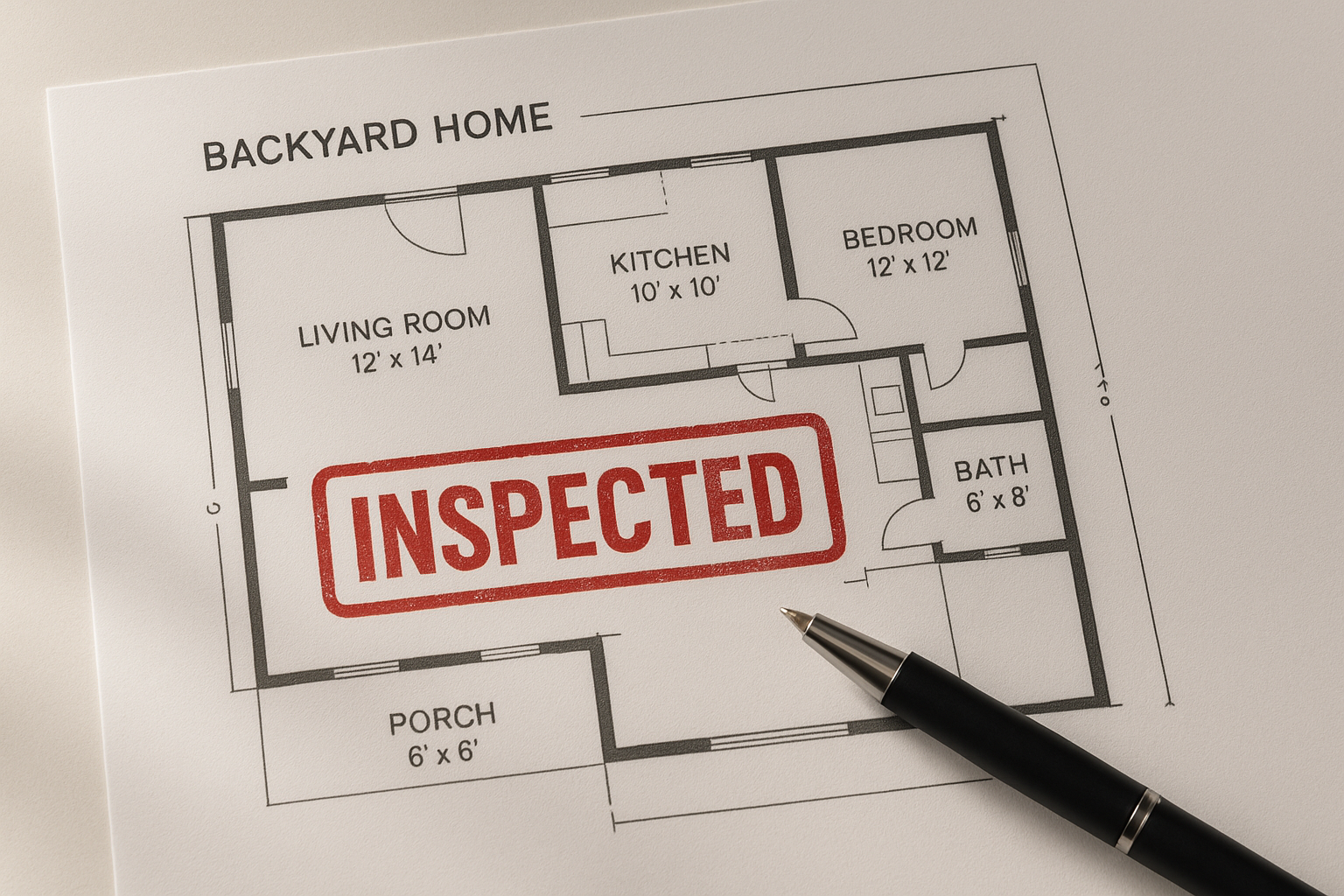
Approved as-built plans are a required piece of the closeout paperwork.
Common Mistakes That Stall a Certificate of Occupancy for an ADU
Several avoidable mistakes repeatedly stall a certificate of occupancy for an ADU. First, some homeowners schedule the final inspection before every trade sign-off is actually complete, which guarantees a failed walkthrough. Second, address assignment, a step that some cities require before final approval, gets overlooked until the last minute.
Third, homeowners sometimes attempt to occupy the unit before the certificate arrives, assuming a passed inspection is enough. It is not. Occupancy without the certificate can create insurance gaps and code enforcement exposure. Finally, poor communication between separate architects, engineers, and contractors on non-design-build projects often means nobody owns the closeout paperwork, and it falls through the cracks for weeks.
In particular, the International Code Council, which publishes the model building codes most California cities adapt locally, notes that occupancy certification exists specifically to confirm life-safety systems function as designed. Skipping steps to save time usually backfires by adding delays later.
How TheADUpro Provides Certificate of Occupancy Assistance for ADU Projects
TheADUpro is a design-build ADU contractor based in Chino, California, serving homeowners across Orange County, Los Angeles County, and western Riverside County. Because the same team handles design, engineering coordination, permitting, and construction, closeout paperwork does not get lost between separate vendors.
The company holds an active CSLB license and a BuildZoom score placing it in the top 1% of California contractors, with an average client rating near 4.9 stars. Its founder brings more than 30 years of broader construction experience to the ADU-specific closeout process, including Title 24 energy compliance and net-zero-focused construction methods.
For example, a detached ADU project like the recent build in Los Alamitos and a custom layout like the ADU plans developed for a Malibu lot both moved through final inspection under one accountable team rather than a patchwork of separate contractors. Homeowners exploring similar projects can browse more ADU project examples across Southern California or read additional permit and inspection guidance before starting their own build. For a fuller look at how the company structures its design-build process, visiting theadupro.com directly is a useful next step.
What Happens After the Certificate Is Issued?
Once the certificate of occupancy is in hand, the ADU can legally be occupied, rented, or used for multigenerational family living. Furthermore, this document often matters for financing and insurance purposes, since many lenders and insurers require proof of legal occupancy before finalizing a HELOC, refinance, or homeowner’s policy update tied to the new square footage.
Similarly, county assessors typically wait for the final certificate before completing a property reassessment tied to the added structure. Therefore, homeowners planning to rent out an ADU quickly should treat the certificate of occupancy as the true finish line, not the last passed inspection.
Frequently Asked Questions About ADU Certificate of Occupancy Assistance
What is ADU certificate of occupancy assistance?
ADU certificate of occupancy assistance is guidance and hands-on support that helps homeowners move a finished accessory dwelling unit through final inspections and paperwork so the local building department will legally approve it for occupancy. It typically includes scheduling inspections, resolving correction notices, and submitting final documents.
How long does it take to get a certificate of occupancy for an ADU?
Most Southern California jurisdictions issue an ADU certificate of occupancy within one to four weeks after the final inspection passes, though it can take longer if corrections are needed. Timing depends heavily on the city’s inspection backlog and how complete the as-built documentation is.
Why do ADUs fail their final inspection?
ADUs commonly fail final inspection because smoke and carbon monoxide detectors are missing, egress windows do not meet size requirements, or electrical and plumbing work was not signed off in the correct order. Incomplete Title 24 energy compliance documentation is another frequent cause.
What documents are required before a building department issues an ADU occupancy certificate?
Departments generally require approved as-built plans, signed-off inspection cards for every trade, Title 24 energy compliance forms, and sometimes a final survey or address assignment letter. Missing any one of these can hold up the certificate even after the building passes inspection.
Can I move into my ADU before receiving the certificate of occupancy?
No, occupying an ADU before the certificate of occupancy is issued is not legal in most California jurisdictions and can create liability and insurance problems. It is safer to wait for official sign-off, even if construction appears finished.
How much does certificate of occupancy assistance cost for an ADU?
When bundled into a design-build ADU contract, certificate of occupancy assistance is usually included in the overall project fee rather than billed separately. Standalone permit expediting services can range from a few hundred to over a thousand dollars depending on the city and how many corrections are needed.
What is the difference between a final inspection and a certificate of occupancy?
A final inspection is the physical walkthrough where the building inspector checks the completed ADU against approved plans and code requirements. The certificate of occupancy, as defined by this general reference on certificates of occupancy, is the official document issued afterward that legally authorizes the unit to be inhabited.
Who schedules the final inspection for an ADU?
The general contractor or design-build team typically schedules the final inspection once all trade work, corrections, and required documentation are complete. Homeowners can request inspections directly, but coordinating timing with each trade usually goes faster through the contractor.
What happens if my ADU fails inspection?
If an ADU fails inspection, the building department issues a correction notice listing the specific items that must be fixed before a re-inspection can be scheduled. Most correction items are minor and can be resolved within a few days to a couple of weeks.
Does every city in Southern California require a certificate of occupancy for ADUs?
Yes, every city and county building department in Southern California requires some form of final sign-off before an ADU can be legally occupied, though the exact document name can vary. Some jurisdictions call it a certificate of occupancy, while others issue a final inspection approval or certificate of completion.
What is a temporary certificate of occupancy?
A temporary certificate of occupancy allows limited use of a structure before every minor finish item is complete, usually when only cosmetic work remains. Not every California jurisdiction offers this option for ADUs, so it is worth confirming with the local building department early in the project.
How can a design-build contractor help with certificate of occupancy assistance?
A design-build contractor manages permit coordination, schedules trade inspections in the right order, and resolves correction notices directly with the building department, reducing back-and-forth for the homeowner. Because the same team handled design and construction, they can usually explain and fix issues faster than a fragmented project team.
In summary, ADU certificate of occupancy assistance covers the final inspections, corrections, and paperwork that stand between a finished structure and a legally occupiable home. Consequently, homeowners who plan for this stage early, rather than treating it as an afterthought, tend to move into or rent out their new space weeks sooner. Whether working with a design-build contractor or coordinating trades independently, understanding this closeout process is what turns a completed build into a legally usable accessory dwelling unit.

